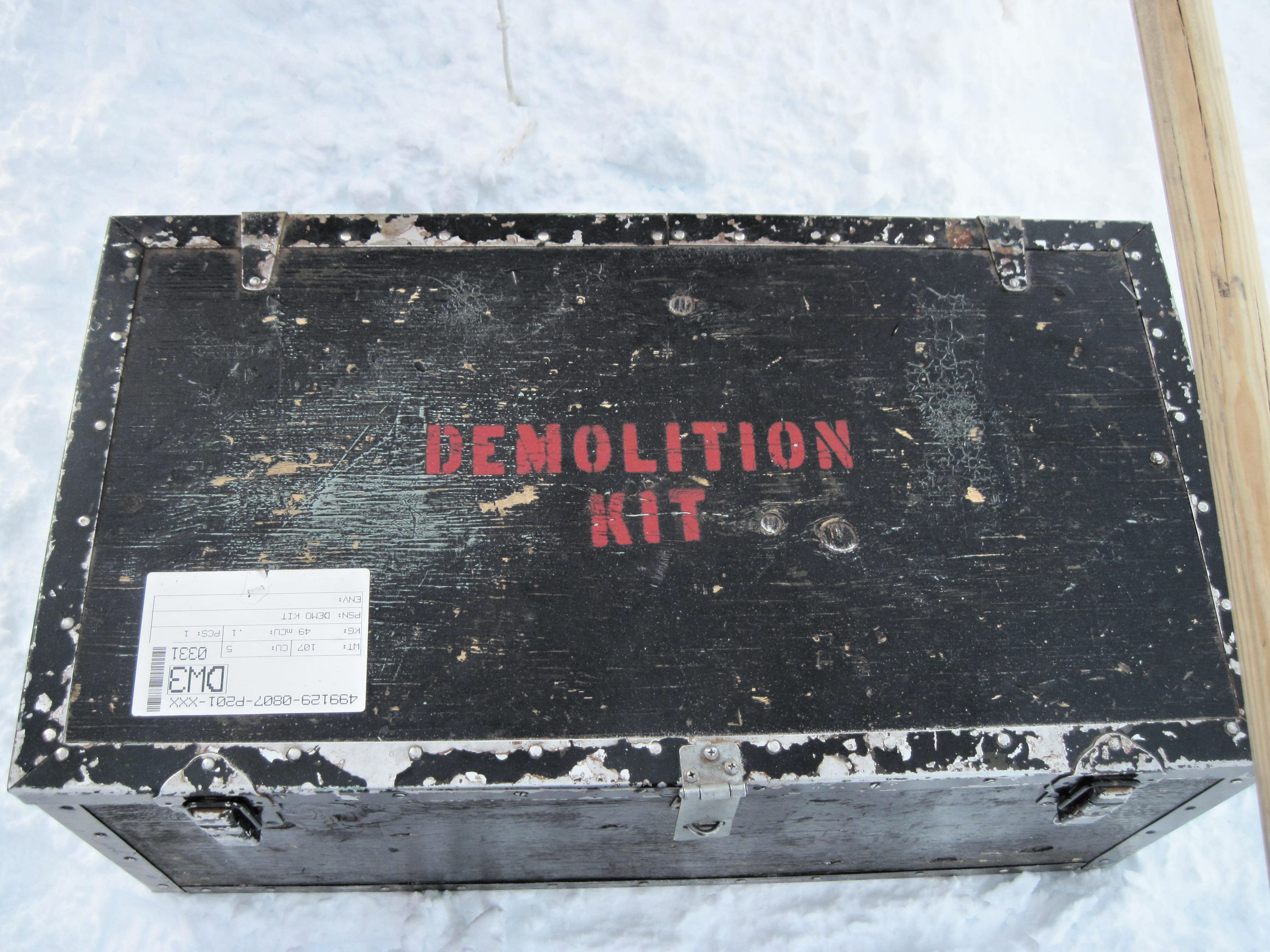
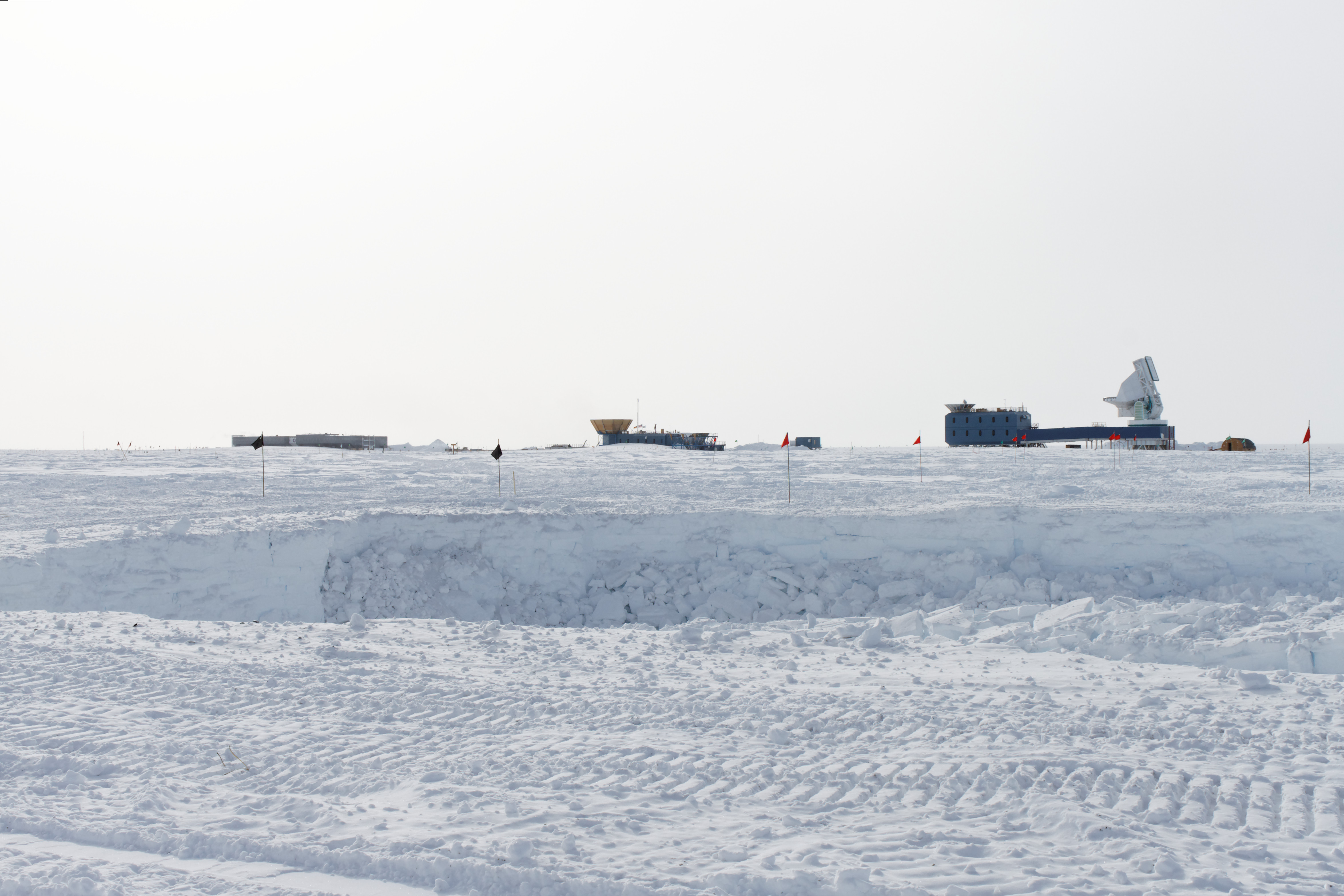
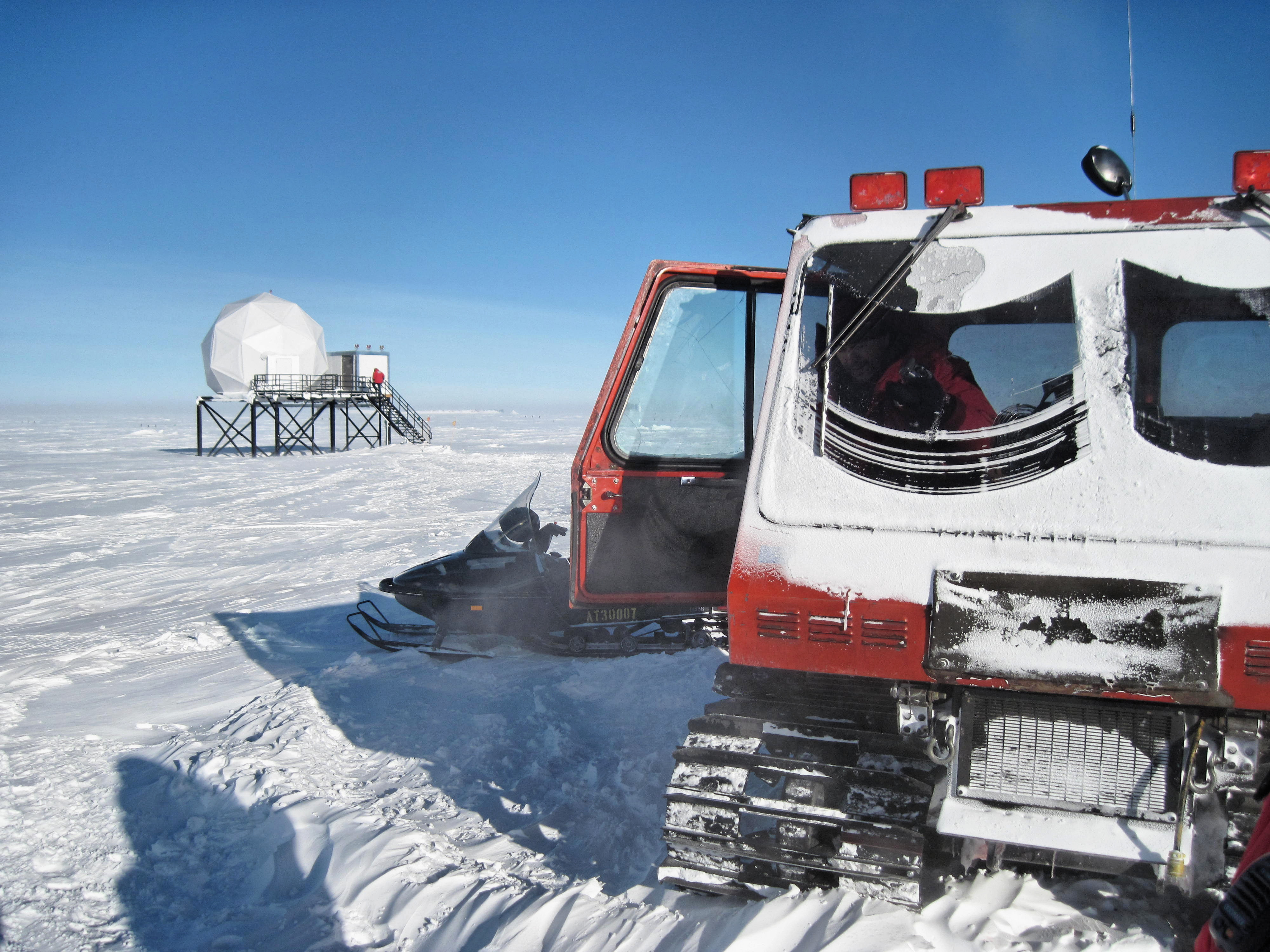
On a windy day in early December, I got to help blow up the South Pole. That morning, a slim band of pale blue sky sat between the white horizon and white clouds, looking really quite pretty from the station. People were getting up from their coffee (dayshift) or cocktails (nightshift) to look out the galley windows, taking pictures, gazing. We took the warm Pisten Bully out past MAPO, past the South Pole Telescope and down a little flagged snow road, pulling up to the snow crater from the first blast just a few days before, the men still smelling like dynamite. We had watched it from Destination Alpha but both Daniel and I, on different levels completely with different cameras, looked away at just the wrong moment and missed the main explosion—the sound arrived some ten seconds later, traveling super-slow through the high altitude air.
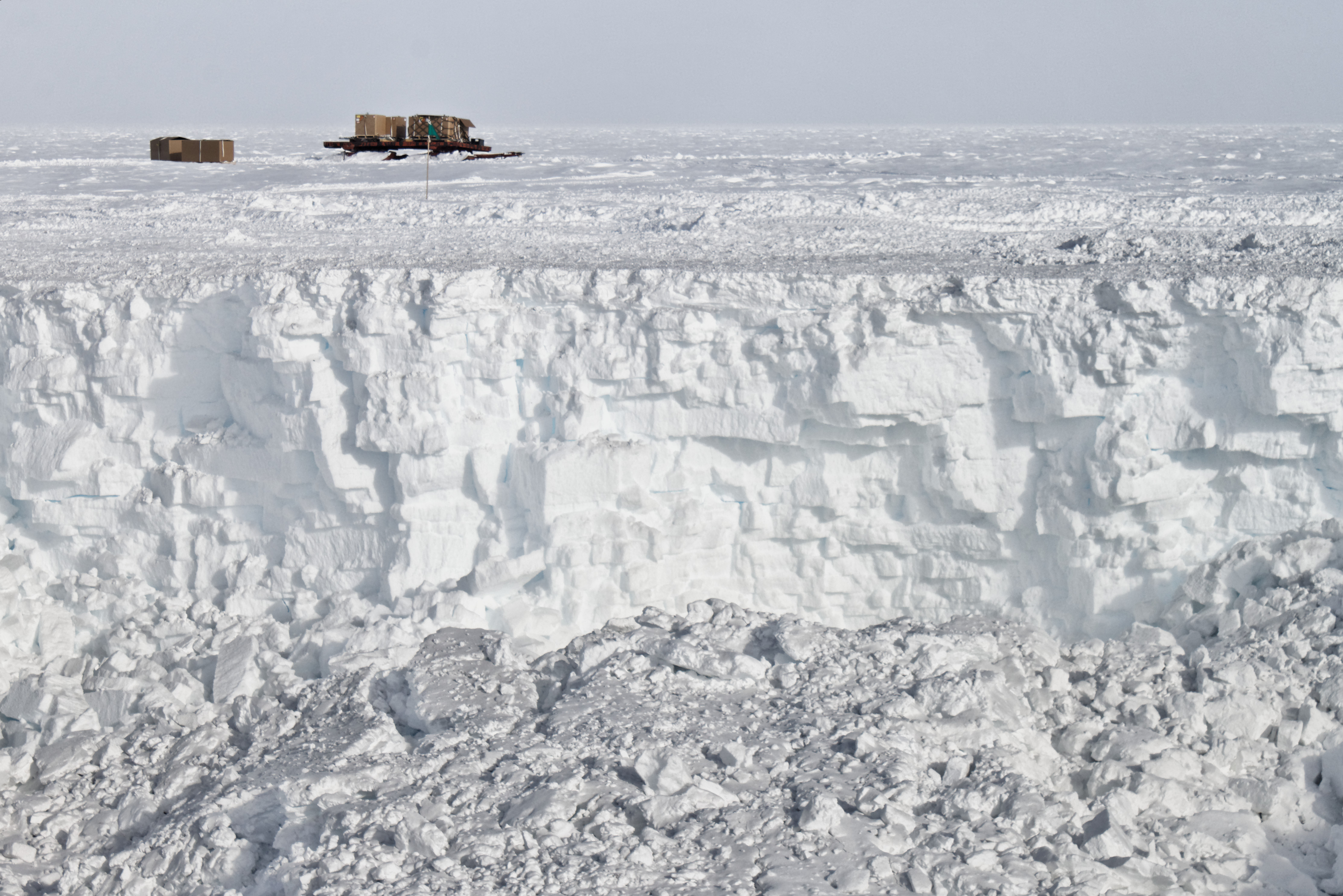
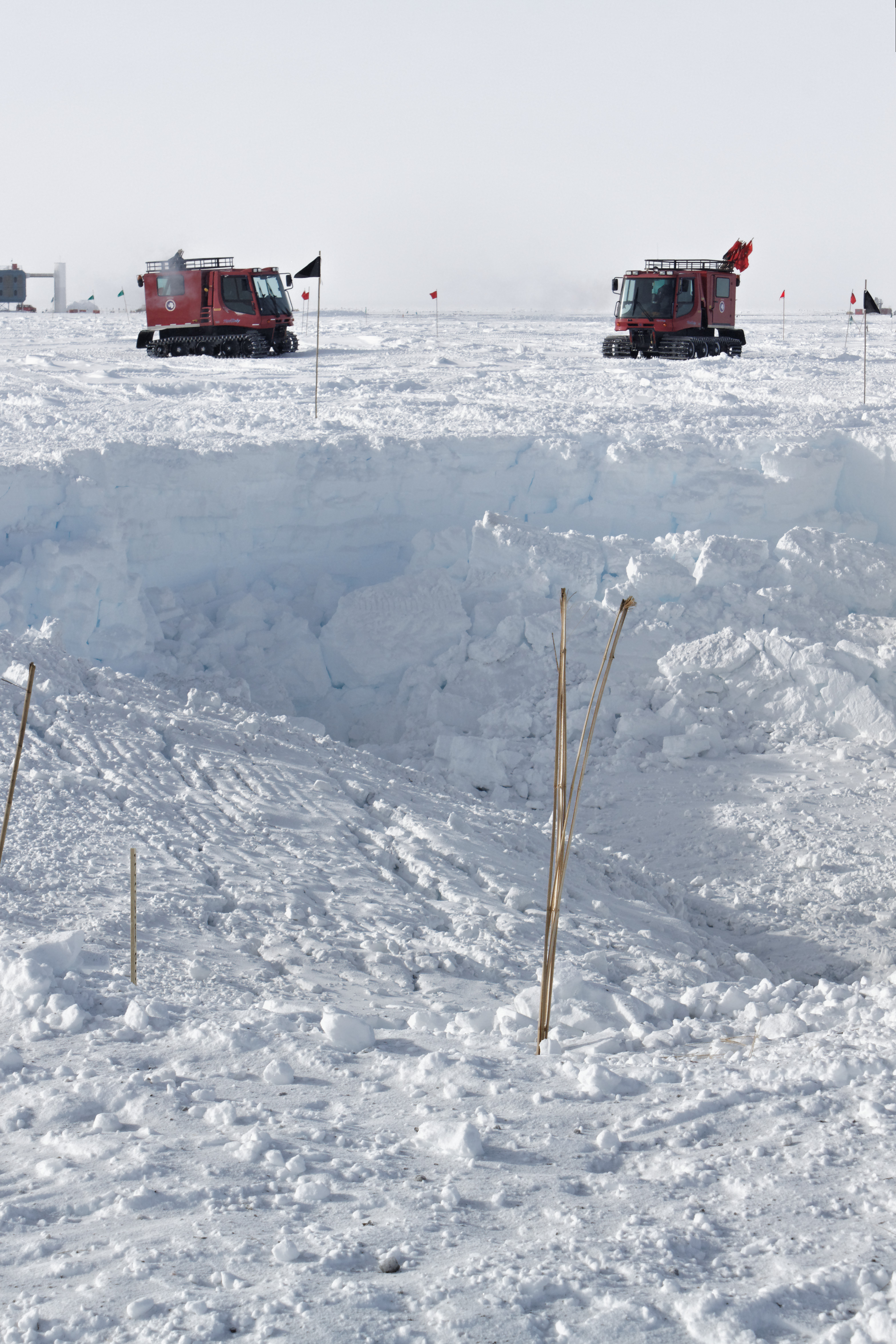
The crater from the first explosion, with the elevated station, MAPO and South Pole Telescope in the background
We started the morning by sorting the packaging from the first blast’s dynamite, digging through and recycling cardboard and greasy looking nitroglycerin-soaked brown paper. A heavy equipment operator brought out a horizontal silo on a sled, a red Wisconsin-Dairy emblazoned piece of farm equipment, 180-degree water sloshing inside of it and shooting out the feed nozzle, instantly transforming into smoky steam streamers.
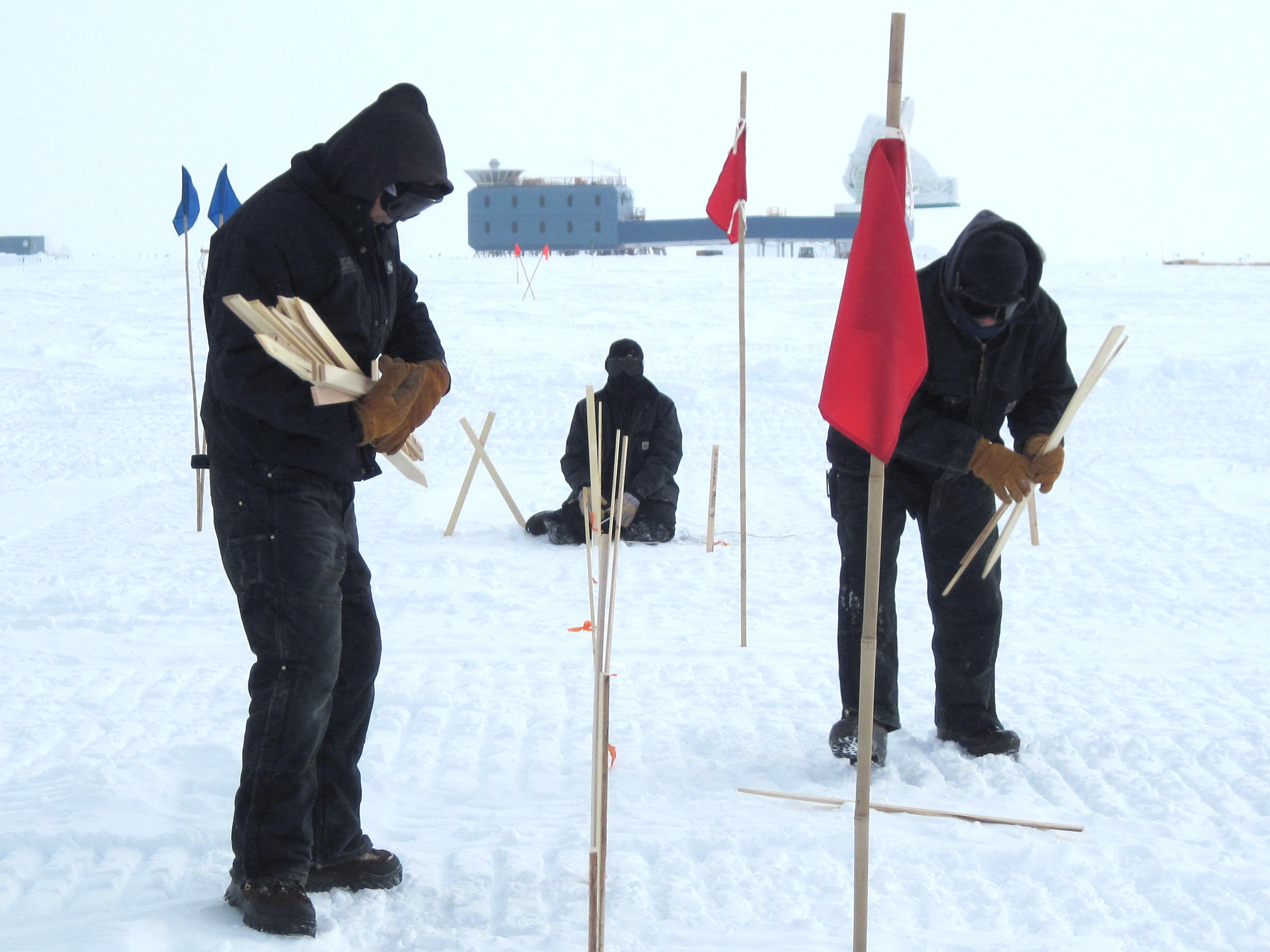
Based on the GPR readings (ground-penetrating radar), the blasters placed stakes along the outer edges of the buildings of the original South Pole Station from the 1950s, now buried under many years of snow drifts, maybe 20 feet below the surface. It was ghostly to walk on top of—knowing that under our feet were open rooms, food left on tables, fuel caches, trash, pee jars and girlie magazine centerfolds plastered on every surface.
Laying stakes
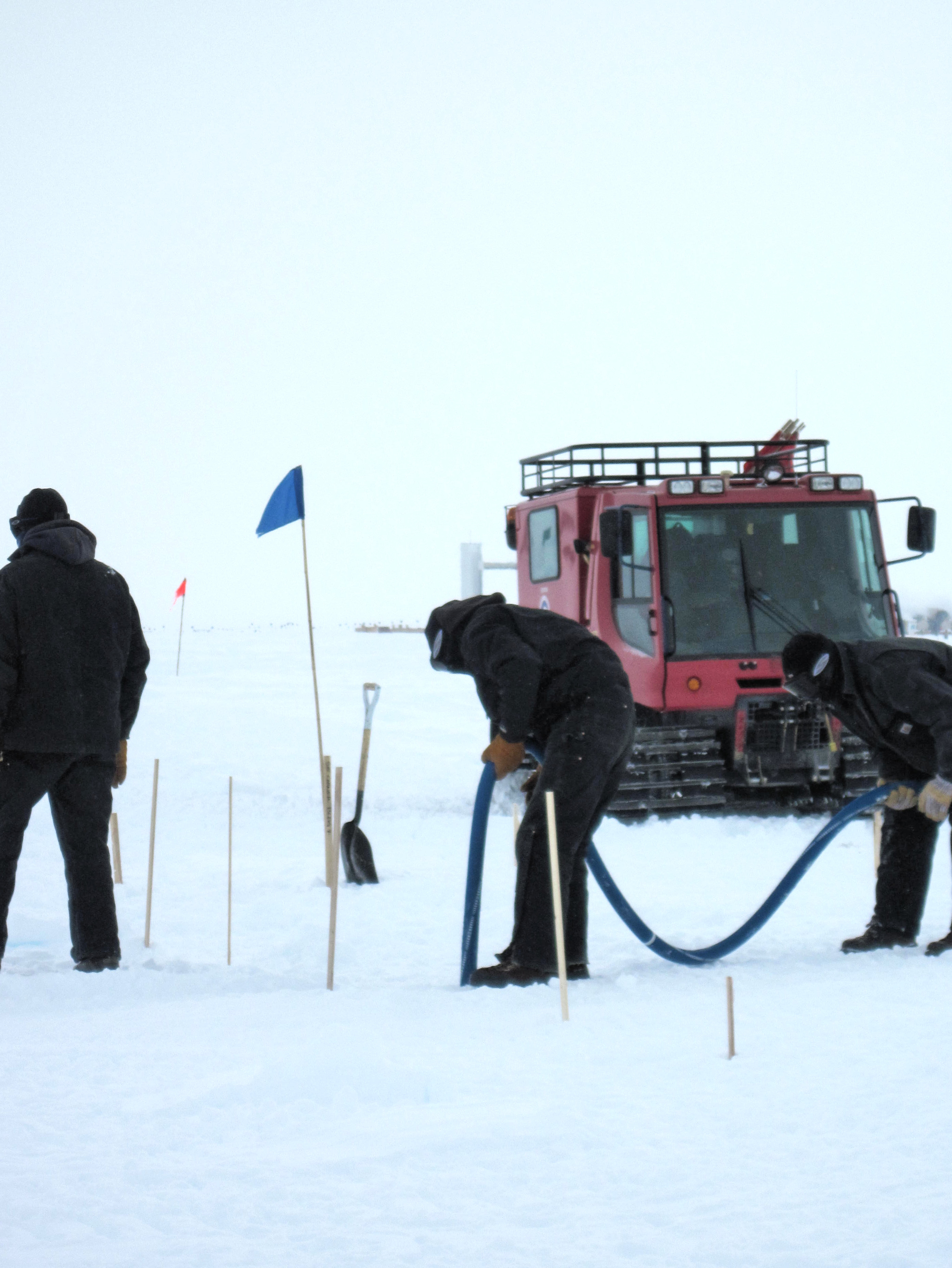
To drill the holes, the blasters would place the flat nozzle of the hose on the surface of the ice and turn the valve at the base of the silo, gravity pushing the water through the hose until a burst of steam came from the far end, the water cutting the ice like a hot knife through butter. The blasters fought with the long hose, full and heavy, until it was positioned to slide straight down aside the buried buildings. When they hit the 25-foot mark (or in some cases, a hollow thud on the roof of a building when the GPR readings had been off—these holes had to be re-drilled) they would turn around and hoist the hose out, three or four of them putting the weight of it on one shoulder and tug-of-warring the hose out of the hole, throwing their whole bodies into the effort. When I helped with this part of the process, my puffy leather work gloves were so icy from water and steam that I couldn’t bend them into any other shape than that of gripping the hose.
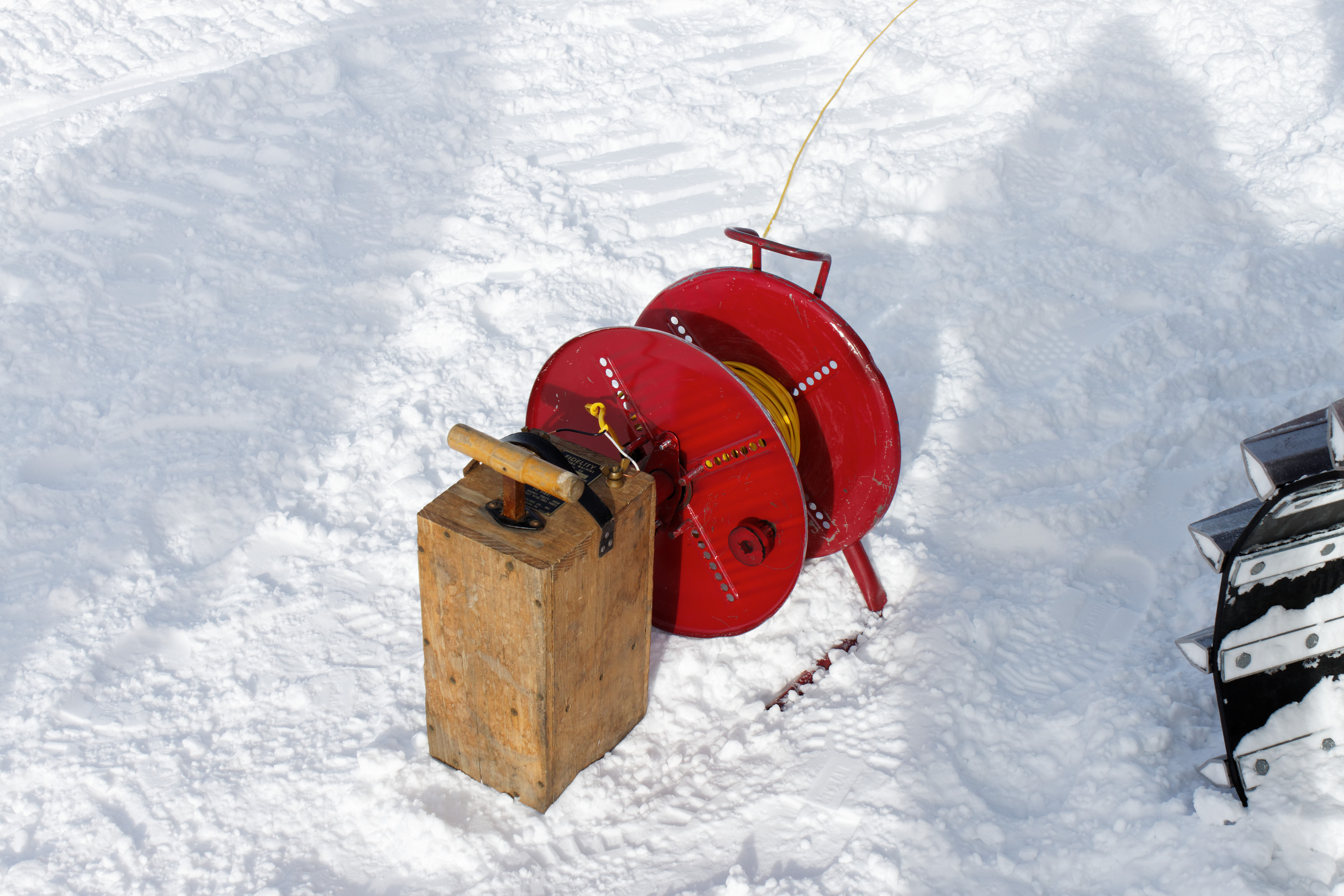
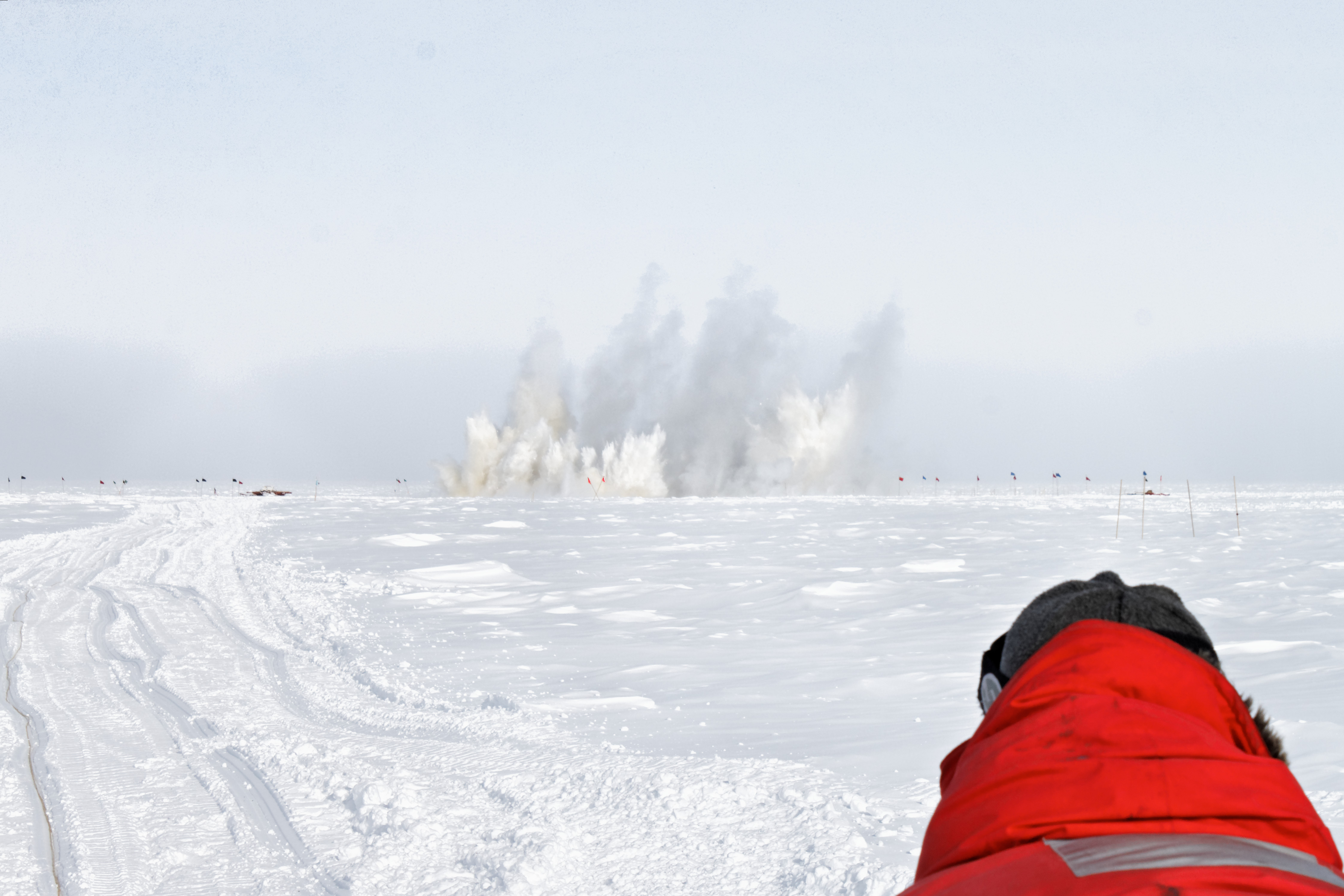
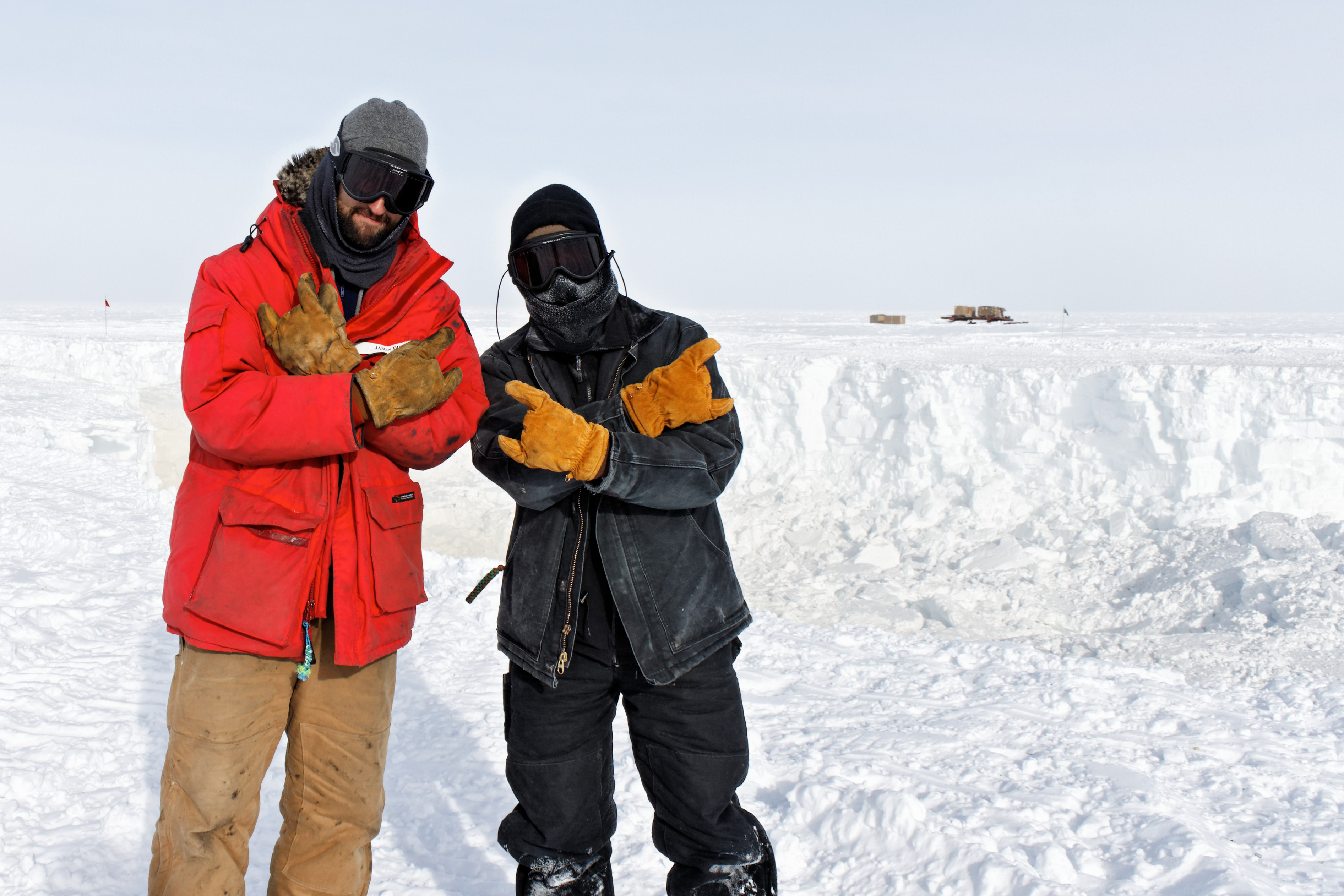
A few days later, those of us who had helped drill and/or lay the dynamite (mostly G.A.s and a few station management personnel) went out to the site to view the blast. The lead blaster had instructed us to always keep an eye on him; while we of course wanted to watch the explosion, we had to be ready to jump behind a Pisten Bully in case something went wrong. Jason, one of the G.A.s who had worked many days with the blasters got to push the plunger, blowing up all the thousands of pounds of dynamite and the contents of the structures below.
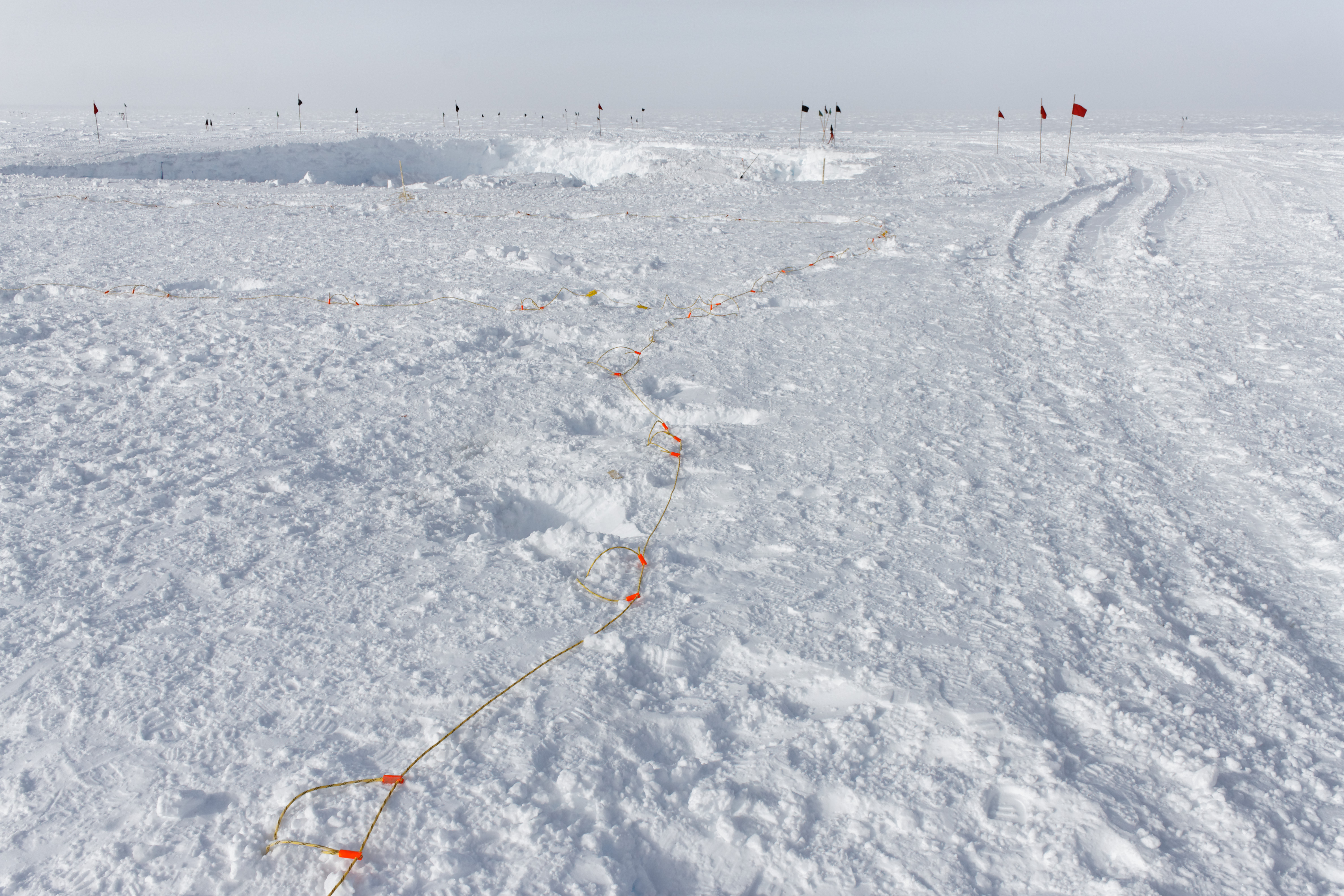
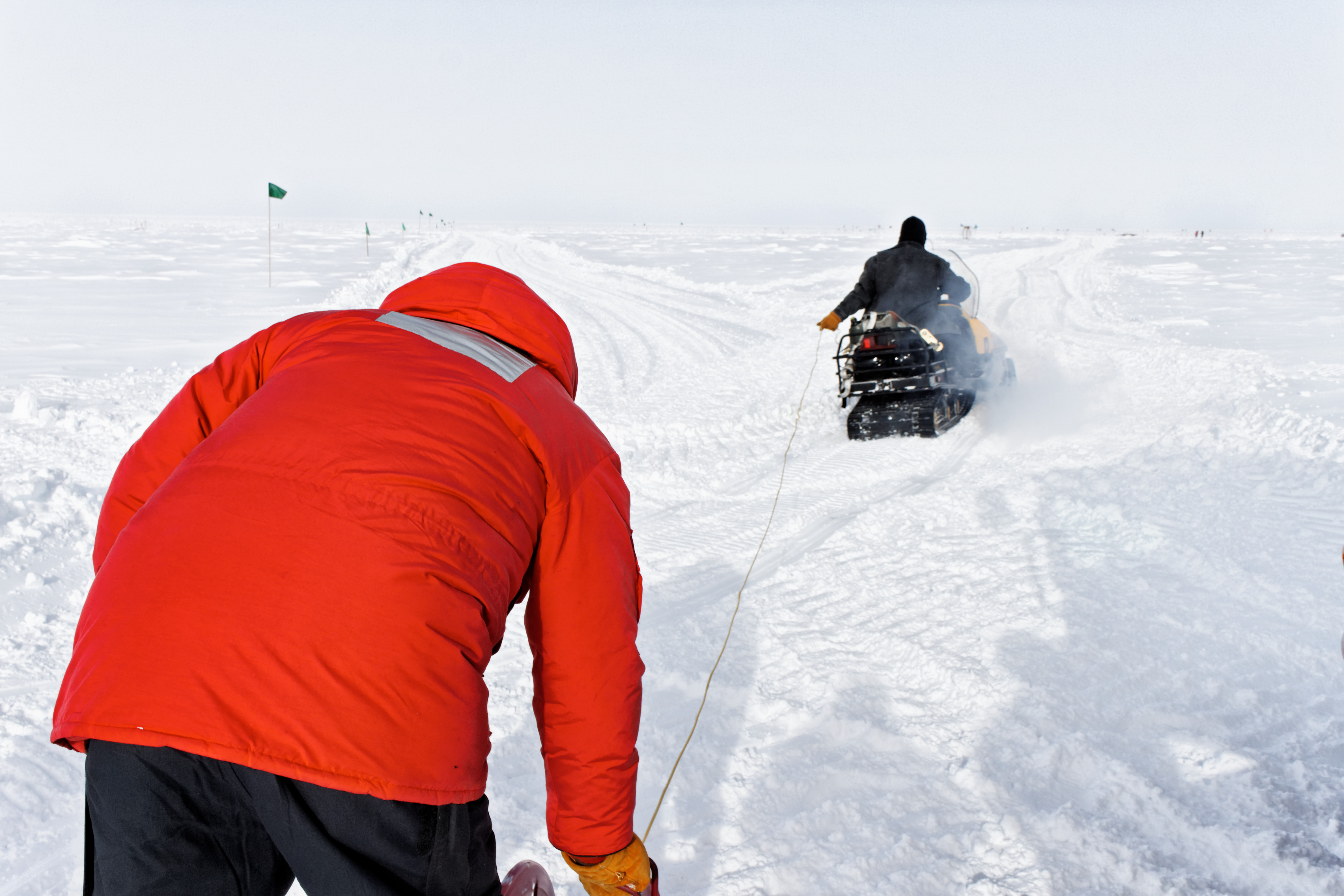
Strings of dynamite below the surfaceRunning the connection wires
Explosion and Jason
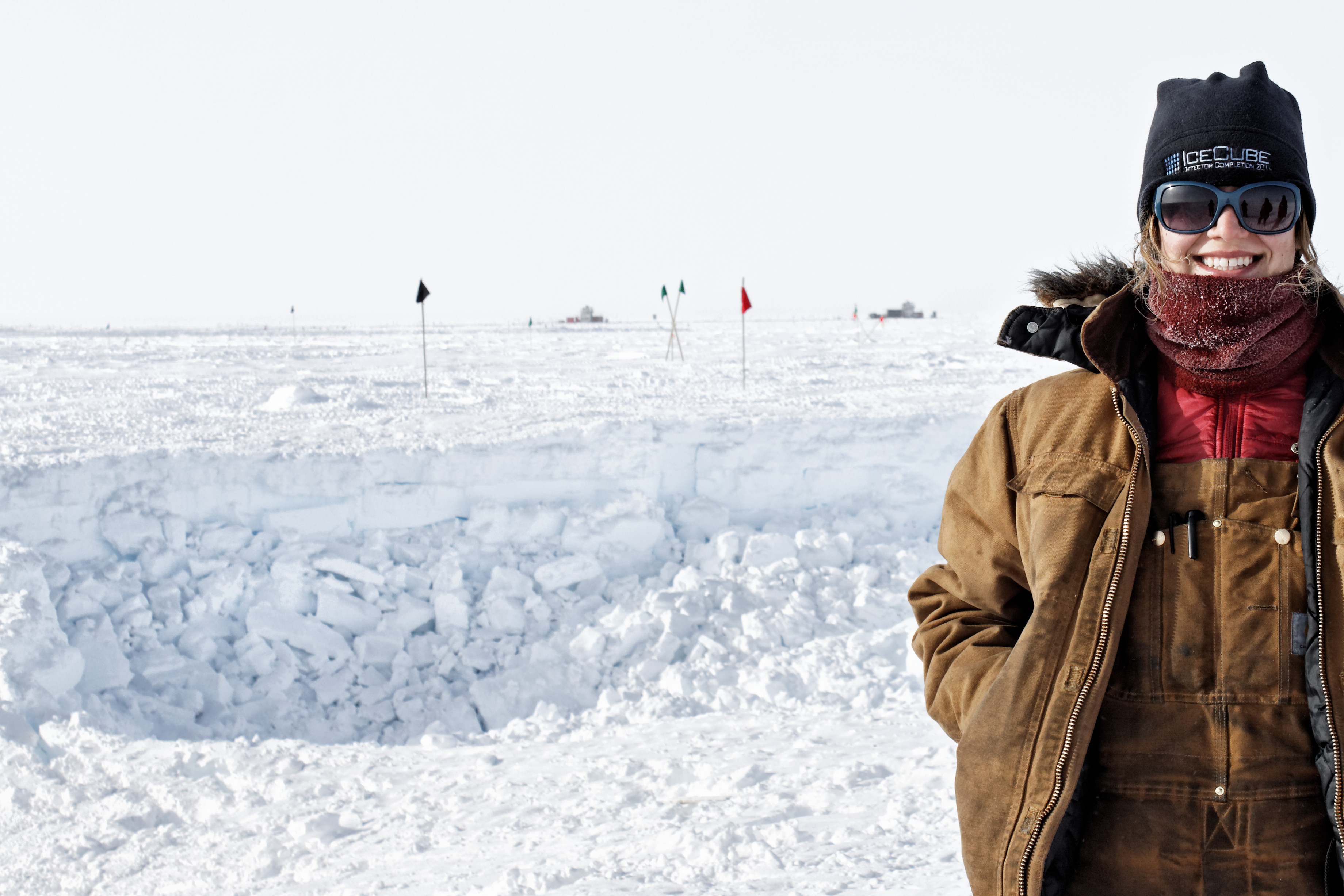
After the blasters did a preliminary check to make sure the dynamite had all exploded, we all drove out to the blast site, the sulfurous yellow smoke still hanging low in the imploded crater. The brick-like layers of drift snow, one for every winter, were like tree trunk rings, and we all had to be careful of crevices and cracks near the edge, indicating a shelf that might slide into the hole.
Jason and EdLayers
Pisten Bullys and CraterMe
Last year at the beginning of the summer the original Old Pole Station (1957-1975) was still buried under the snow whole, and the Dome (1975-2003, decommissioned in 2008), the second station, stood on the ice waiting to be deconstructed. This year, they’re now both gone—the elevated station the last man standing.
Lying in bed in the Jamesway with the lights off and the window covered; the air is so dry that slight movements cause static electric shocks so intense you can see, hear and feel them, like tiny blue fireworks. If I touch the plug of the Christmas lights with my foot or the blanket and cause a shock, it causes them to flicker on momentarily.
Working in the VMF, a trackloader will groan to a start, leaving behind oily black icicle stalagmites.
At night, you can hear the wind whip the canvas walls of our Jamesway tent, the plywood structures inside shifting, clapping. Both sides of the pillow are cold sides. During the storm (the biggest since 1990), we came back to our room after dawdling due to the weather one night to discover half an inch of snow on the bed that had come in through the gaps between the canvas. We worked for half an hour plugging up the holes with towels and issue socks, each bit of insulation causing a gap somewhere else.
When dull white clouds cover the sun, it flattens out the shadows making it nearly impossible to see the texture of the ground directly in front of you. This makes it difficult to walk, and coming to or from station we stumble and trip like a bunch of drunks.
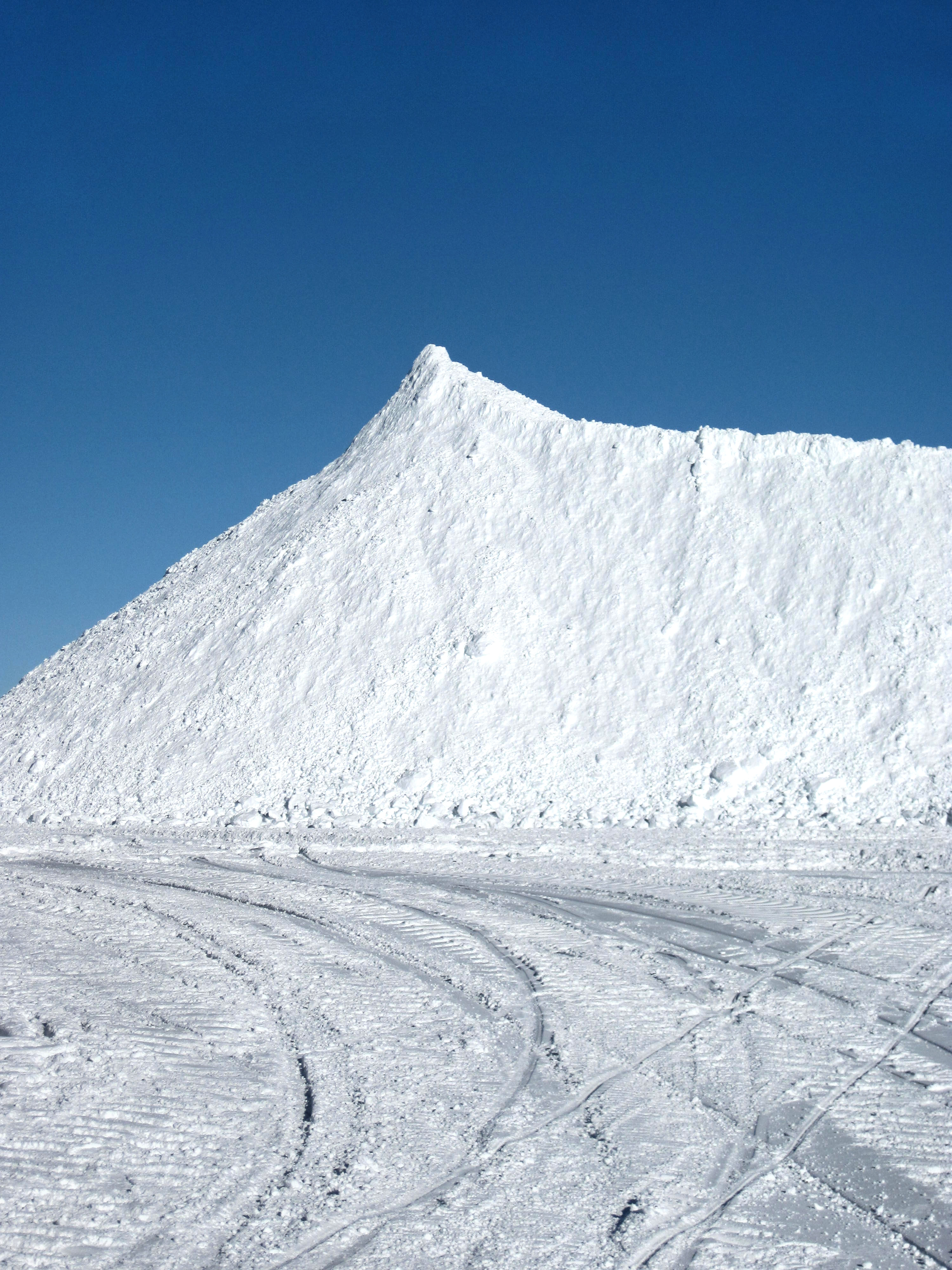
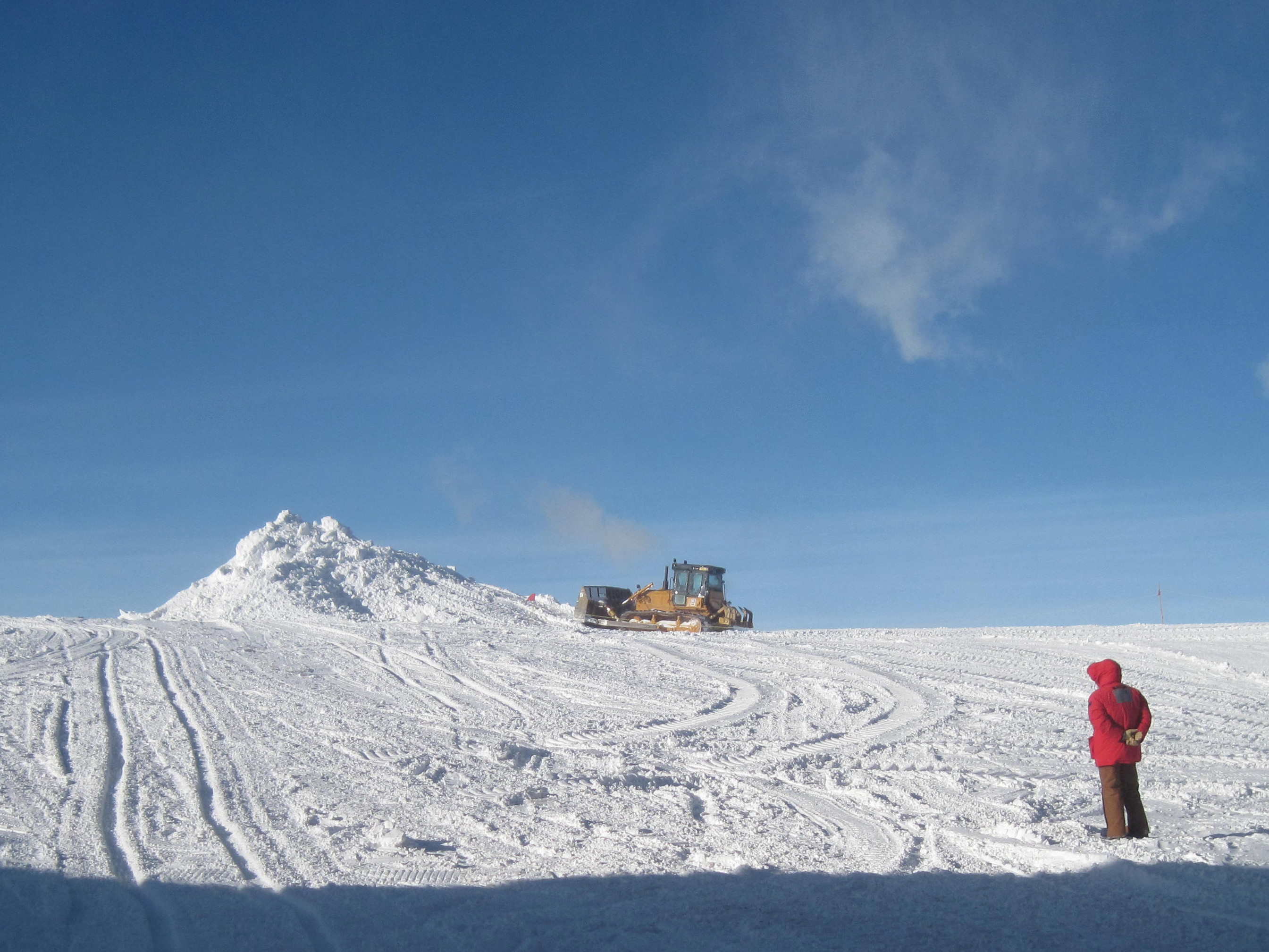
The terrain is constantly evolving. The heavy equipment operators work day and night shifts to clear snow away from the buildings, and later to the “end of the world,” downwind from the station, Summer Camp and storage berms so it won’t blow back. Mountains of snow will appear and disappear, grow and shrink, making it difficult to know exactly where I was before I got to know the area well.
You can hear tractors roaring all night long, grumbling up and beeping back down the hills, moving snow. When a plane lands late, you can hear it as though it is landing right in Summer Camp. You can also hear everyone else in the Jamesway; coughs, sneezes, low battery radio beeps, alarm clocks, or when someone is putting their pants on.
When “freshies” come in, fruit, vegetables, and real eggs, Comms will make an all-station announcement asking for help. People line up from the bottom of the Destination Zulu stairs, up two flights to the galley on the second floor. Passing boxes up the steps, oohing and squealing at the contents. “Mango!” “Pineapple!” “PLUMS!”
So, six weeks before we leave the ice, you may wonder exactly what I do to earn my living around here.
Everything we do at the South Pole exists solely for the purpose of supporting science endeavors. The scientists and all of their support staff need to be able to travel to the continent, eat, sleep, and research in the station and the surrounding couple of miles. Most of the science projects and subsequent departments need vehicles at some point; track loaders, snowmobiles, plow-accessorized tractors, Pisten Bullys and LMCs, Ditch Witches for trench digging, cranes, cherry-picker lifts and various other vehicles for special projects and transportation. This is where the Heavy Shop comes in. Most of these machines don’t like the regular 50 below temperatures and tend to break down often and especially need care at the beginning of the summer season after taking an 8-month nap at temperatures of 100 below.
Much of what the Heavy Shop did at the very beginning of the season was bringing up equipment for the summer. We spent a lot of time digging out herds of snowmobiles almost completely buried in winter drifts and towing them back to the shop for warmups and maintenance; towing out huge portable heaters to the heavy equipment and, after digging that out, placing the foot-wide flexible hoses of the heaters on the vehicles’ motors and covering them with old quilts and leaving them running for hours and hours just to warm them up enough for a drive back to the shop; heating up and starting shuttle vans and then pulling them off the blocks they spent the winter on so that they wouldn’t become completely buried with engines full of ice.
Vehicles buried at the beginning of the summer season with the station in the background (photo from VMF common drive)
(Photo from VMF common drive)
Heating the CAT 307B (Photo from VMF common drive)
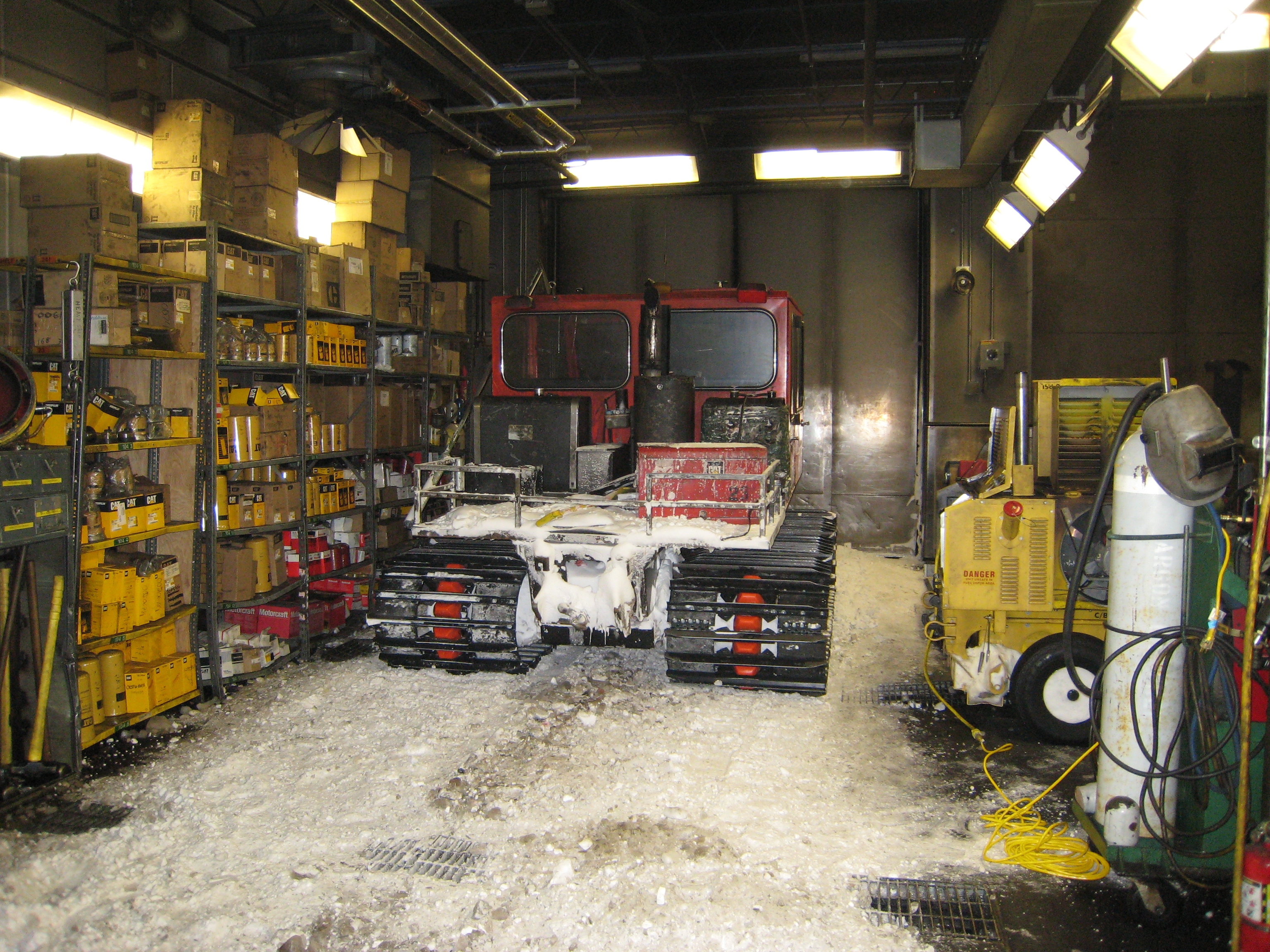
Now, every vehicle that comes into the shop is, understandably, completely covered with snow throughout the body of the engine, packed into the grooves of the track, iced onto the roof and sometimes even the sides. When it comes into the shop it melts everywhere, mixing with glycol, engine oil, and sometimes hydraulic fluid. Because of the rules of the Antarctic Treaty (and general common sense) this can’t just be shoveled back out onto the clean snow.
A snowy LMC in the shop (photo from VMF common drive)
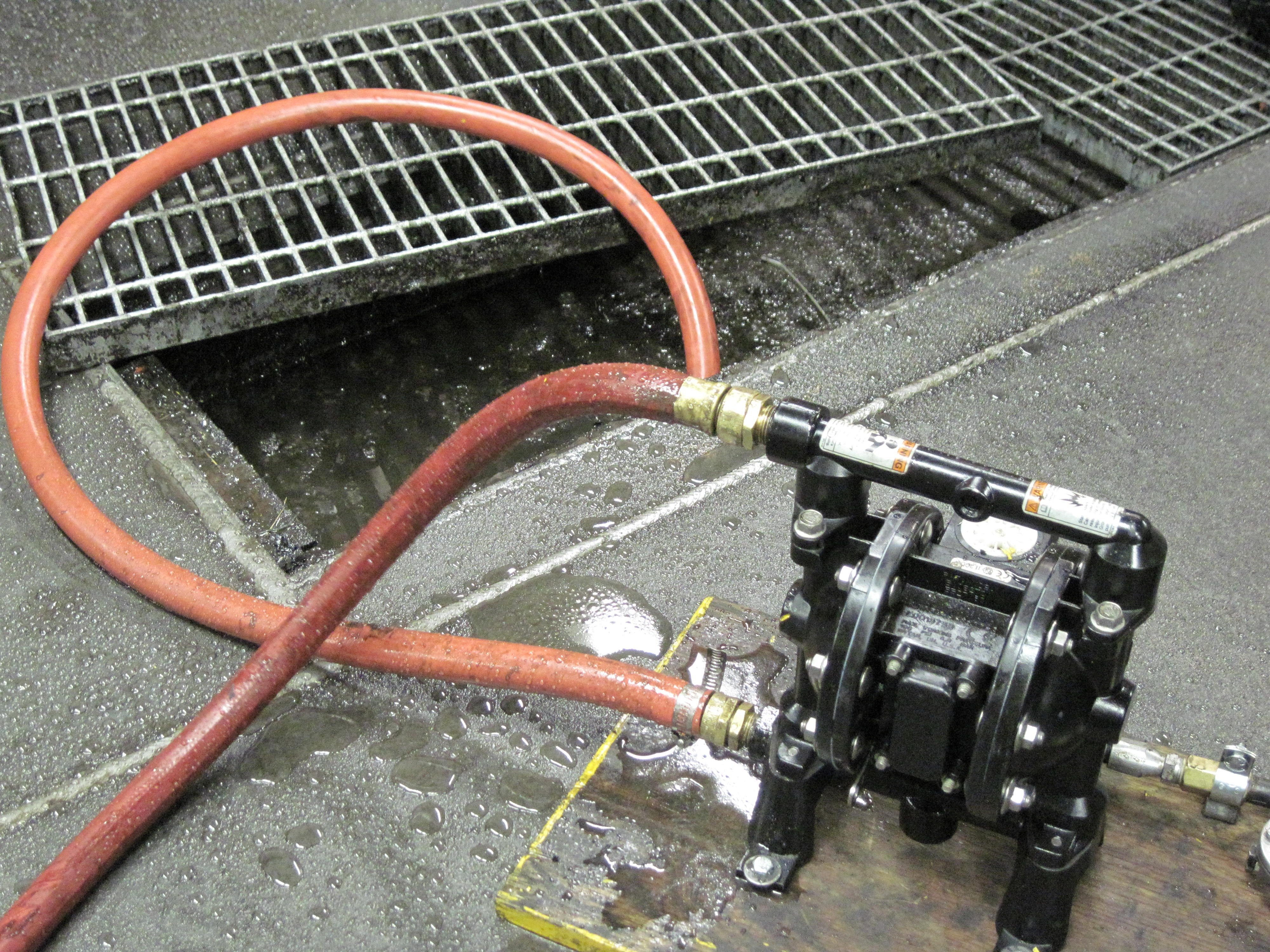
I get to remove waste ice from the shop in a variety of ways, and I spend probably two to six hours a day doing this. I can place a heating fan on the frozen grates and, when they melt to water, use a pneumatic pump to suck it out of the floor into the oil/water separator.
I can also use an air hammer, sharpened iron bar, or pickaxe (sometimes all three) to break the grate contents into smaller bits and take them out with a bucket if it’s really watery, a shovel, or by hand—pocked, sharp, oily slippery ice. If the melted water misses one of the ten or so grated reservoirs in the floor, and freezes solid to the floor, then I use the pickaxe or pointy iron bar to chop that up into small bits and sweep-shovel it off the floor. With the latter two crud-removal systems the ice has to be put into a 55-gallon drum and melted with a hot electric band. Then I get to use that same pneumatic pump to suck that waste water into the oil/water separator.
Crud, barrels and pump (on a block so it won't freeze from the cold floor)
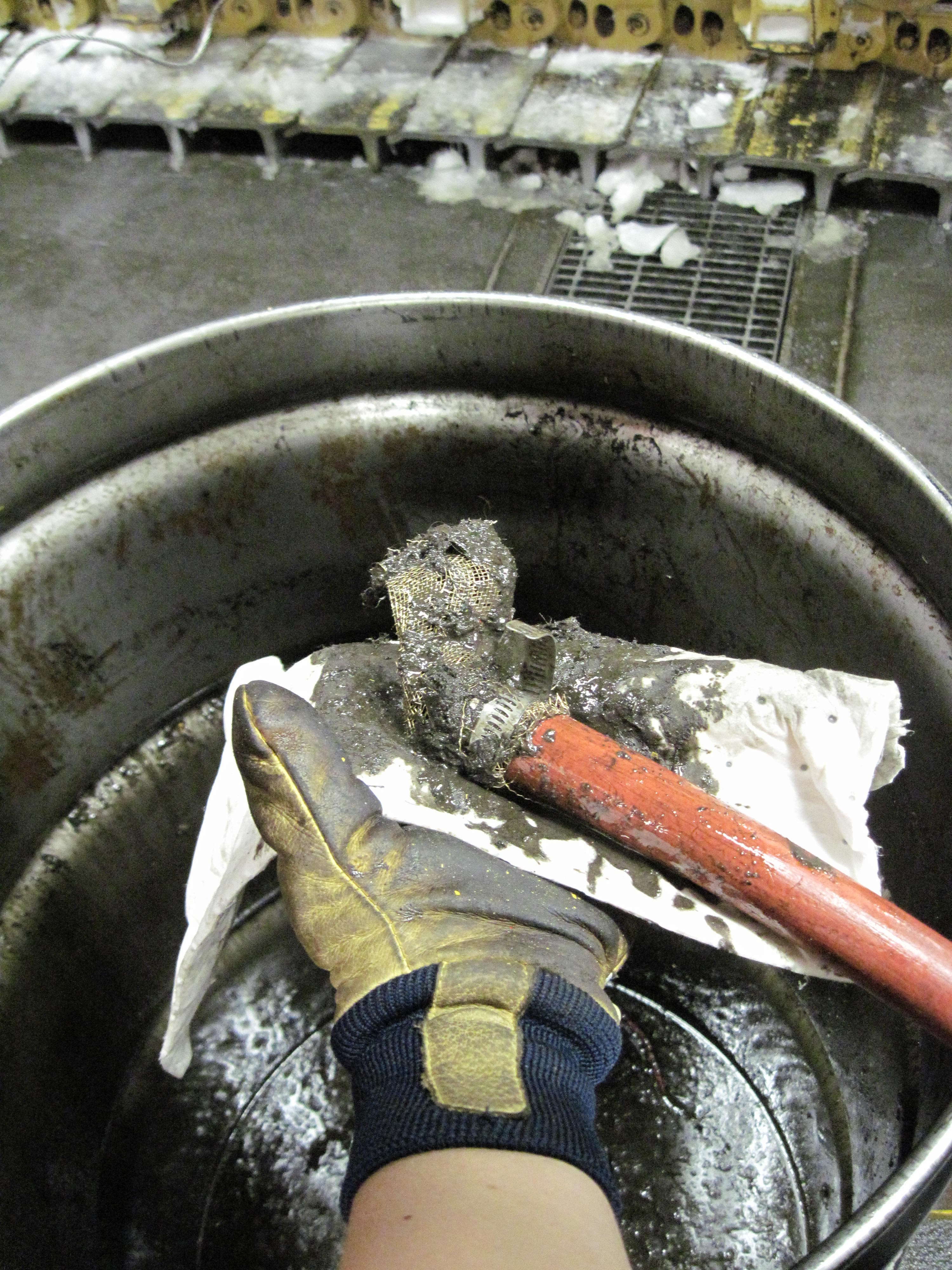
This pump (which I’ve given many nicknames that I keep to myself) tends to freeze up anytime the water running through it is too cold or slushy, when the mechanics open the bay doors to bring in a vehicle, letting 50 below air pour in (this happens all the time—it’s a shop), when it sucks up a blob of crud that blocks the suction, or when you look at it the wrong way.
Clogged
Most of the rags we have are recycled torn up clothing and sheets, and once, when I put a frilly, lacy rag on the pump to keep it reasonably dry, it stopped working for almost a week out of spite; no amount of taking it apart to look for blockages, bleeding the hoses, soaking the hoses in hot water, cajoling it, or priming it with oily water could make it work again until I removed the frilly rag.
Once the water has gone through the separator, I use an electric pump to transfer it to different 55-gallon drums. Once I have two or three of these full–at the beginning of the season it was about 5 per week, but now that the temperature is up to -10 and everything is really melty, the shop is like a swamp and I do up to 4 per day–I grab it, all 440 or so pounds of it with a dolly, throw my whole weight on it, and take it for a walk. The wastewater input is through a subterranean (sub-ice-ean?) hallway that remains at 50 or 60 below no matter how warm it gets outside. I drag the now-wheeled barrel through the shop and VMF office, past the plumbers and electricians’ shop, across the Logistics Arch which houses much of the station’s frozen food storage, and over to the power plant arch. The pipe is in the naturally refrigerated hallway, but the switch to turn off the pump inside of the wastewater input pipe, which helps to prevent me from getting covered in raw sewage, is inside of the power plant bathroom, the only unisex toilet for five floors and as many departments. This is incredibly irritating because I have to wait until whoever is depositing their own sewage while reading hunting and fishing magazines is finished before I can begin my job. Once the internal pump is turned off, I remove the cap of the pipe and connect yet another pump (pump count for this task: 4) before sucking the separated waste water into the pipe to be treated.
Other things I do at work include receiving, inventorying and putting away anything we ever purchase including hoses, pumps, turbochargers, tools, o-rings, bellypans, windshields, welding materials, batteries and many more exciting objects, and anything the entire Ops department purchases (read: half the station), like amplifiers, DVDs, and sousaphones. I sweep and put things away, push water into my favorite grates and suck it out again, change the empty barrels for full barrels of ethylene glycol, arctic low-pour hydraulic fluid and engine oil, and dolly out full barrels of waste liquids and used oil and fuel filters.
Using the hoist to swap empty barrels for full ones. This was a few weeks into the job, and those Carhartts were shiny new when I received them in CHC.
I take out and sort shop trash, which is much more complicated than it sounds—everything here is recycled if possible, and the waste system is quite extensive. I’ve also gotten to do some more mechanic-y things like fixing the pump when it clogs, repairing leaky couplings on the fresh oil and glycol pumps, helping change the oil on Elephant Man, the beast of a vehicle that drags the mobile firefighting sled, and learning how to change broken fittings on hydraulic hoses. I have learned how to operate and start snowmobiles, Pisten Bullys and LMCs, and, unofficially, some of the heavier equipment like track loaders. I also get to shovel quite a bit, sometimes even for different departments which is actually pretty fun.
Shoveling out a fuel hose that was buried in snow up to my waist
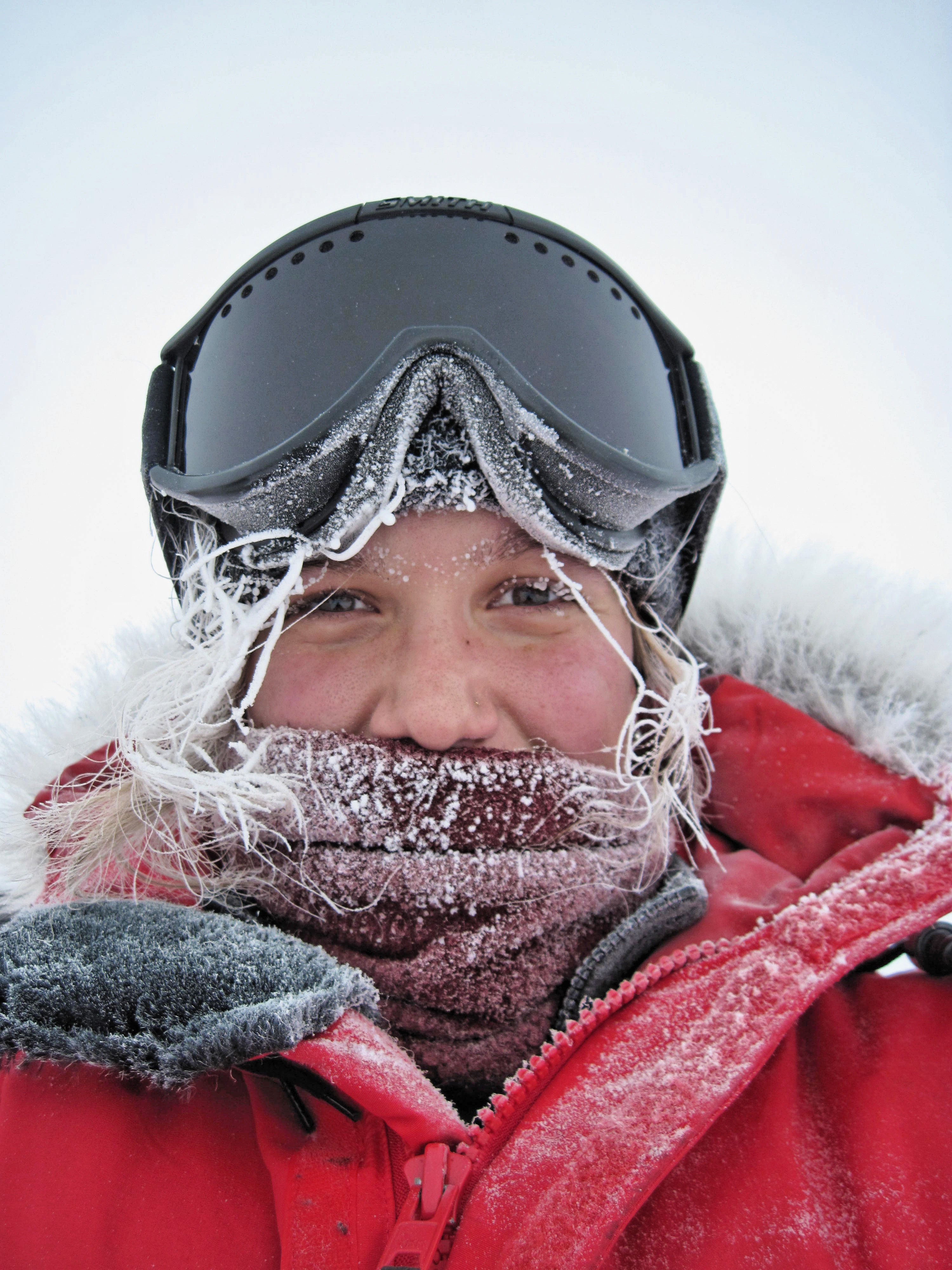
Frozen eyelashes and hair while shoveling for Fuels
Despite the greasy nature of the job, I actually enjoy it. The tasks are pretty simple, just physically tiring, but it feels good to get exercise at work every day and it’s satisfying to see a task get done, even though it will get undone by the next morning. I feel really lucky to work in the VMF—the crew there is so funny and relaxed, while somehow simultaneously being some of the hardest workers on the entire station and being really responsive to the needs of the crew. My supervisors just laughed and offered advice when I overflowed the waste water barrel all over the entire shop (a HUGE mess), and later the water/oil separator (a slightly less huge mess), or when I dropped the cap to the waste input pipe through the grated floor outside the power plant, never to be seen again. I honestly think that the heavy shop is the best department at the whole South Pole, but I might be a little biased.
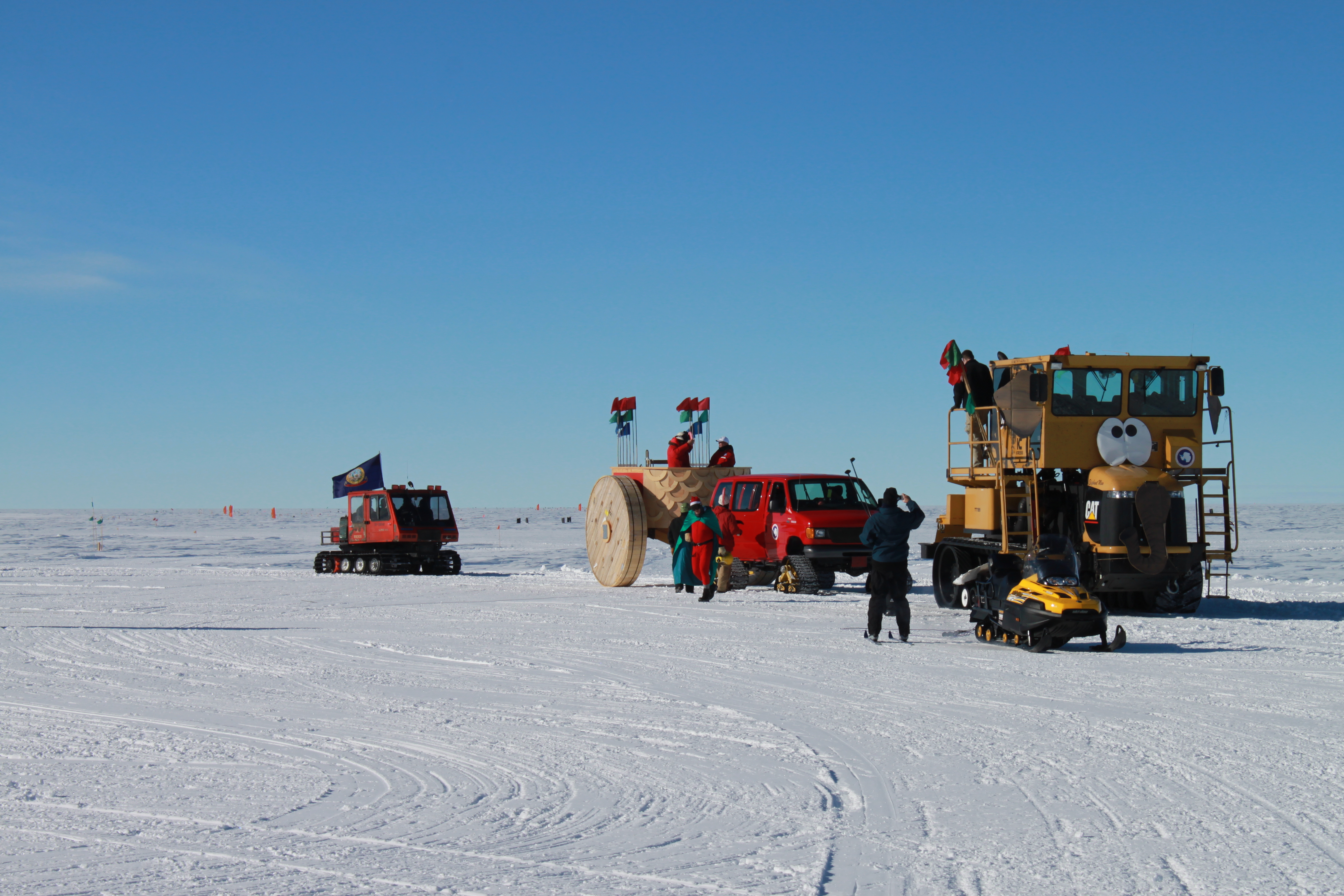
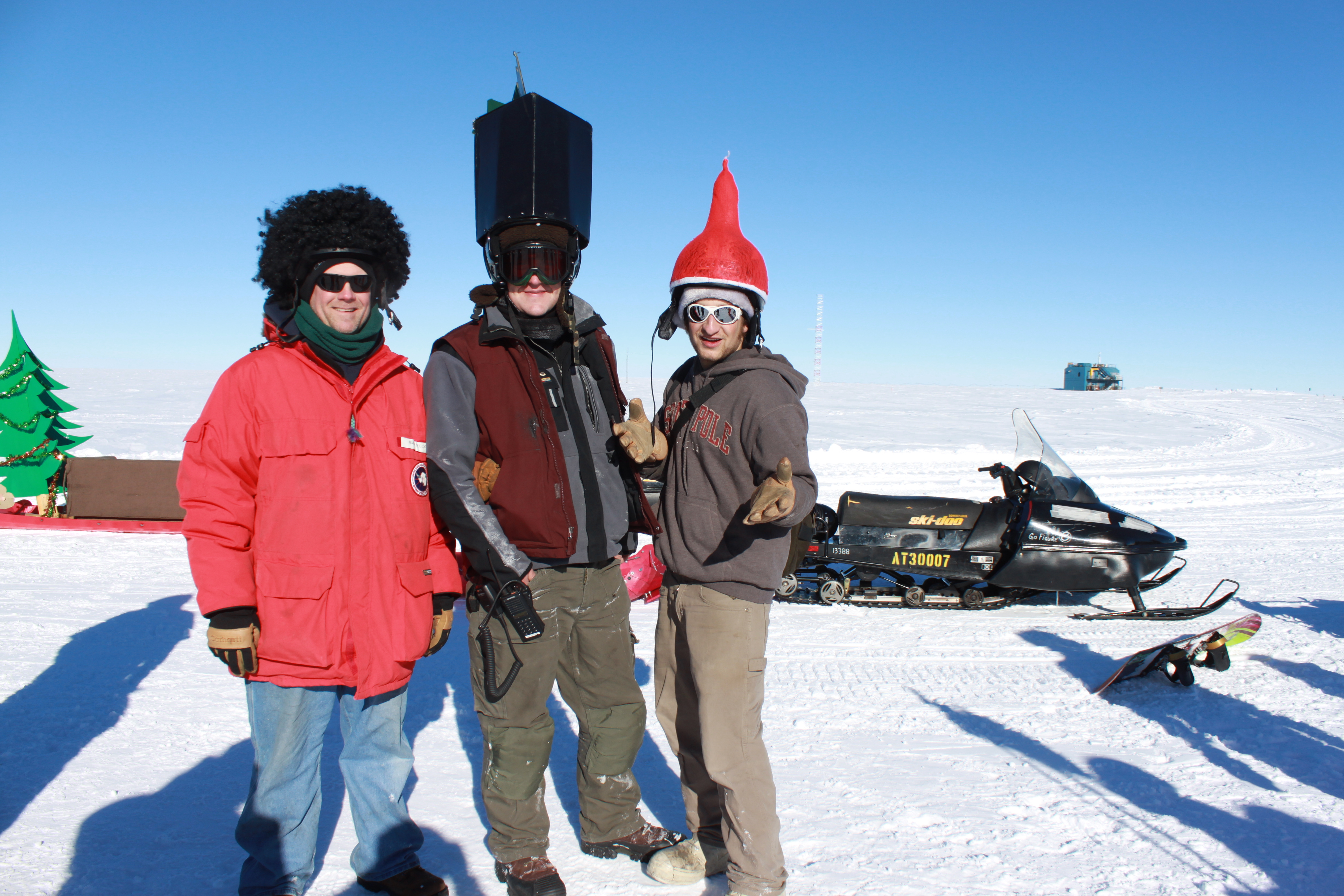
Daniel and I ran our first race ever, a Christmas morning 2.1 mile course at 10,000 foot physiological altitude, with a -25 windchill and soft ice underfoot. Participants in jogging clothes and costumes ran, jogged, walked, skied, drove snowmobiles, Pisten Bullys and tractors decked out like parade floats.
Click to enlarge photos.
Participants getting ready to race around the world
Pre-race
My goals in the race were to jog the whole time—optimistically jog, I told people who asked if I planned to run the race—which I did, except for to snap a few pictures, and to clock in under half an hour. I had spoken to a real skier/runner who said he hoped to be able to average 12 minute miles due to the terrain and altitude, so I thought 15 minute miles was okay for a novice runner.
Elissa and Fire Captain Don
Ralph, Eric and Max don't let safety get in the way of fashion--check out those snowmobile helmets
The male winner ran the race in 13:32 minutes, and the female winner ran it in 18:22 minutes. Daniel was close behind the female winner, beating the second place woman, and I ran it in a little over 28 minutes. The male and female winners of the race get to fly to McMurdo in a few weeks and run their sea-level marathon. I have heard that the South Pole contestants do quite well and often win this race due to the drop in altitude.
Daniel crosses the finish line at 18 or so minutes–we didn’t get an official time, unfortunately
Kiell crossing the finish line
After the race we had brunch, eggs to order, potatoes, fresh fruit and cheese, pastries, scotch eggs, bacon, sausage, toast, coffee. We returned to Summer Camp to shower and start getting ready for evening festivities and dinner. People get pretty dressed up for holidays—Thanksgiving was like this, too—some people went all the way in suits and ties, dresses heels, and makeup. It’s fun to see everyone dolled up like that since most of the time we’re quite dirty due to showering restrictions, and lots of people tend to wear their issue clothes, like the Carhartt overalls, even when their workday is over.
I put Charlie Brown Christmas on, with my laptop on the sink in the bathroom while my friend Rachel showered and got ready to serve wine at the second of three dinner seatings. When it was time, we started with appetizers and eggnog in the hallway outside the galley, musicians singing Christmas carols while we noshed. Dinner was delicious, beef wellington, lobster tail, basil mashed potatoes, green beans with hazelnut shallot butter, challah, red wine and cherry pie with fresh whipped cream and orange chocolate for dessert.
After dinner we played four games of paper telephone (I don’t really recommend laughing so hard on a full stomach), followed by dancing until 1 in the morning in the galley before going back outside to the midnight sun and walking home to our little jamesway room to go to bed.
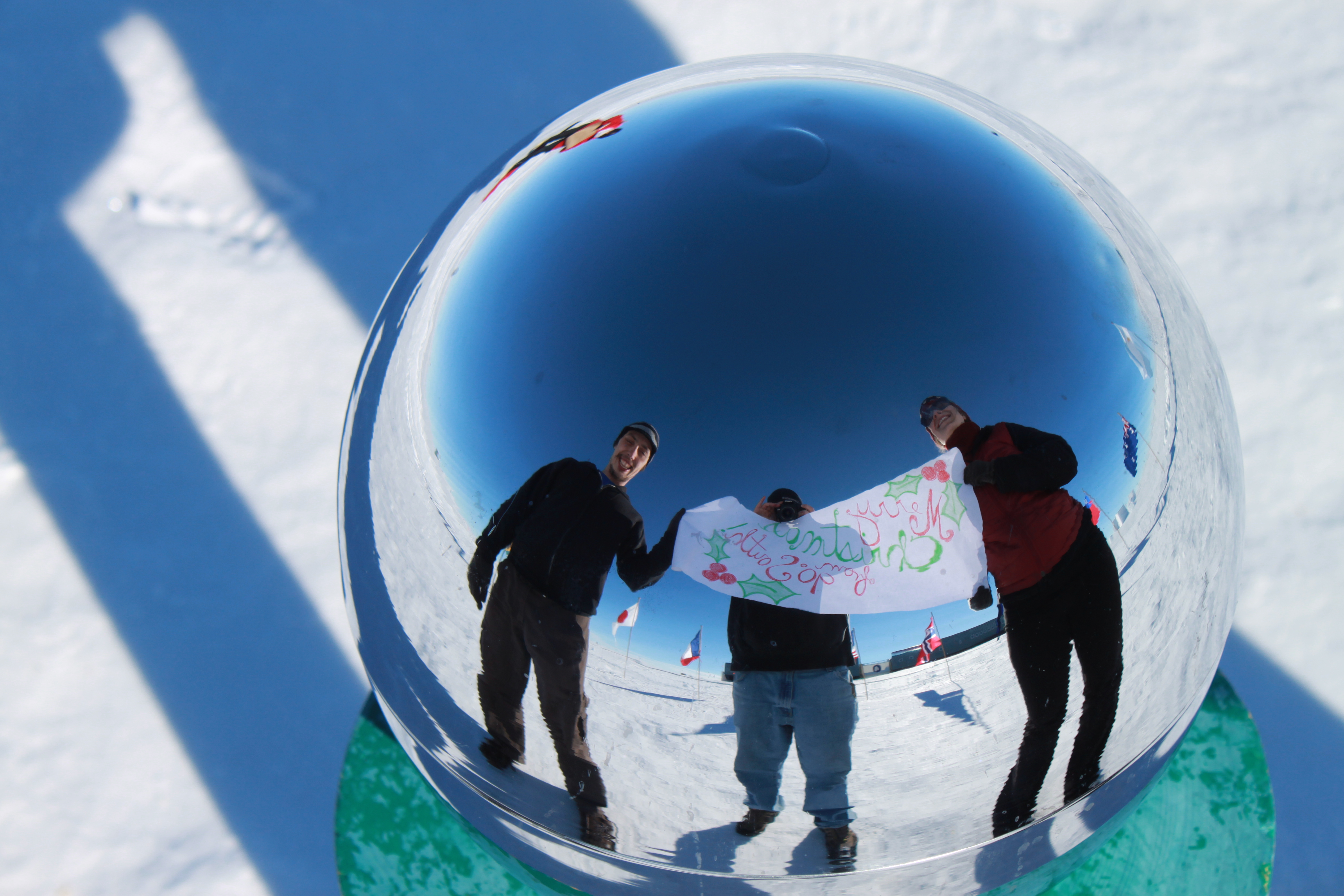
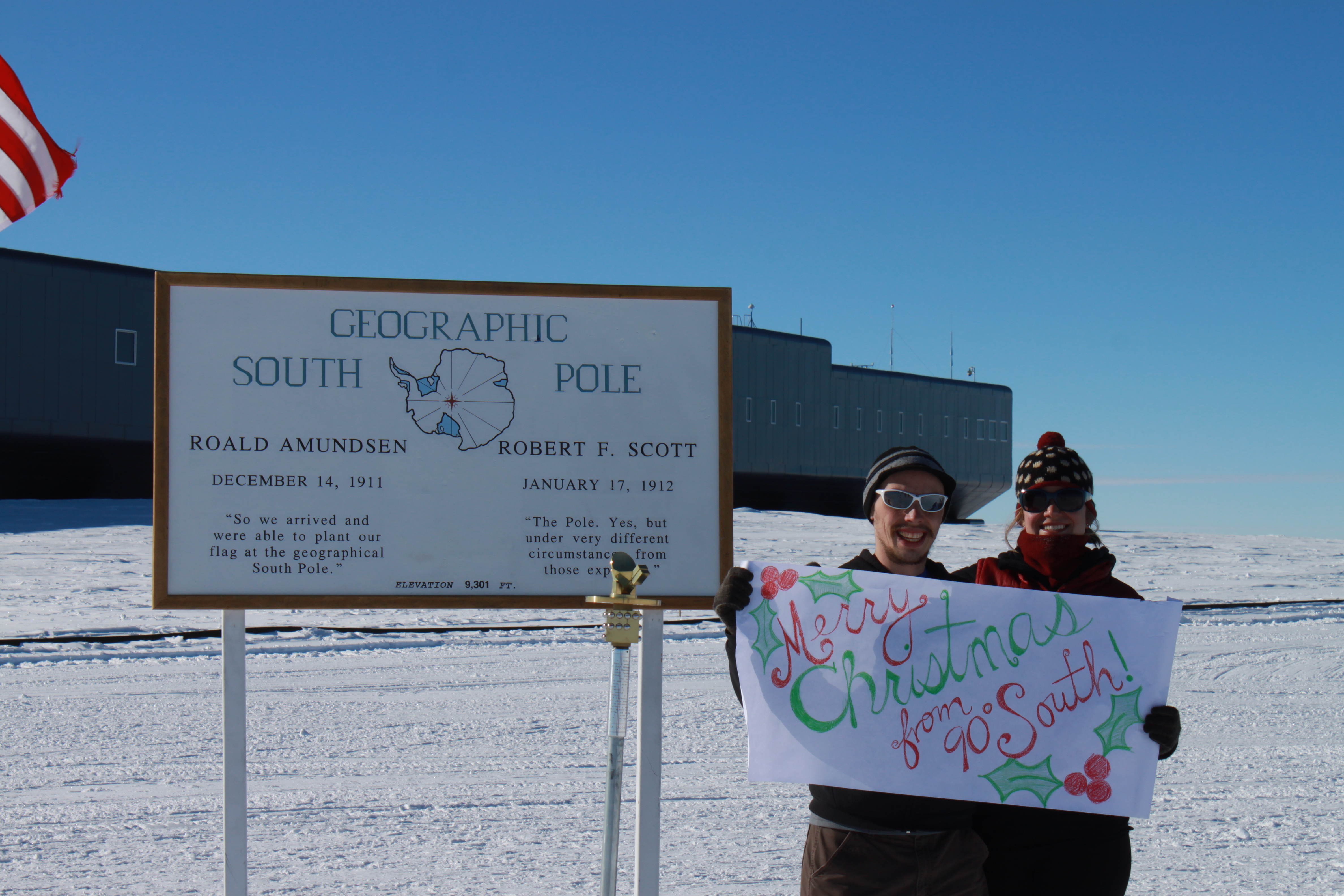
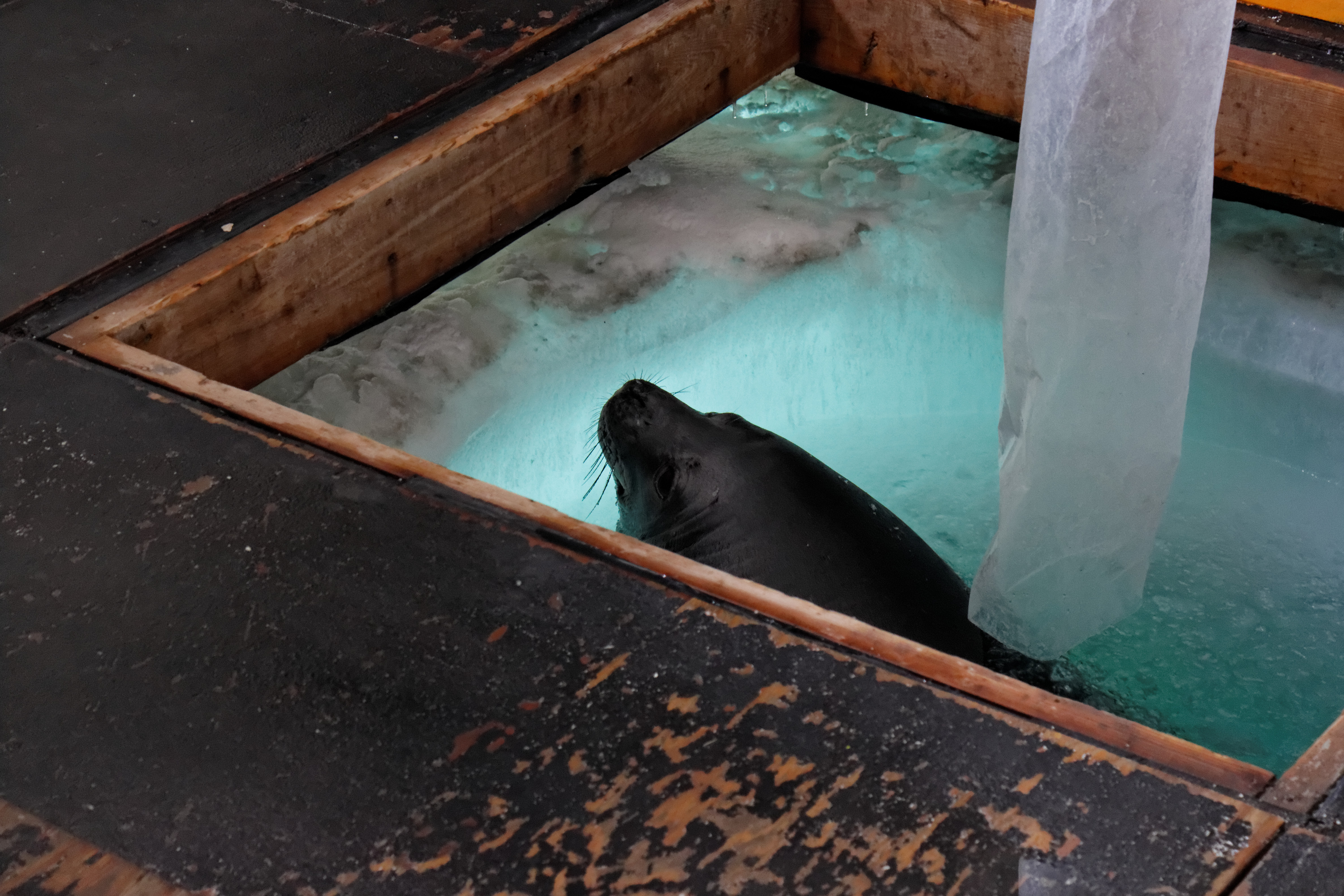
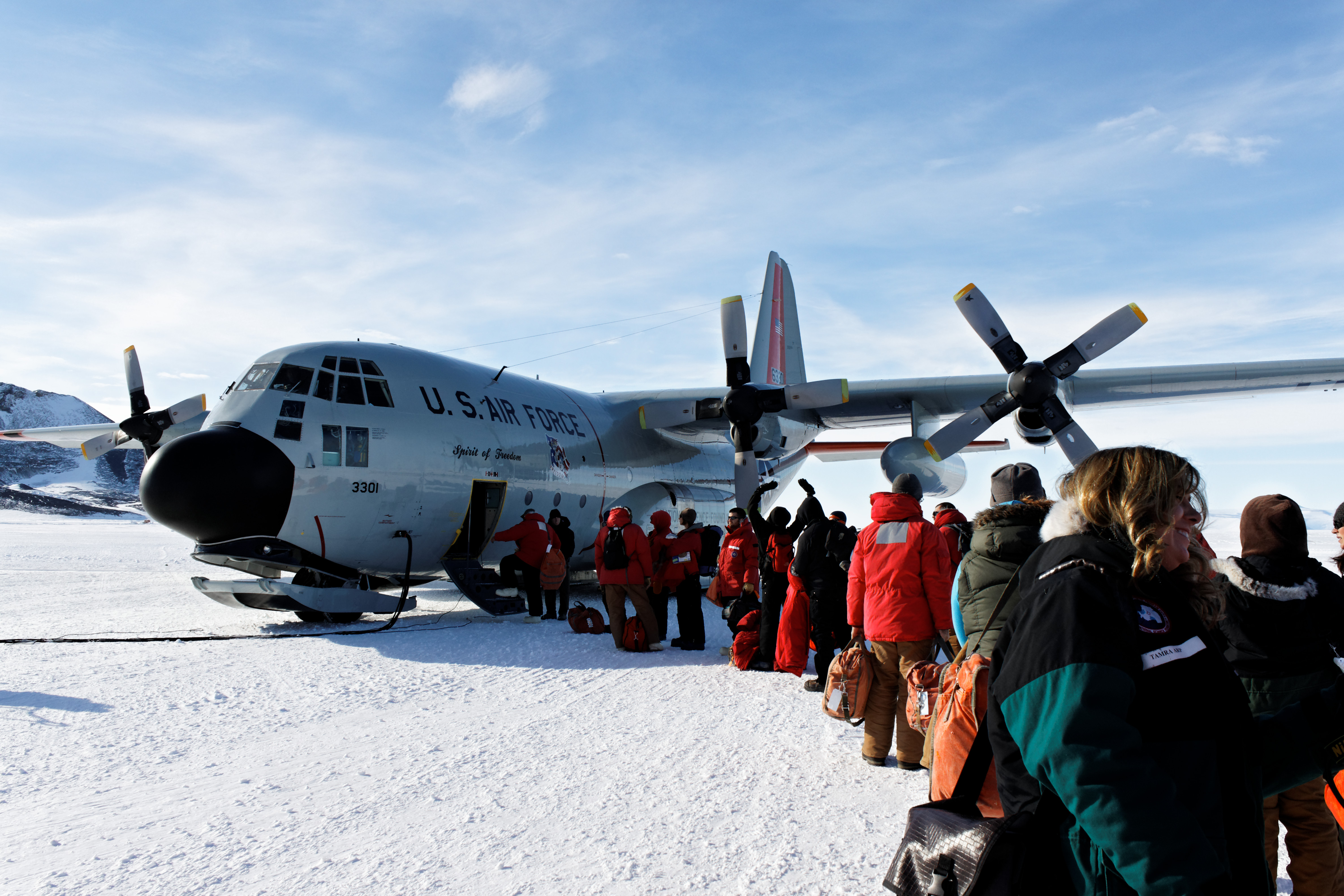
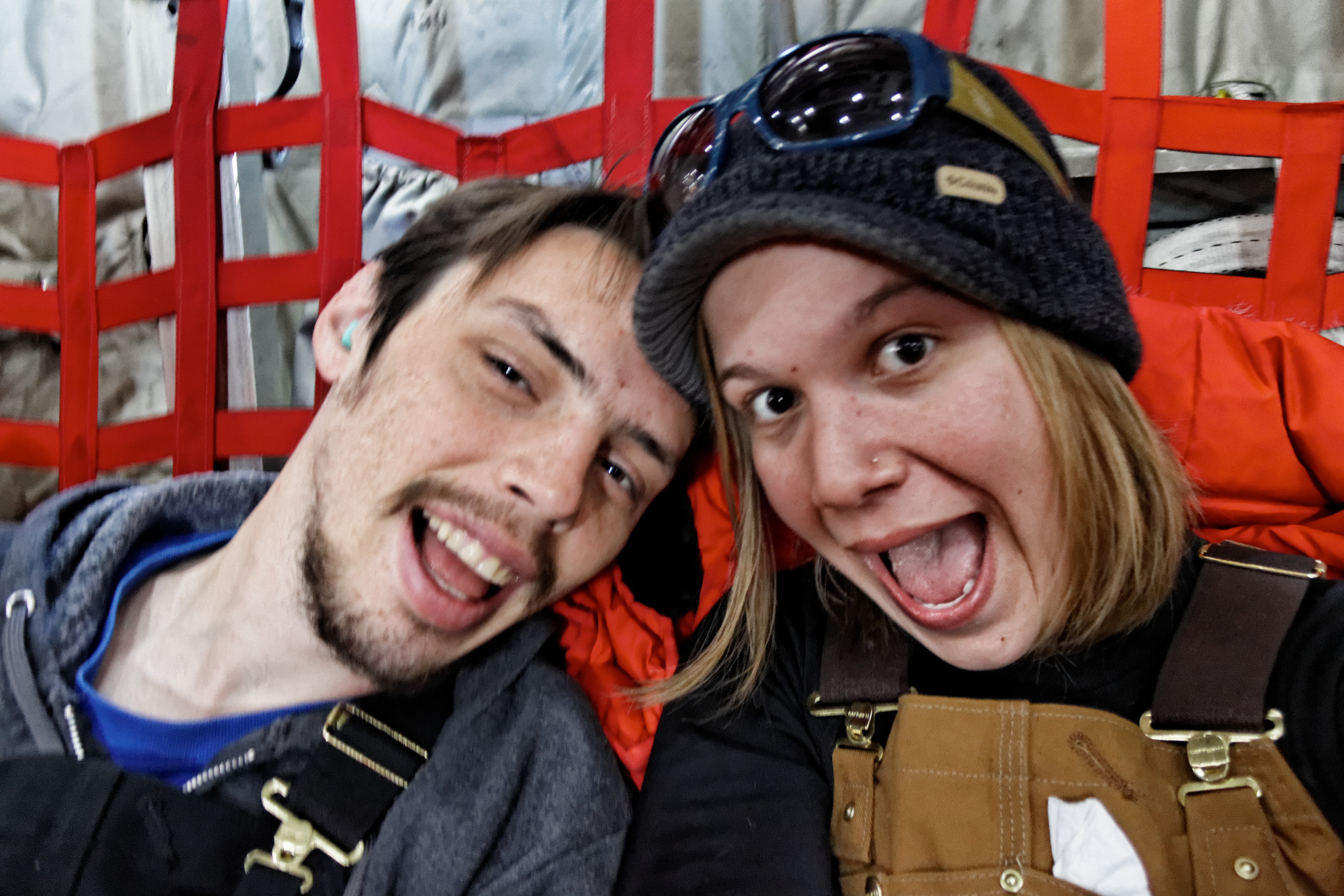
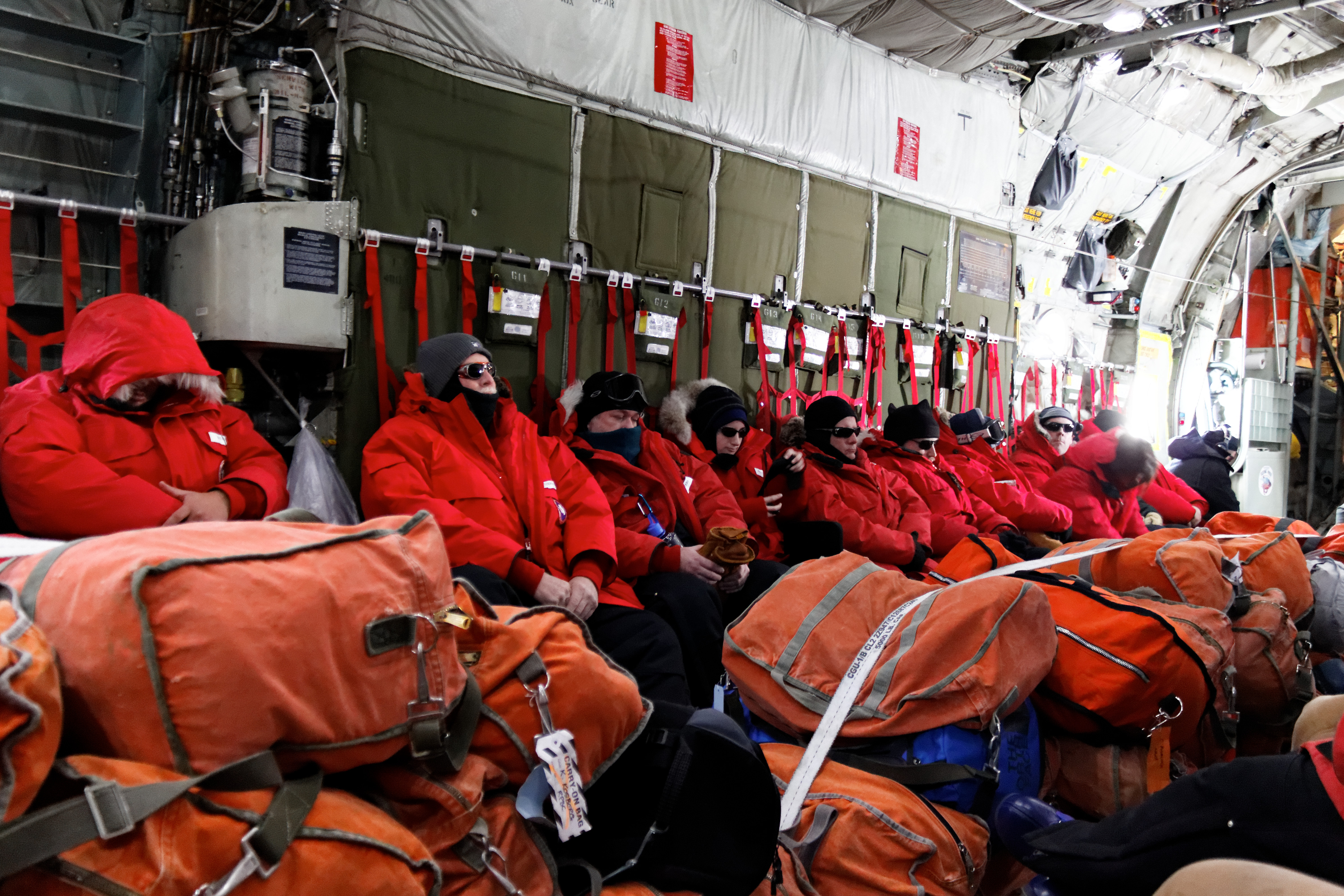
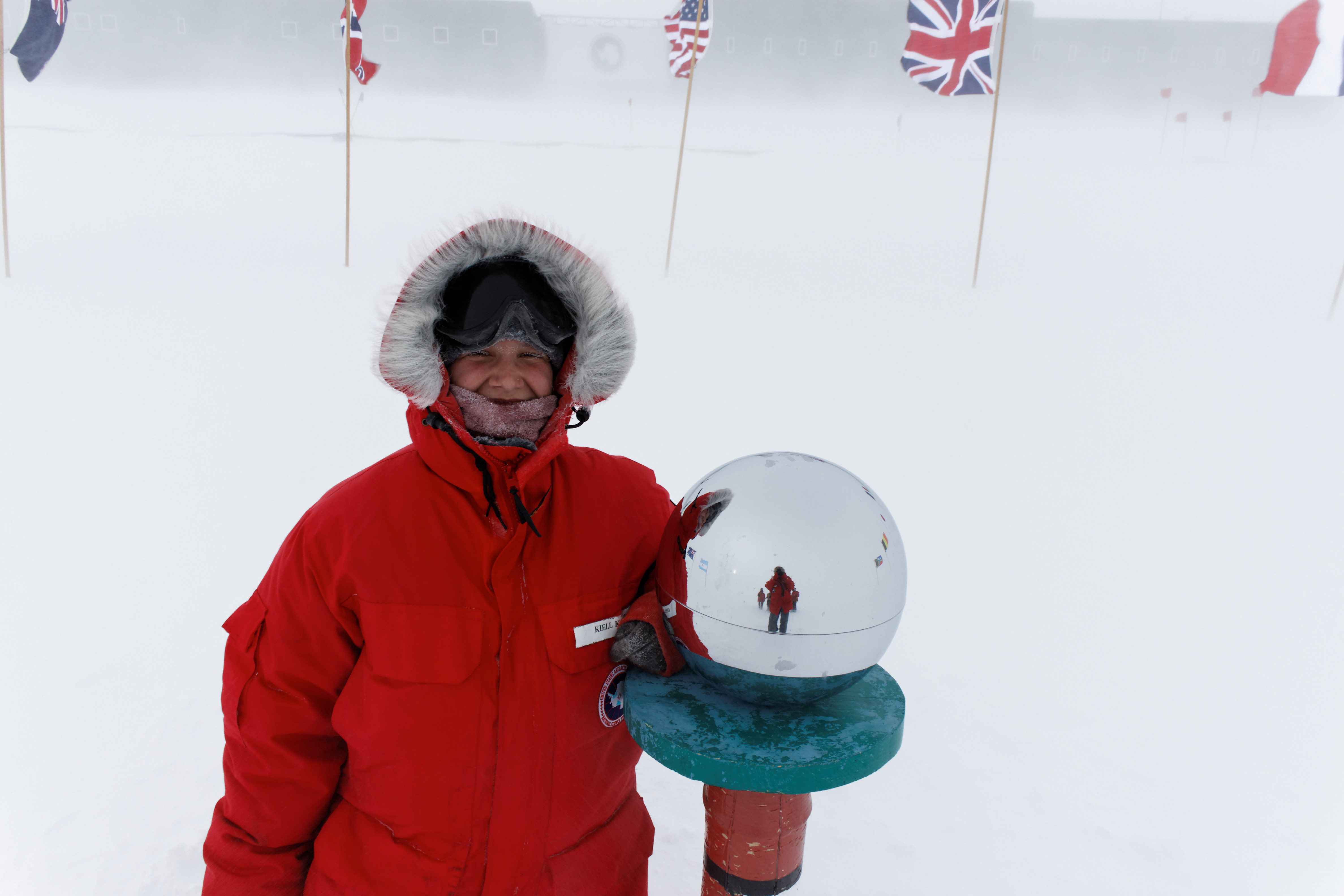
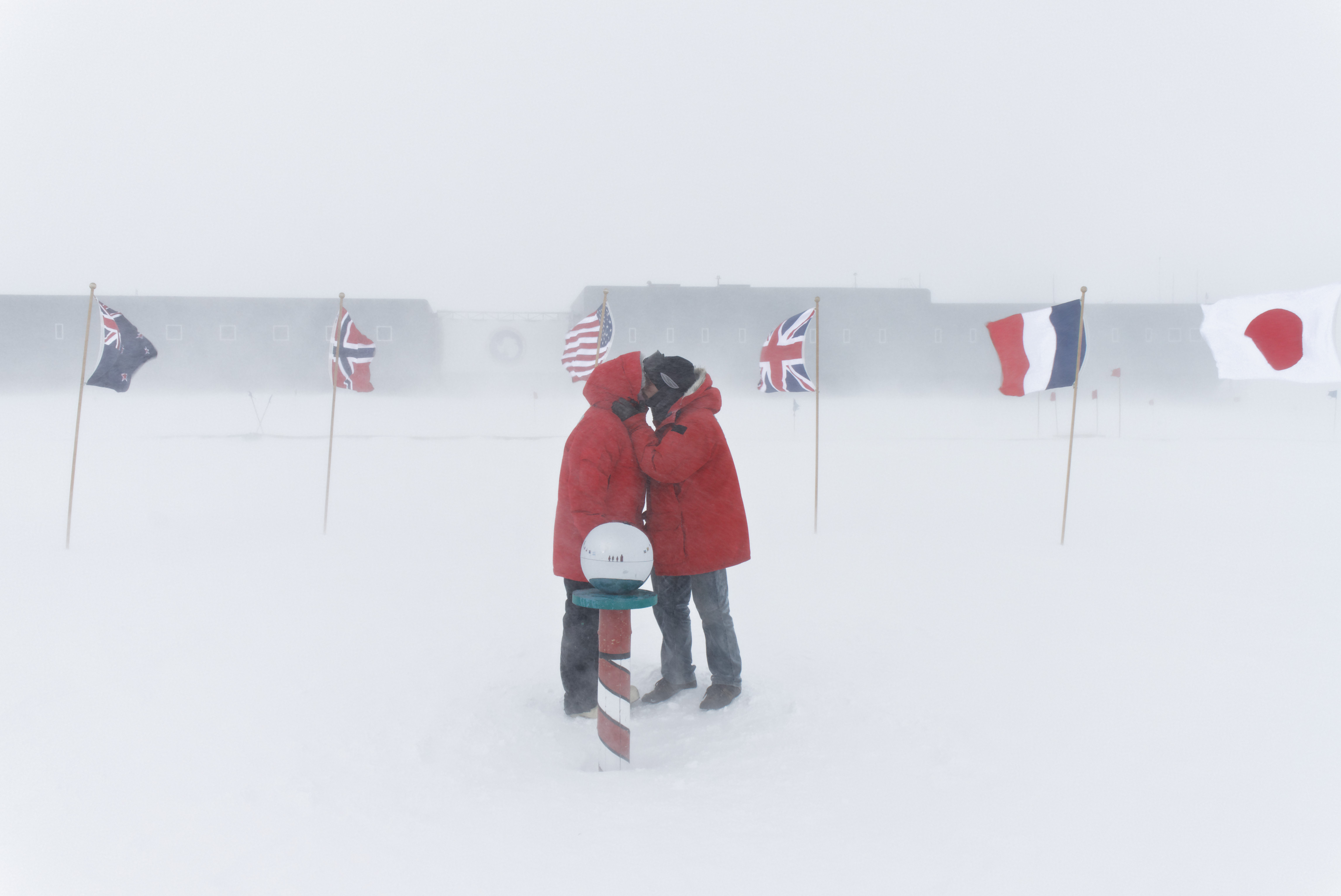
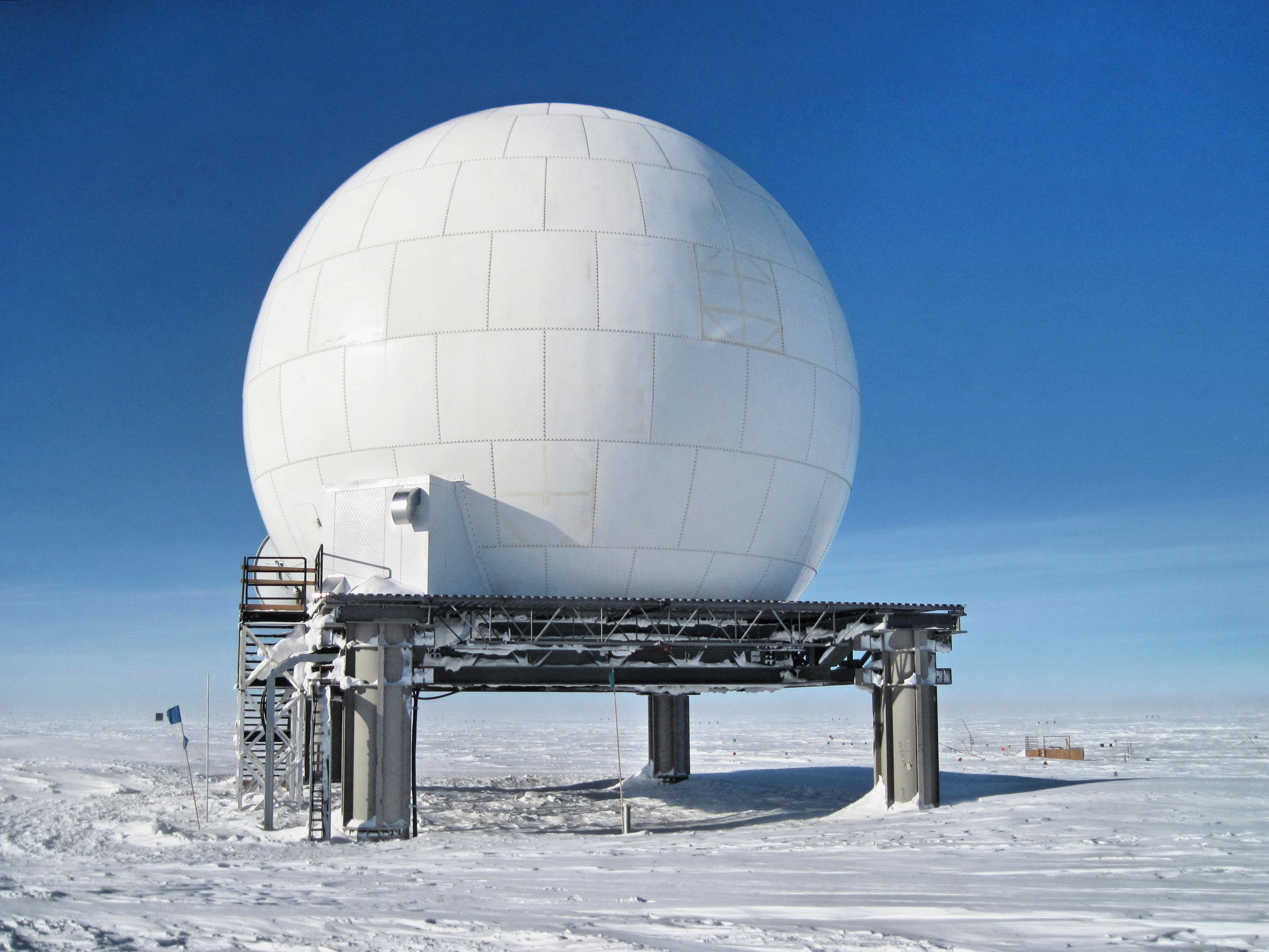
McMurdo seal!!Boarding the plane to PoleOn the planeAntarctic Mountain RangePassengers on the flightA few days after arrival, the storm dubbed "Deathclaw" hit--we decided to go out to the Ceremonial Pole for a photoshootKiell and Daniel at the South PoleAw.Driving the LMC out to the Remote Facilities--the SPTR shack, where half of our internet livesGOES, the other half of the internet
Daniel taking a photo on our walk back to bed one night
Snow Mountain right between the station and Summer Camp, ready to be movedContemplating a small snow pile and track loader
From McMurdo, we flew to South Pole Station in a C-130 military plane, a deep gray monster machine, passengers lined up along the walls stuffed in in our ECW gear, slouched on the industrial webbing cot-like seats. Our carry on luggage, mostly in orange issue duffel bags, was lined up neatly in the center of the plane and strapped down tight for stability; our checked luggage, which we had parted with at Bag Drag the night before our first of many scheduled and canceled flights to Pole, was palletized and loaded into the back of the plane, right where we could see it. Because of the noise from the engines, everyone wore earplugs, making conversation strained. Most of us read or slept, people sinking into their parkas and nearly disappearing for a few hours.
We landed smoothly, about three and a half hours later, some thousand miles South and nine thousand feet higher, greeted by a bitterly cold, dry wind and a bundled up welcoming committee standing off to the side of the ski-way; all you could see was red parkas, white snow, metallic blue-gray buildings, sky-blue sky. Many of our managers were there to meet us, including mine, although I had to be reintroduced to him later that evening since both of our faces were entirely obscured by polar fleece and snow goggles. We carried our bags across the ski-way and towards Destination Alpha, essentially the well-dressed front door to the station. We were heaving and breathing hard by the time we reached the stairs leading up to the station (which is elevated to prevent it from being buried in snow drifts) due to our added gear weight and the altitude. The galley had saved us dinner, and after a brief orientation we ate, explored the building that would be our home for the next four months, and made the first quarter mile trek to Summer Camp.
Summer Camp is a grouping of about a dozen Jamesways on a slightly elevated ice platform, olive drab war issue tents about twelve feet tall and forty feet deep, each with plywood partitions between the little rooms, and plywood or curtain doors separating the twelve beds from the very dark hallway through the center. Daniel and I got rooms 1 and 3 in the same Jamesway, which we were relieved to discover is a double—not only do we get to share a room, but we get twice as much space. The room came with a plywood wall and a door with a latch, two tall shelves, two twin mattresses with twin sheet sets, a princess-castle-frog themed bolt of fabric for decoration, a string Christmas lights, a carpet patched together of sample sized rectangles, a crusty homemade snow globe that appears to depict the Pole and station, and, unfortunately, a previous resident’s plastic water bottle labeled “pee.” Some people who live in Summer Camp (and some very, very lazy souls who live on station) use jars to pee in so that they don’t have to leave their rooms at night; I guess this makes sense as you have to go outside and face the cold and the bright sun to get to the Summer Camp bathrooms, but it’s not a practice we partake in. It’s really not that bad going outside, especially now that we’re acclimated to the temperature; I can go outside in just long underwear, boots and sunglasses without getting too cold.
Within the first few days of arrival, we experienced the full gamut of weather. From -40 degrees Fahrenheit with a -60 windchill when we arrived, the temperature dropped to -50 with a -80 windchill, and within a few days an unusual storm blew in, warming the air to -11 but blasting us with 30 knot winds for nearly a week and covering the sun with a heavy haze of blowing ice crystals. This made Summer Camp invisible from the station, transformed the walk to the station into an aerobic fight every morning, and prevented all incoming and outgoing flights, about 6 a day, leaving Pole winterovers stranded here and incoming Polies at McMurdo Station. Part of my work before the storm was to help install lines of red flags from the station to some of the remote science facilities and to Summer Camp; we also ran guide ropes from the station to Summer Camp to prevent people from losing their way.
The drifts from the storm were enormous, and all old ice crystals rather than fresh snow. One morning I spent four hours shoveling out the inside of the big bay doors at the Vehicle Maintenance Facility (where I spend most of my time), dense snow drifts up to my armpits. The outside of the door was considerably worse, with fifteen foot drifts blocking some doorways. The plows can only get so close to the building, leaving some intense shoveling for the GAs (General Assistants—that’s me). The heavy vehicle operators plowed for days, clearing out the “bowl” that the VMF is nestled inside of; its metal arch encasing used to be on top of the ice years ago when it was built, but has been slowly buried and now has a somewhat cavernous entryway. The tractors waltzed around each other, one pulling backwards into the bay doors of the VMF while another slid up alongside the front side of the building, pushing snow into its pathway, then backing up while the first vehicle pushed the pile up the bowl hill to sit on the “ground” level until it could be taken care of at a later date.
This post is photoless because we have been having some major satellite failures and I have very little access to internet. I hope to get some pictures up soon.
This particular brand of anticipation is different than I had expected when I first considered applying for a job with the Antarctic program. It’s a blend of excitement, ordinariness and relief—that I got a job at the South Pole, that I don’t have to spend another winter without my partner, that Daniel and I will be working at the same station. It seems so routine and normalized after his season that one would be going to Antarctica for a job that sometimes I forget about what an incredible, unique thing it really is.
This July, I got a call from the manager who interviewed and hired me as an alternate for the General Assistant position for last year’s season, asking me a few questions, making sure I was still interested, and letting me know that he would hold a place for me if my other interviews didn’t pan out. A few weeks later, I got a quiet offer letter by email, which I signed and faxed back. It seemed so anticlimactic after all the stress, excitement and anguish of the application process in early 2009—but easy enough that it feels a little bit like I didn’t work my ass off for it, which I did. And now that deployment is here, only days away, it feels like it isn’t happening, which it is. And I can’t wait.
















 brown paper blue ink