The end of the season at South Pole went by so fast, it felt like it barely happened. From New Years Eve onward, everyone started talking about their upcoming off-ice plans and job applications for next year—that is, if they planned to come back. It was pretty difficult to focus on work and still plan for travel, and coupled with the cumulative exhaustion from altitude, lack of fresh food, dryness of the air, dropping temperatures with the onset of winter, and simply having a physically demanding job, I started to slow down a lot.
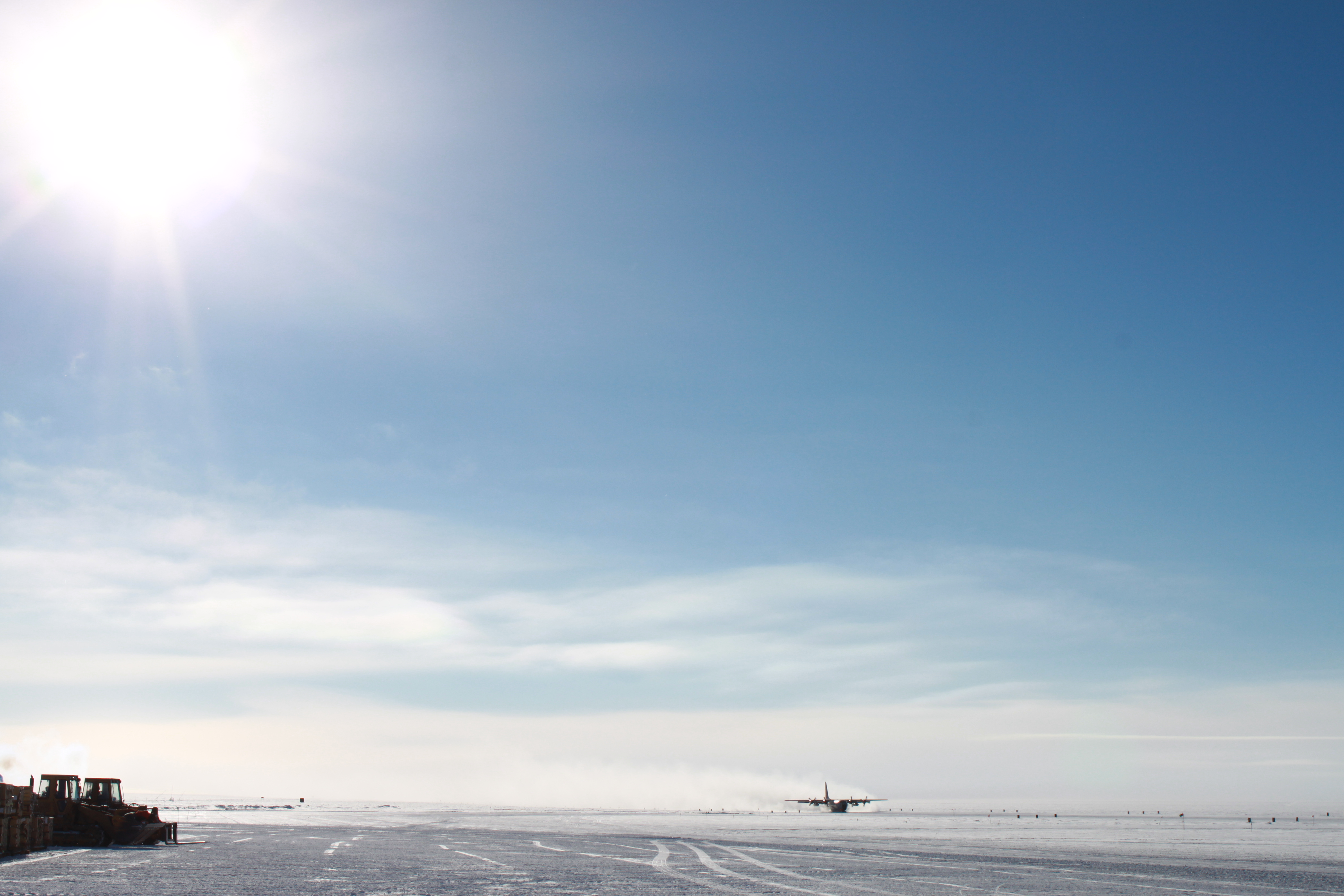
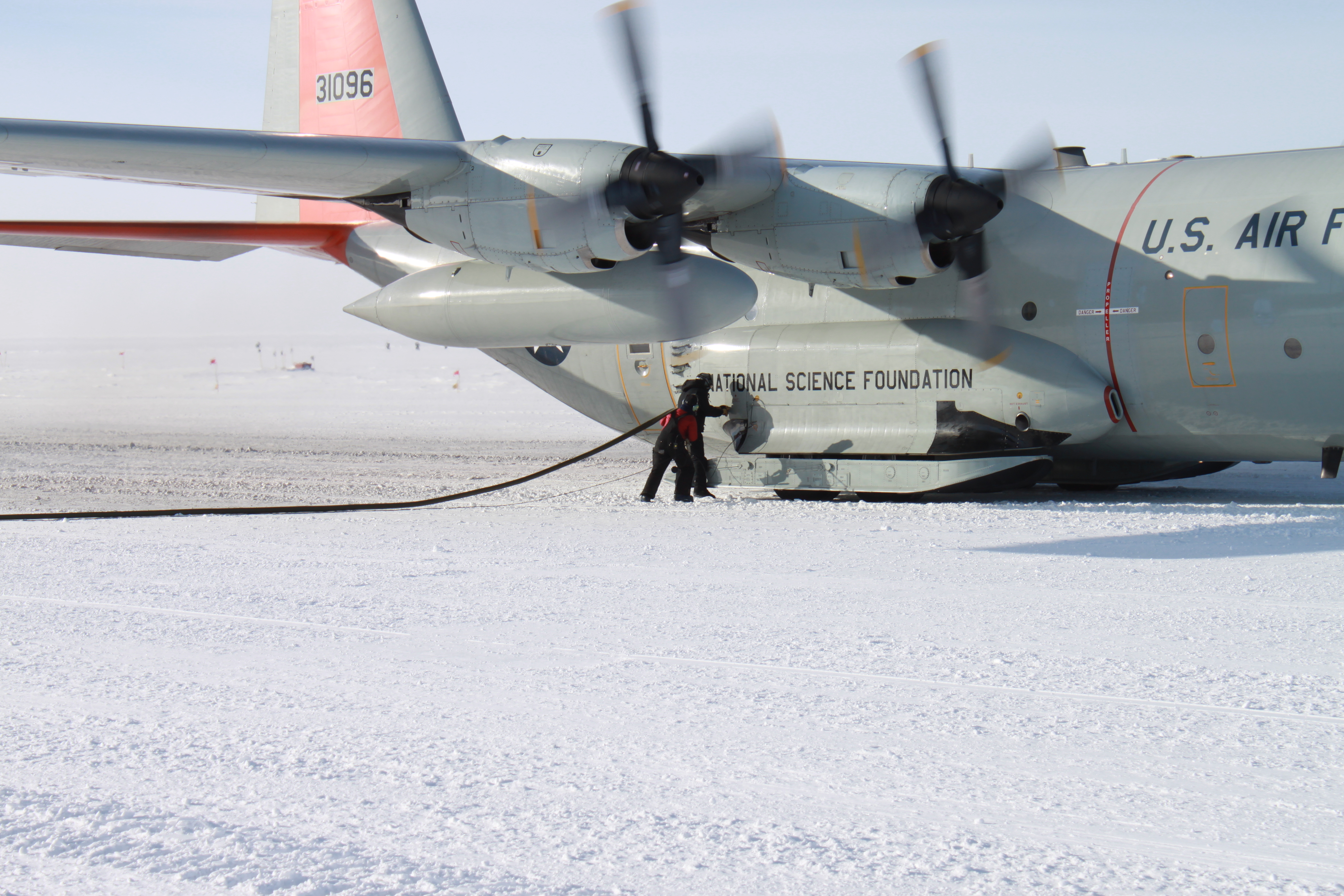
In one of my last weeks at Pole, I got to be a stand-in full time Fuelie, something I had been doing on and off throughout the season. I walked the full fuel line that runs from the flight deck where all of the fuel is offloaded from aircraft, all along the front of the station by the geographic and ceremonial poles, down through the fuel arch that extends out under the station, and the lines that run up to the Power Plant and vehicle fueling module. I performed fuel testing and helped fuel Baslers and Twin Otters. I landed LC-130s and helped defuel them, walking the heavy hose up under the wing of the aircraft in the fine line between the exhaust and the powerful propeller, so loud you can barely hear the communications on the soundproof headsets.
Fuel for testing
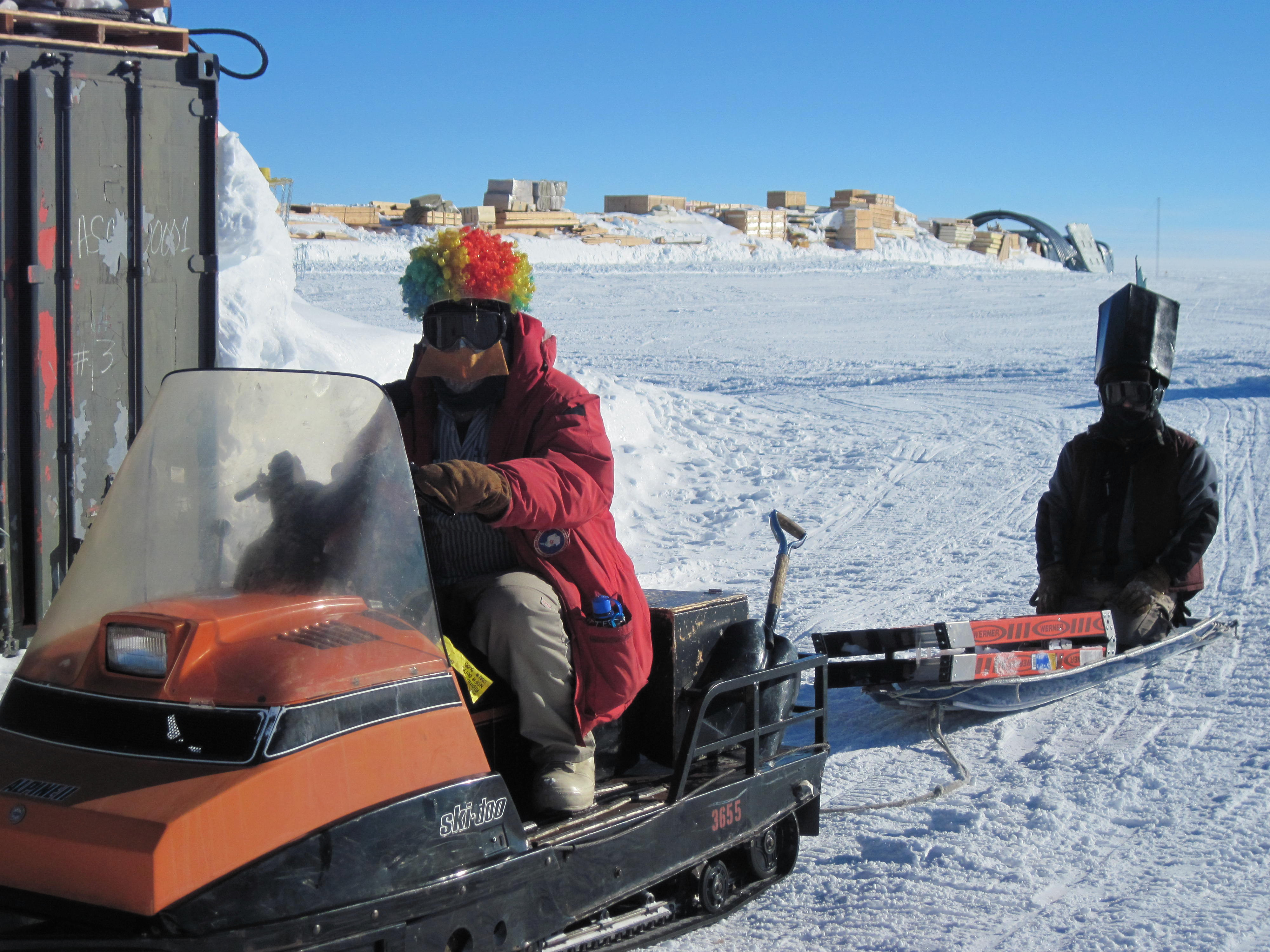
I’m not generally excited about airplanes, but at Pole for some reason I felt this little-boy awe and excitement at each first visual, landing, and during takeoff. But my favorite thing about working with Fuels was checking the skiway every morning to ensure it was safe for the day’s aircraft to land—riding the snowmobile a few miles out and looking for debris and downed runway flags. On a clear day I could see the endless horizon, the sun reflecting brightly off the windpolished snow, the station far, far away. And on a windy day I couldn’t see the station and my radio wouldn’t work because of the distance, and despite the reassuring rumble of the snowmobile, handles warm and vibrating under my frozen thumbs, I got a little glimpse of the frozen, barren wasteland I’ve heard so much about, stepped foot on, lived in, but so rarely saw.
Some of my favorite things from the end of the season:
-Discovering the sauna, relishing the hot, moist air and diffusion of prickly eucalyptus oil. Seeing skin (a fairly rare sight, bundled as people normally are), red-light illuminated legs and sweat and frizzy hair. We overheated and went out on the deck outside, steaming and looking at the ice.
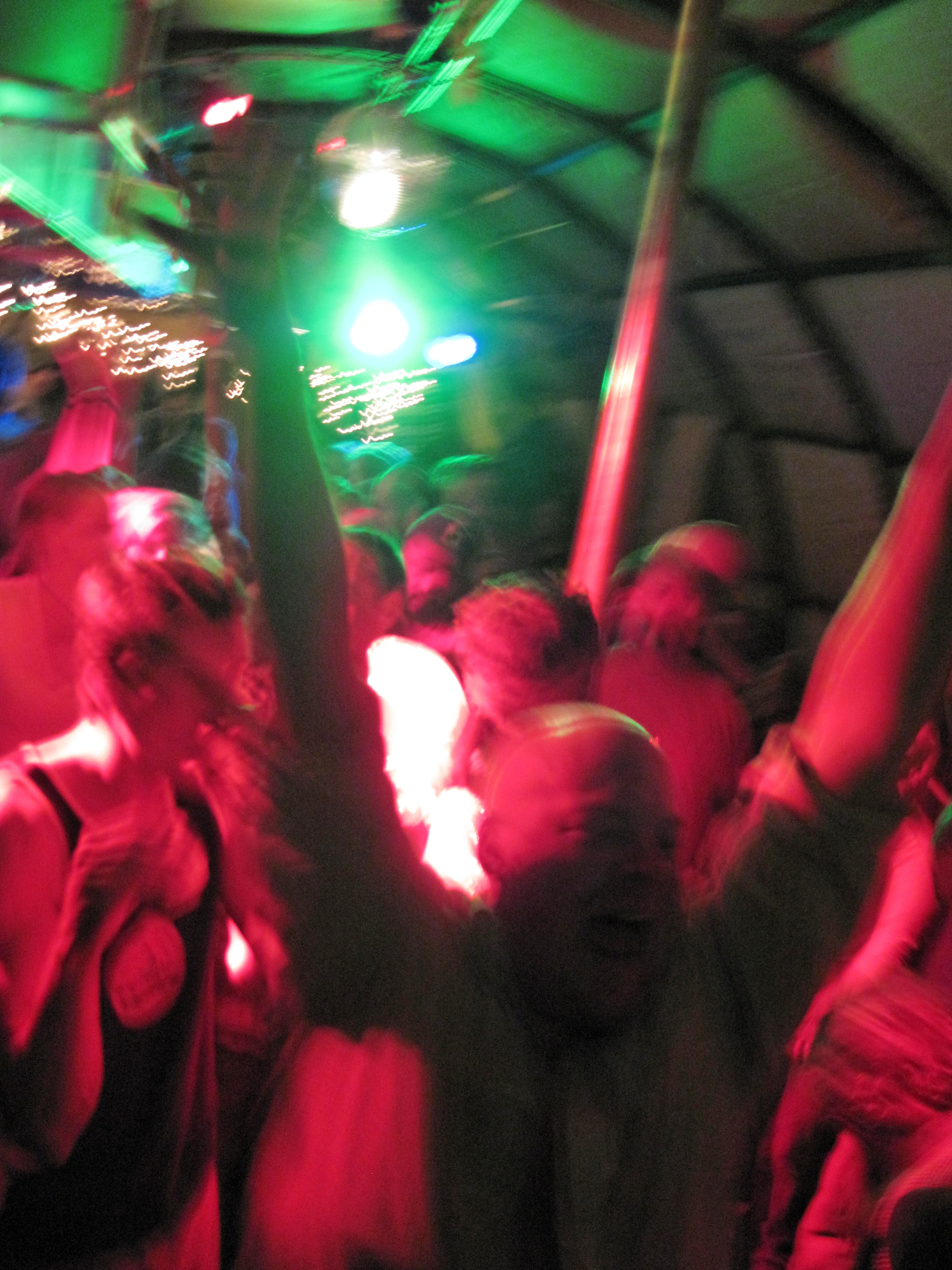
-On a late-season manager cook day I did dishes with my friends Rachel and Joselyn (work order scheduler and greenhouse tech, respectively), playing music from the world cup and dancing in elbow-high rubber gloves to the lights of a whirly double dicso ball, pata-pata-ing and proving my theory that you can polka to anything.
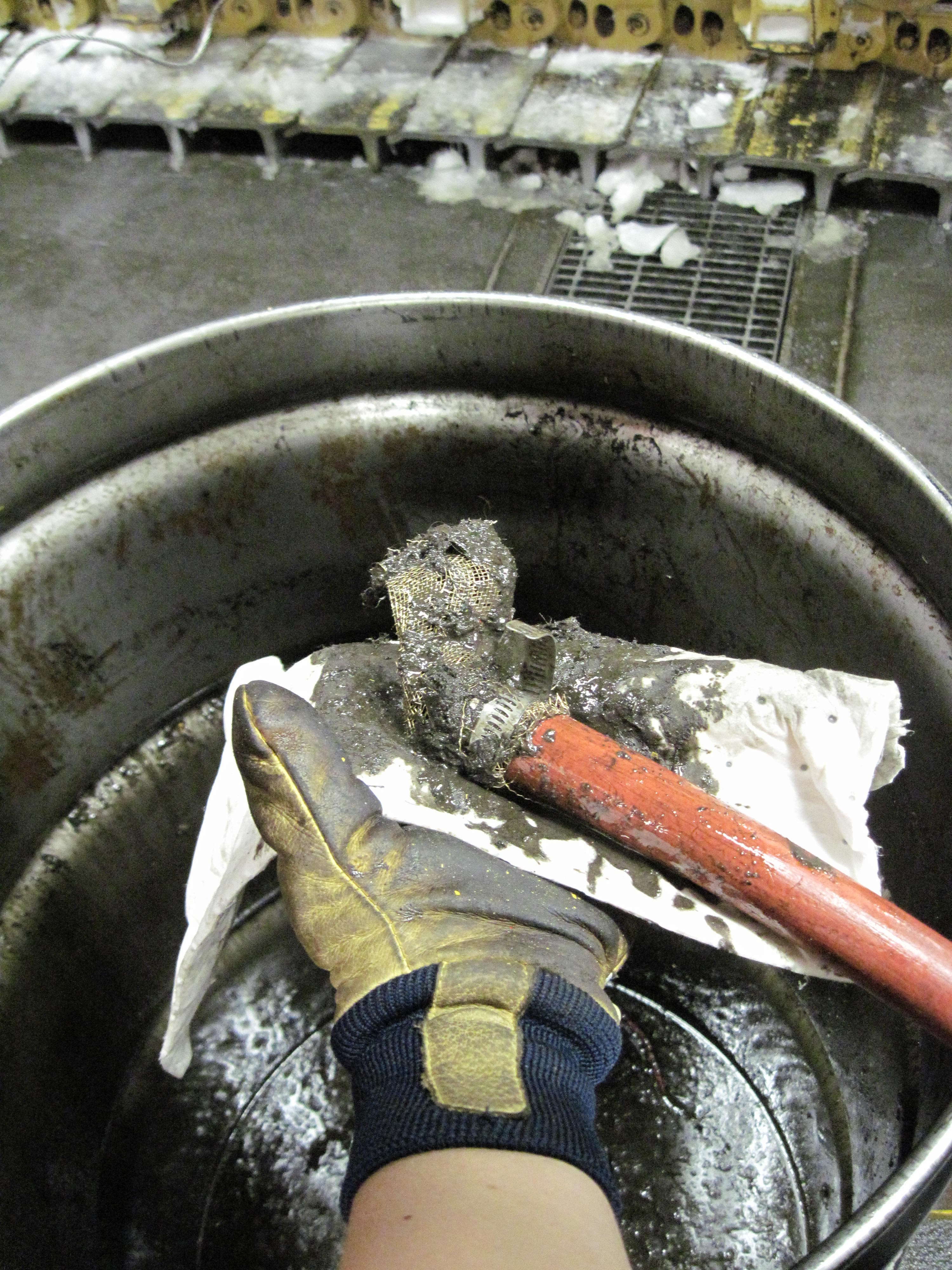
-The satisfaction of taking that damn pump apart and finally, for once, finding some really obvious blockages, taking them out, and fixing the pump (I’d say once and for all, but that would be a lie).
-Seeing snow, also rare, and feeling a brief, overwhelming, visceral homesickness.
Heavy Shop on the Flight Deck–Kiwi Dave, Rachel, Jim, Dave and me.
On the way home from South Pole, after some very teary goodbyes, during which all the tears froze to our faces, we crossed back over the trans-Antarctic mountains, the first dirt I’d seen in months. Looking out under the plane’s wing, soft dinosaur mountains arching their spines up from oceans of snow, the ice’s surface like elephant skin with eddies and ripples and wrinkles snagging the bottoms of blue and white clouds, without an apparent hurry to get anywhere.
We landed that night in Christchurch, people stripping down to shorts and sandals while still on the plane, groaning with pleasure at the moist air, at the night sky, at the smell of rain and the simple joy of standing up after a long flight.
So, I do want to write a little more soon about the end of the South Pole season and what we’ve been up to in Christchurch (not much, really), but we have both made it back to New Zealand and some of our friends from Pole have rented a house in Wanaka–we’ll be leaving Christchurch tomorrow morning and camping for a night before meeting up with them.
A few things we’ve been working on in the past few days:
Our trip itinerary. We’re leaving New Zealand March 4th-ish for South Africa, and heading later to Victoria Falls, Tanzania and Zanzibar, Mauritius, Turkey and perhaps a bit of overland travel through Eastern Europe, depending on our energy level and ability to be strict about our budget before that point. This trip would have us landing in Minneapolis in early May. I will post our full itinerary with dates as soon as the tickets go through.
Packing. We really want to do a better job packing this year and we’re bringing our tent and a few other odds and ends for camping that we didn’t have last year. We both have a smallish backpack–mine is a 35Litre framepack and Daniel has a normal backpack–and a messenger bag. We’ve managed to fit the tent inside the backpacks and left the sidebags mostly empty for daytrips and food.
Our “tans”. I got in on Monday night, and we went to Sumner beach the next day (amazingly beautiful, by the way) and promptly got incredibly sunburned. It is now Friday and our skin is starting to fall off.
Obviously, it’s cold and dry. But it isn’t always easy to anticipate all the ways that will affect what you’re doing, in big ways and small. For example, doing inventory or pulling food from frozen storage for the coming week in the Logistics Arch/Office (L.O.), you shouldn’t even bother using a pen: it stops working immediately. For this reason, pencils (especially mechanical pencils) are a hot commodity. Also, there are natural refrigerators everywhere: on the floor, in the windows, on the cargo decks. Meat and ice cream sit out on shelves and on the floor in the L.O. The galley can freeze leftovers on the deck outside. When you work out in the gym in Summer Camp and then walk over to the bathrooms, your whole body steams, hands, feet, armpits, the top of your head. When you shower and walk back to the Jamesway, your hair freezes instantaneously.
The water restrictions:
Two minute showers, twice a week, except for certain dirty or stinky jobs (like Fuels—who get three). It’s starting to get to me, the perma-filth from the VMF. The other day I was washing my feet, leaning up against the shower wall, and I left a greasy-grey smear behind from my elbow that I couldn’t clean up, even with degreaser. When I get to Christchurch I’m taking an hour-long shower.
The food:
I have to hand it to the kitchen, they do a good job with what they have. But because of the extended supply chain, a lot of the food has been frozen on the berms for years, and it doesn’t always age well. And because the LO where the food is stored is right next to the VMF, it sometimes absorbs the exhaust. A lot. Bacon, for example, is something I have learned not to ever eat here. Pickles are so dehydrated that they’re literally paper-thin except for the ring of skin around the edge. And fresh vegetables are uncommon. When they come, you gorge. I don’t envy the kitchen’s job. It’s hard enough pleasing everyone (impossible, actually), and compounded by limited ingredients.
The internet:
Sucks, period. At this point it’s only up before I wake up in the morning and when I’m working. I depend on it for relaxation a lot more than I ever thought, and I can’t have it, and it’s frustrating.
The gossip culture:
Once you get over the honeymoon of being here, taking your picture at the Pole, commiserating about your Jamesway, and buying some souvenirs, not a lot changes. The one thing that’s always evolving and always interesting is people, for better or or worse. People start dating, stop dating, drink too much, pick a fight, have run-ins with coworkers or neighbors. Close quarters mean you can hear a lot more than you would in a normal residence: fights, sex, vomiting, late-night whispers. And people talk about it, because it’s interesting, and because everybody pretty much knows everybody else. However, it can also be really dangerous and get out of hand really quickly, and you can hurt and lose your friends with a slip of the tongue.
The skua system:
If I could take one thing about Antarctica back to my home community, it would be skua. Named after crafty, aggressive birds closer to the coast, skua is a sharing system for unwanted, but still nice, stuff. Pants don’t fit right? Slight stain or hole? Flying out and you still have a whole bottle of shampoo left? Put it in skua. I have found so many great things in skua: clothing, boots, books, toiletries, craft supplies. It’s like a used-things store, except you don’t have to pay for it. It’s great. It also satisfies a mild shopping urge every now and then, and provides an endless source of material for sewing projects.
House Mouse:
Everyone has to clean the bathroom they use once a week on an assigned date. I think this is a good system because it gives everyone equal accountability and a feeling of responsibility for our public living spaces. Also, you can get out of work for an hour.
The difficulty of not being able to separate work and home life:
This doesn’t really seem like a big deal, but it’s surprising how much I miss things like commuting home (even, sometimes, traffic), going to the grocery store, making dinner, going for a walk, wasting time on the internet, watching TV, or just going to see something different than you always see to decompress from a hard day at work. If someone at work is frustrating you, you’re still going to see them at dinner, in the bathroom, at the store, in the lounge. You run into your boss at your worst: sick, tired, bad attitude days, forgot to brush your teeth on a Sunday days. I imagine the work-social mixedness makes on-ice romance more complicated, new relationships but especially break ups, and especially in the winter (you live with some 45 other people for eight months straight, no breaks, no escaping). On the other hand, it really gives you the opportunity to know people in an in-depth way faster than you ever would working with them for forty hours a week; friendships get sped up to close in a way I really like and I’ve met some people who I hope will be lifelong friends.
…
Michele from Midwest, my old job, asked me if I’m happy I came here, and I am. Despite being homesick and tired, and despite some of the quirkier, more frustrating things about living here, I’ve learned a ton and met some really interesting people who are living a life I have only dreamed of. My New Years resolutions list and my laundry list of minor life goals are growing, and I’m inspired by my coworkers here who can make their lives happen the way they want with on-again-off-again employment, crappy healthcare, patchwork living situations and amazing travel experiences. I still feel really lucky to be here and to be planning the next year out with Daniel. I think the whole thing is summed up pretty well by something I overheard from someone I don’t even know; people were complaining about the food (or the internet or something) and the guy replies, “I’m just happy to be here.” I’m still just happy to be here.
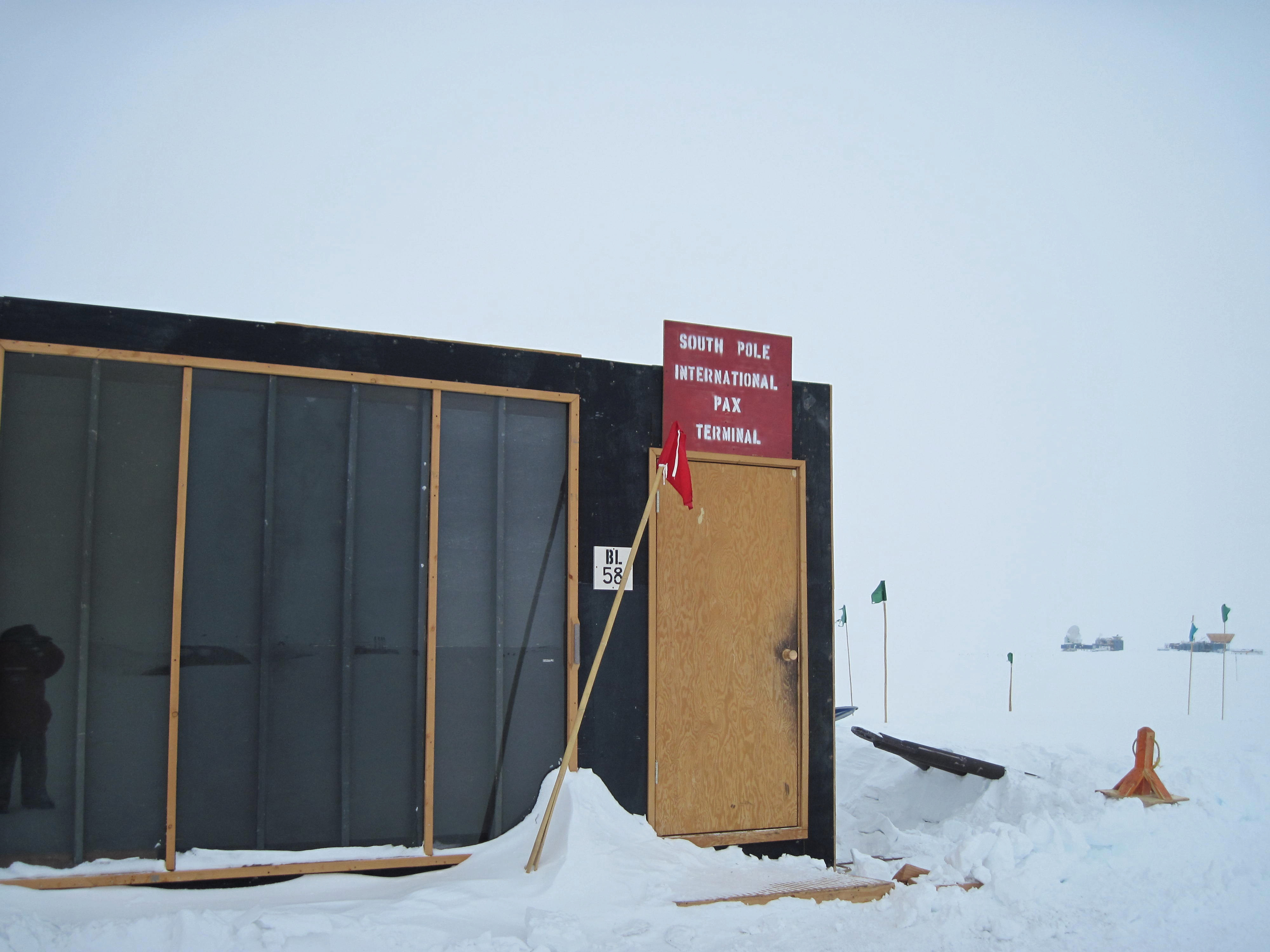
The South Pole International Passenger Terminal/Fuelie warm-up shack.
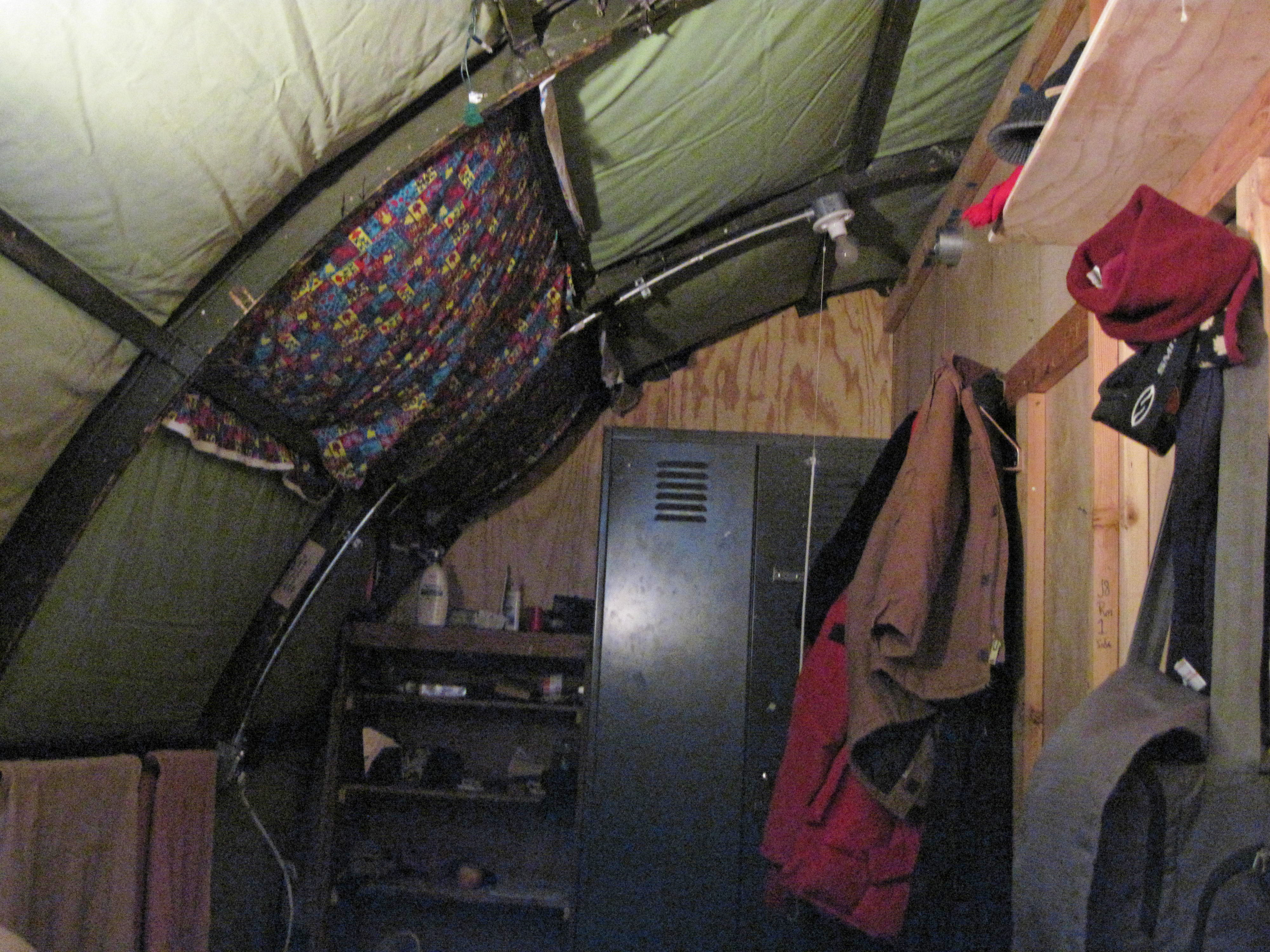
Our room inside Jamesway 8 (taken from the bed).
Icy bolts inside the VMF arch.
Big Country having a cigarette in his undies before bed outside the Jamesways.
Party in Summer Camp lounge.
Ben and Daniel doing dishes on Manager Cook Day.
Trudy Lyn at the Summer Camp open mic night.
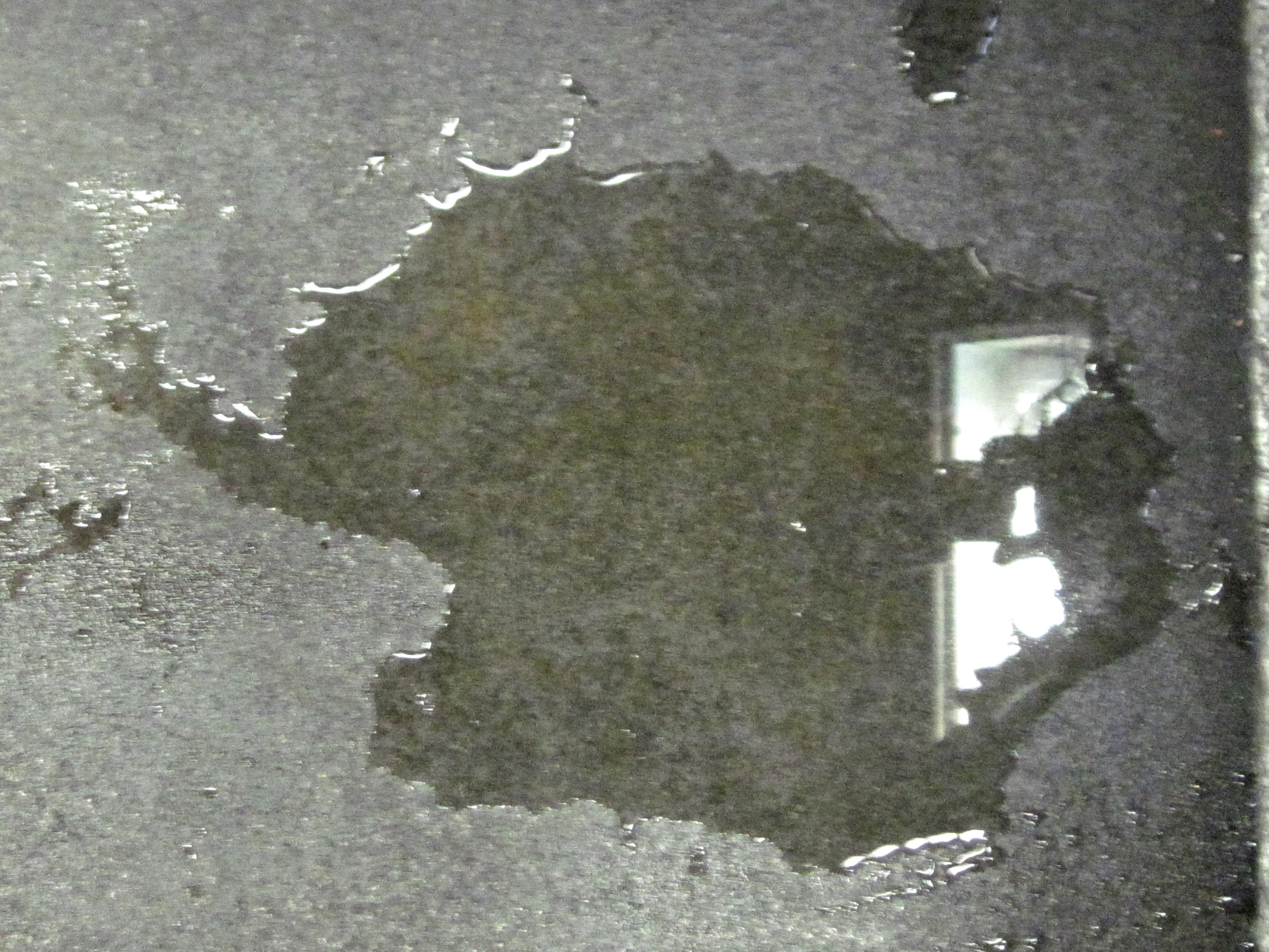
This is a puddle. It looks like Antarctica to me.
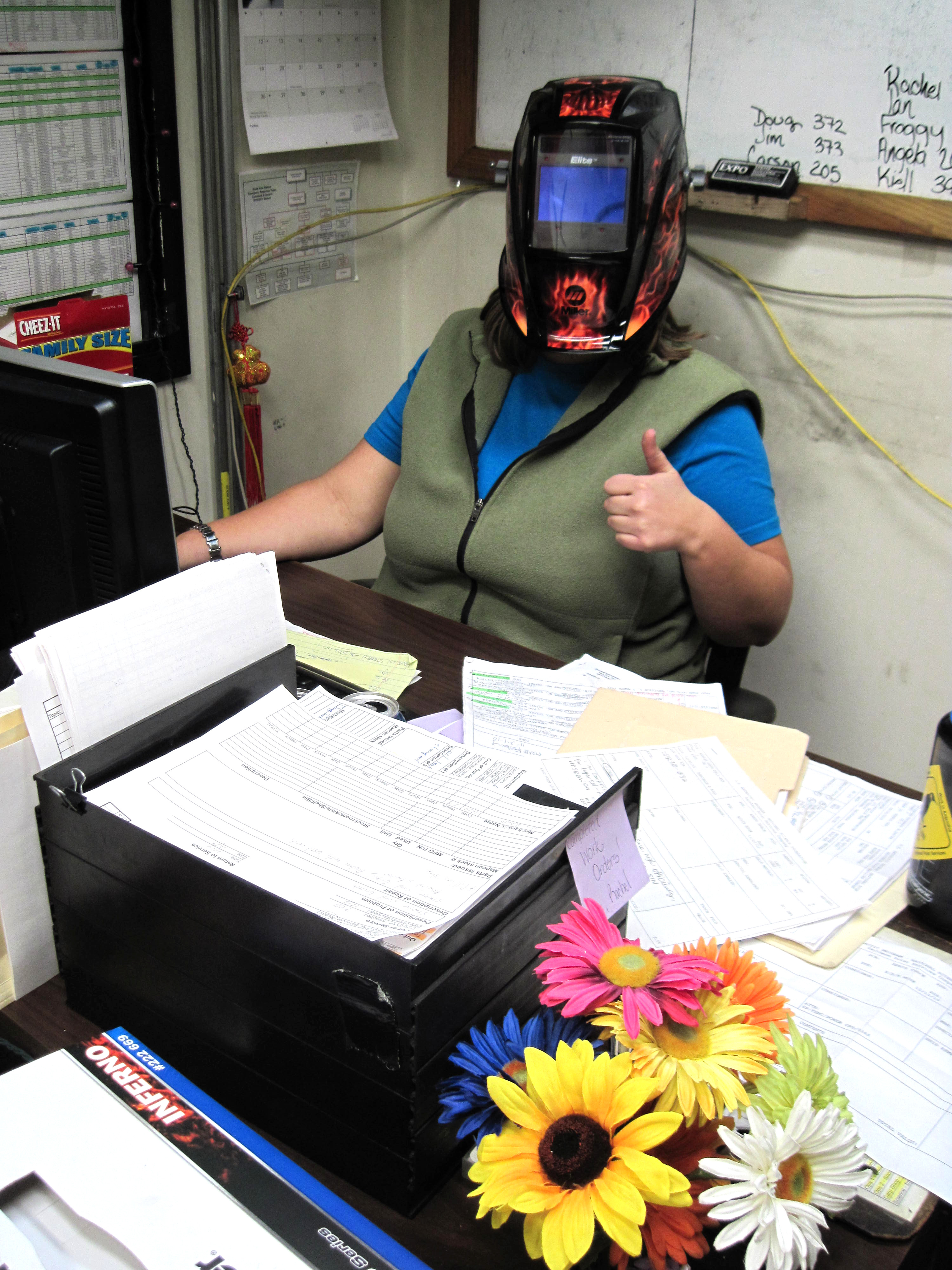
Rachel + new welding helmet + plastic flowers = a normal day in the VMF office.
Playing football at the Carp Shop party.
Playing washers at the Carp Shop party.
The view of the Station, Powerplant Arch and VMF Arch from the Fueling Module.
Plumbers at the Milvans.
Antarctic Research Observatory–Clean Air Sector.
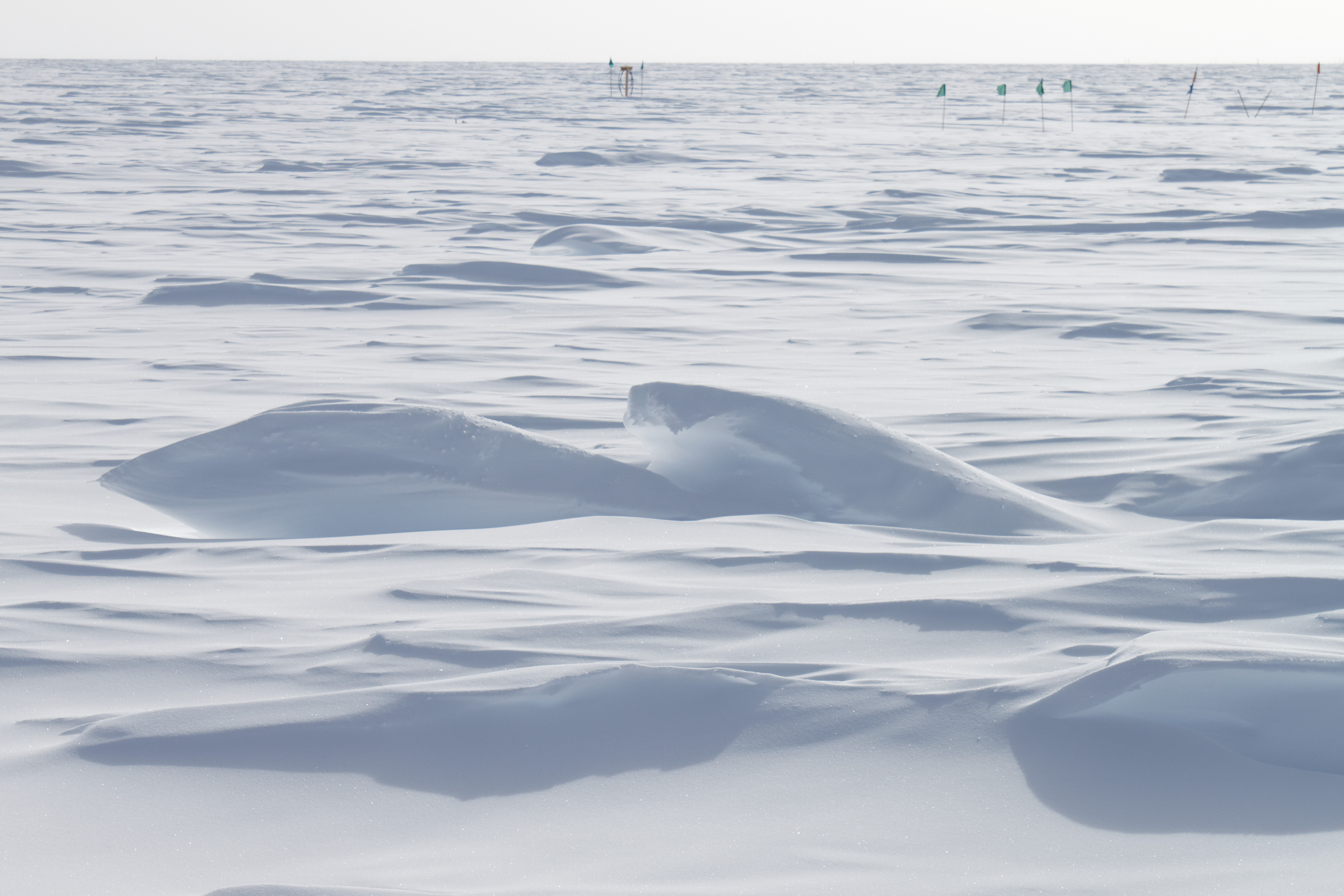
Sastrugi: wind-texturized snow.
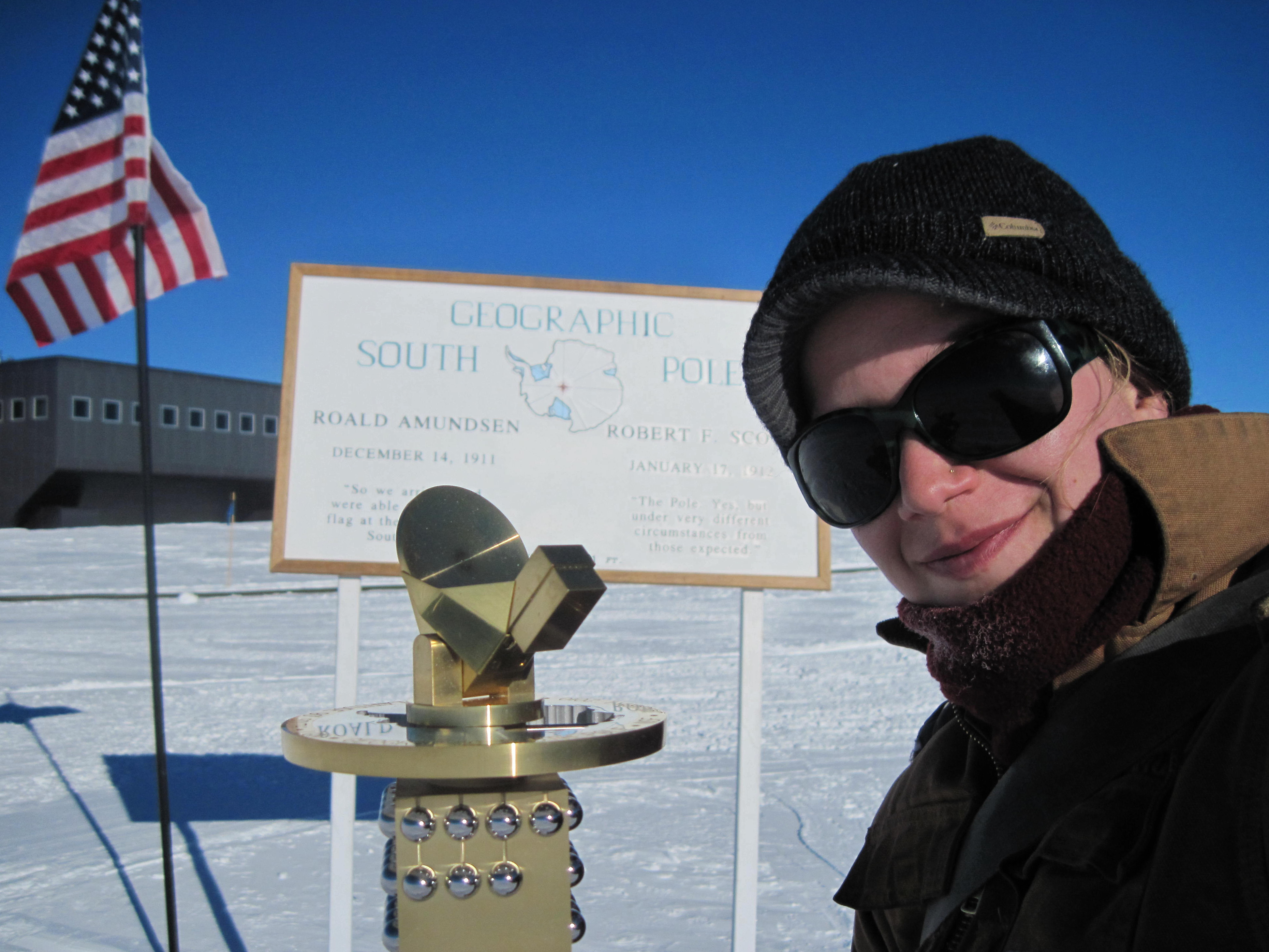
Kiell at the Geographic South Pole.
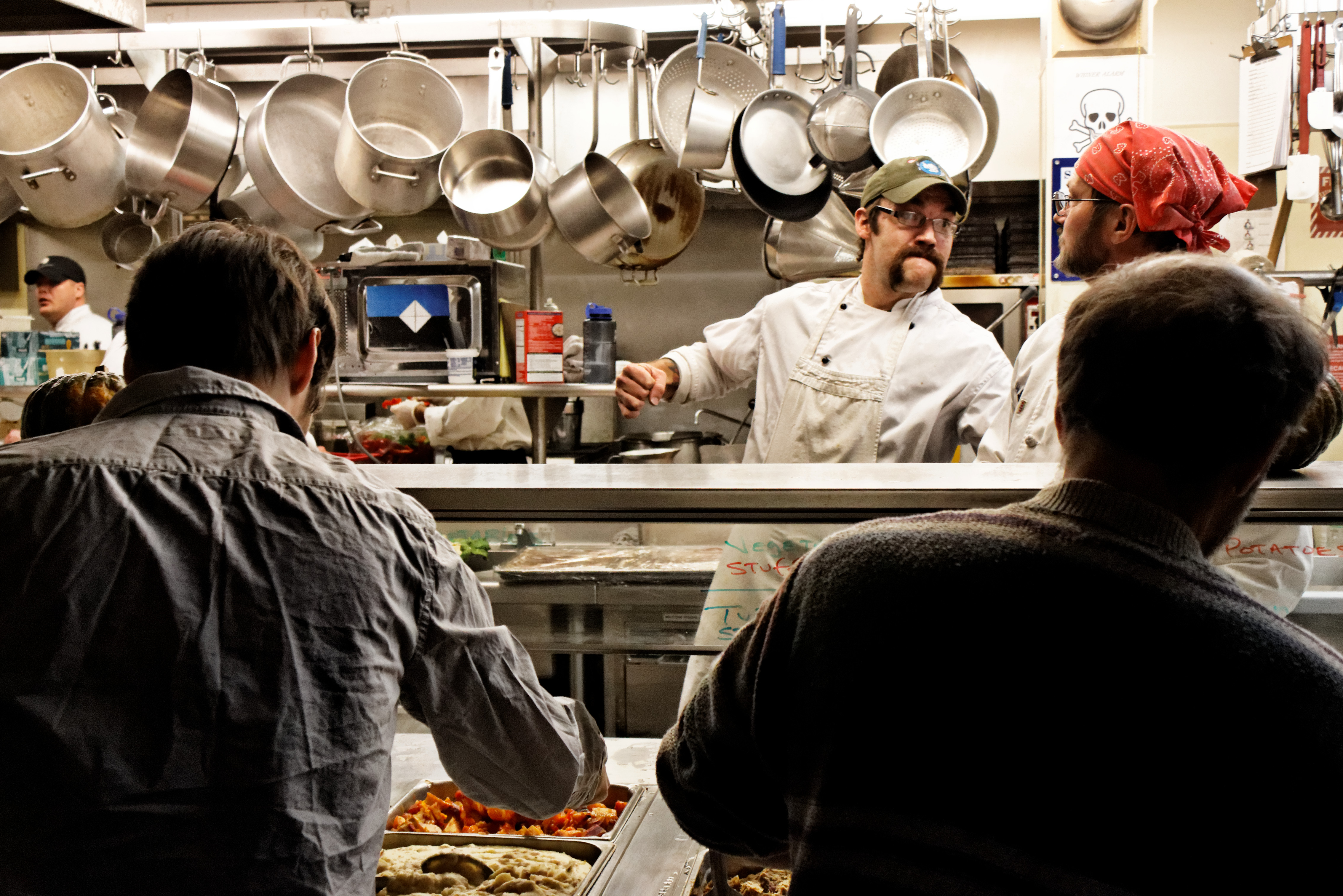
Kitchen shenanigans.
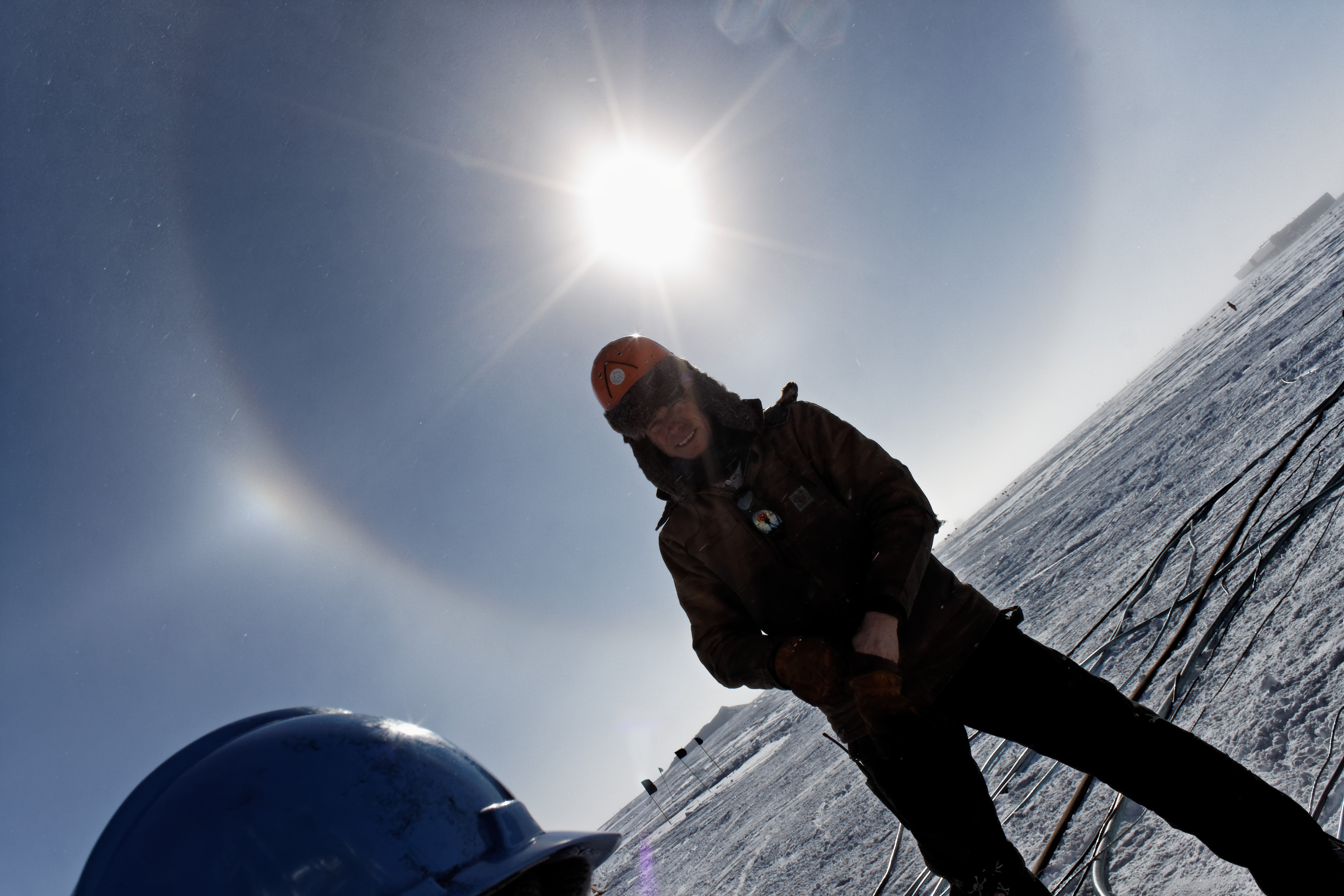
Jim the shop foreman and a sundog.
The incoming South Pole Traverse, the tiny speck right in the middle of this photo. On the left, lines of storage berms and the Remote Satellite Facilities, on the right, the runway.
The view from the End of the World.
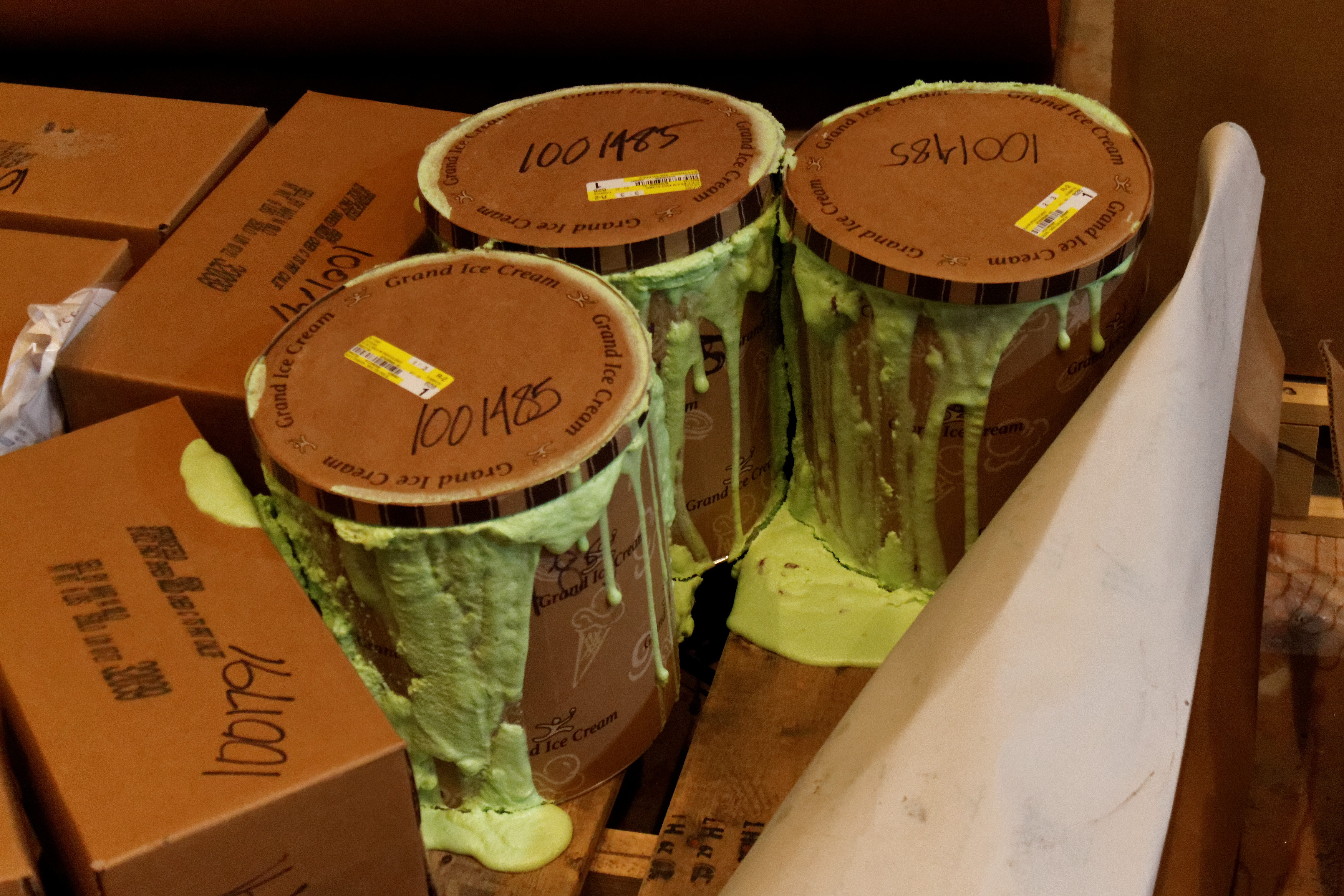
Pistachio ice cream explosion in the LO Arch.
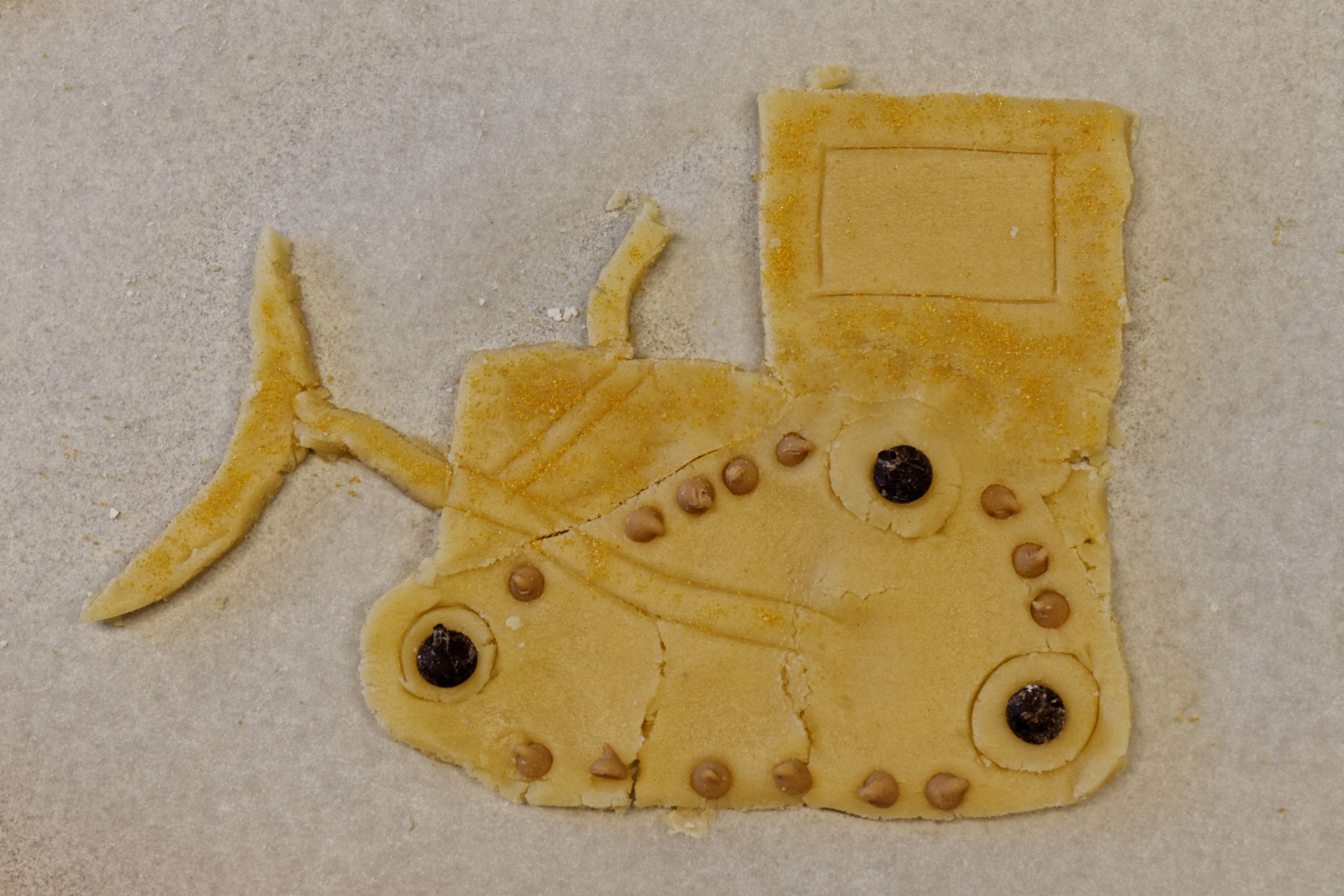
Bulldozer cookie made by Rachel.
Sarra, Kiell and Rachel at the Ceremonial South Pole.
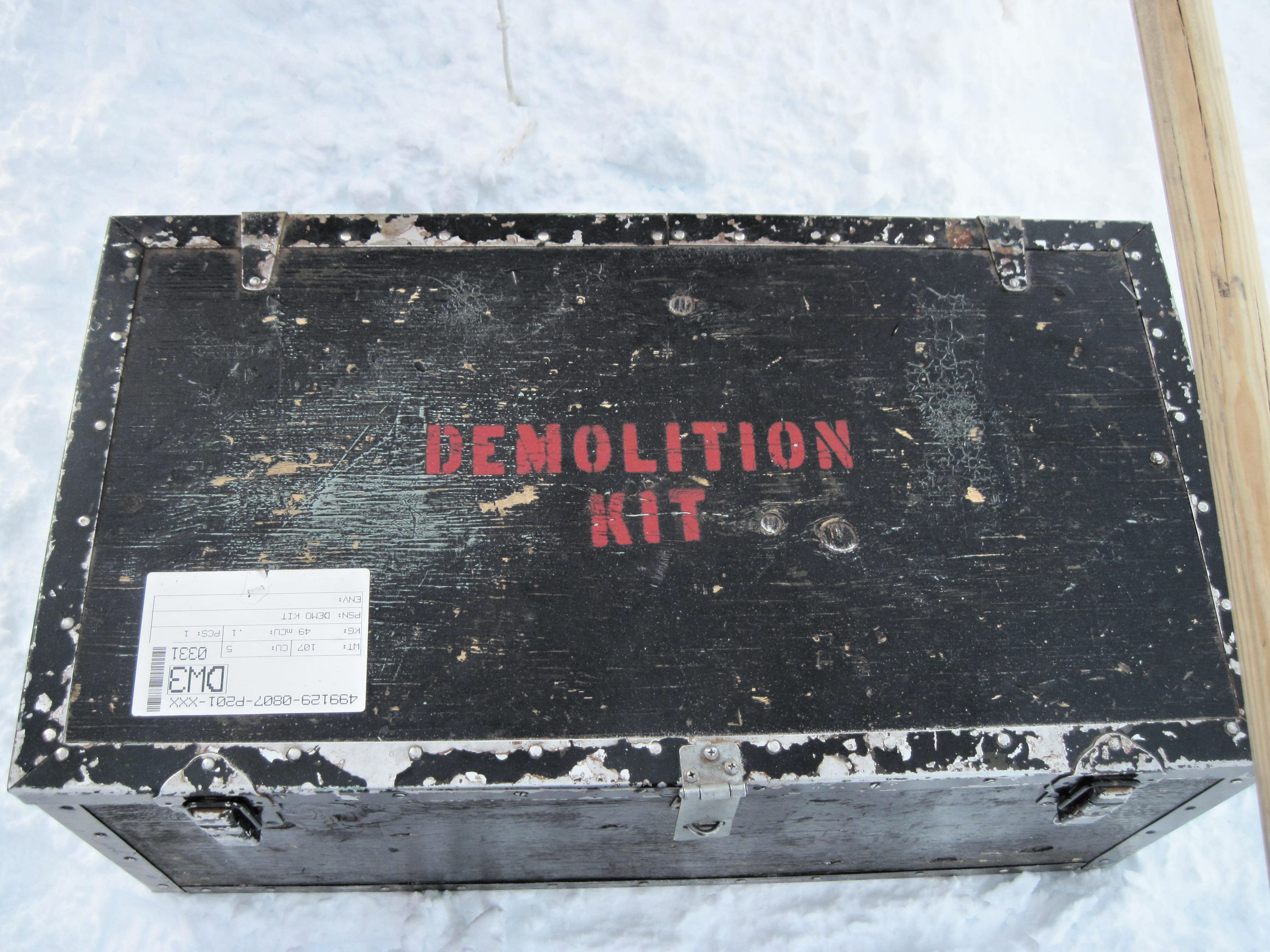
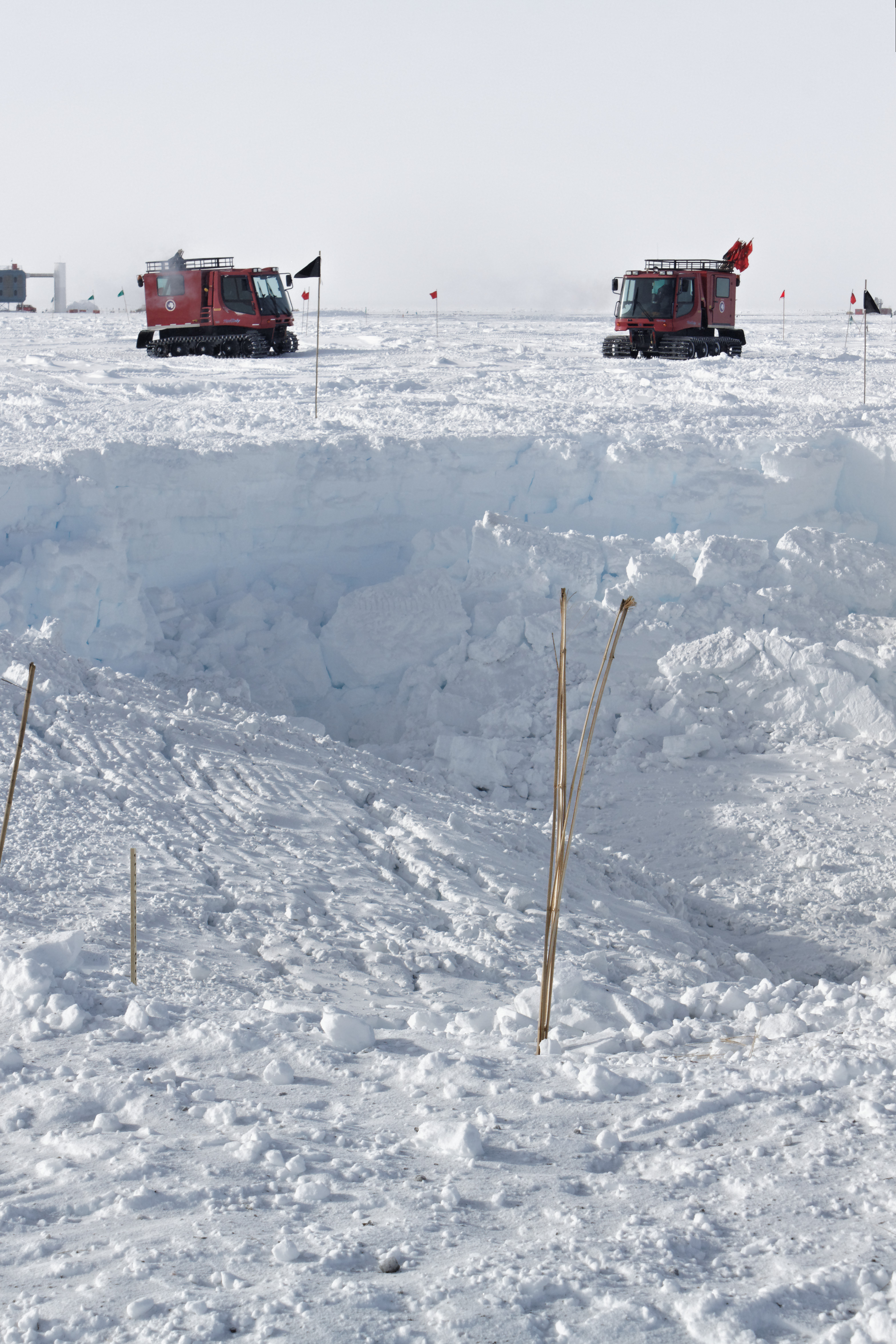
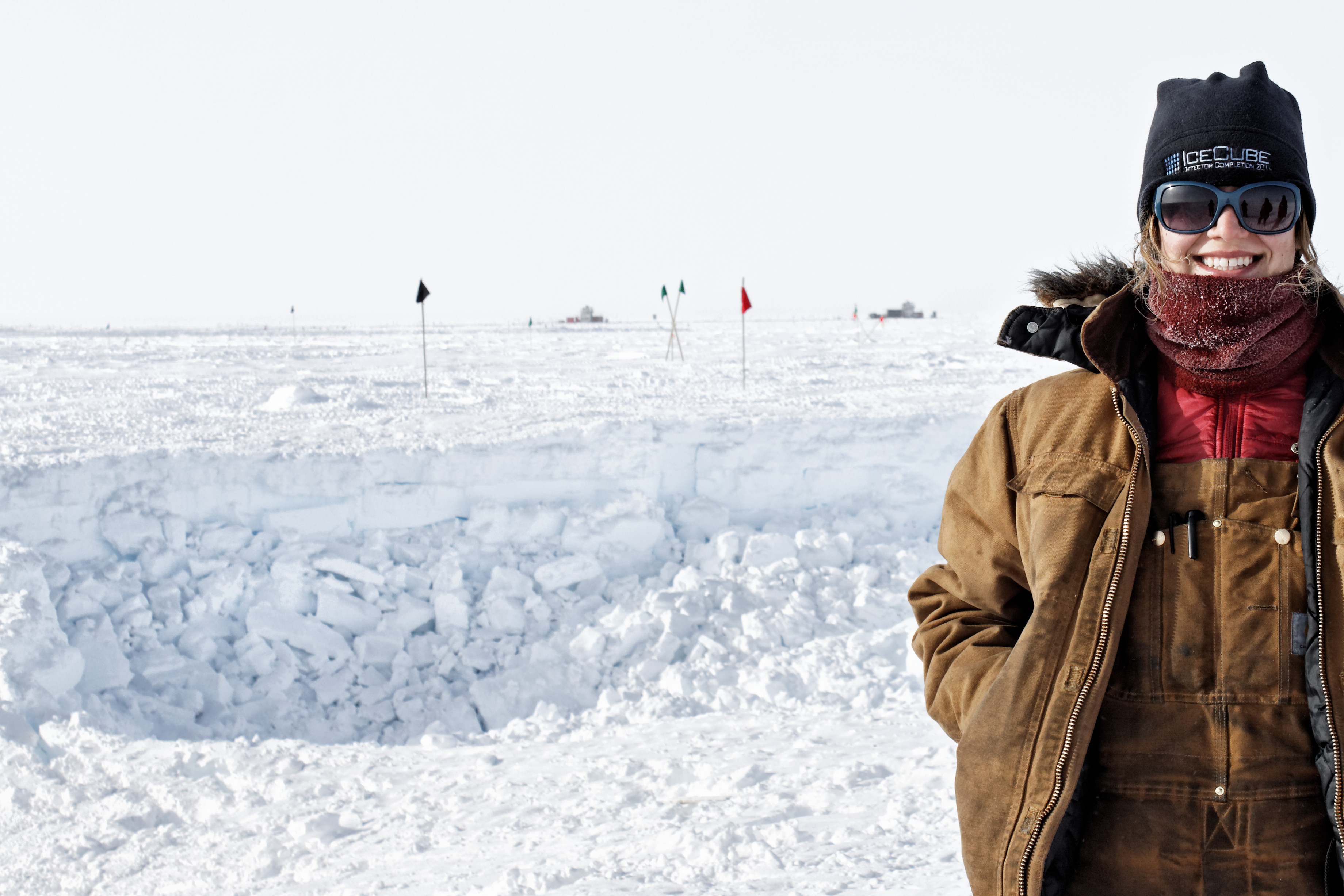
On a windy day in early December, I got to help blow up the South Pole. That morning, a slim band of pale blue sky sat between the white horizon and white clouds, looking really quite pretty from the station. People were getting up from their coffee (dayshift) or cocktails (nightshift) to look out the galley windows, taking pictures, gazing. We took the warm Pisten Bully out past MAPO, past the South Pole Telescope and down a little flagged snow road, pulling up to the snow crater from the first blast just a few days before, the men still smelling like dynamite. We had watched it from Destination Alpha but both Daniel and I, on different levels completely with different cameras, looked away at just the wrong moment and missed the main explosion—the sound arrived some ten seconds later, traveling super-slow through the high altitude air.
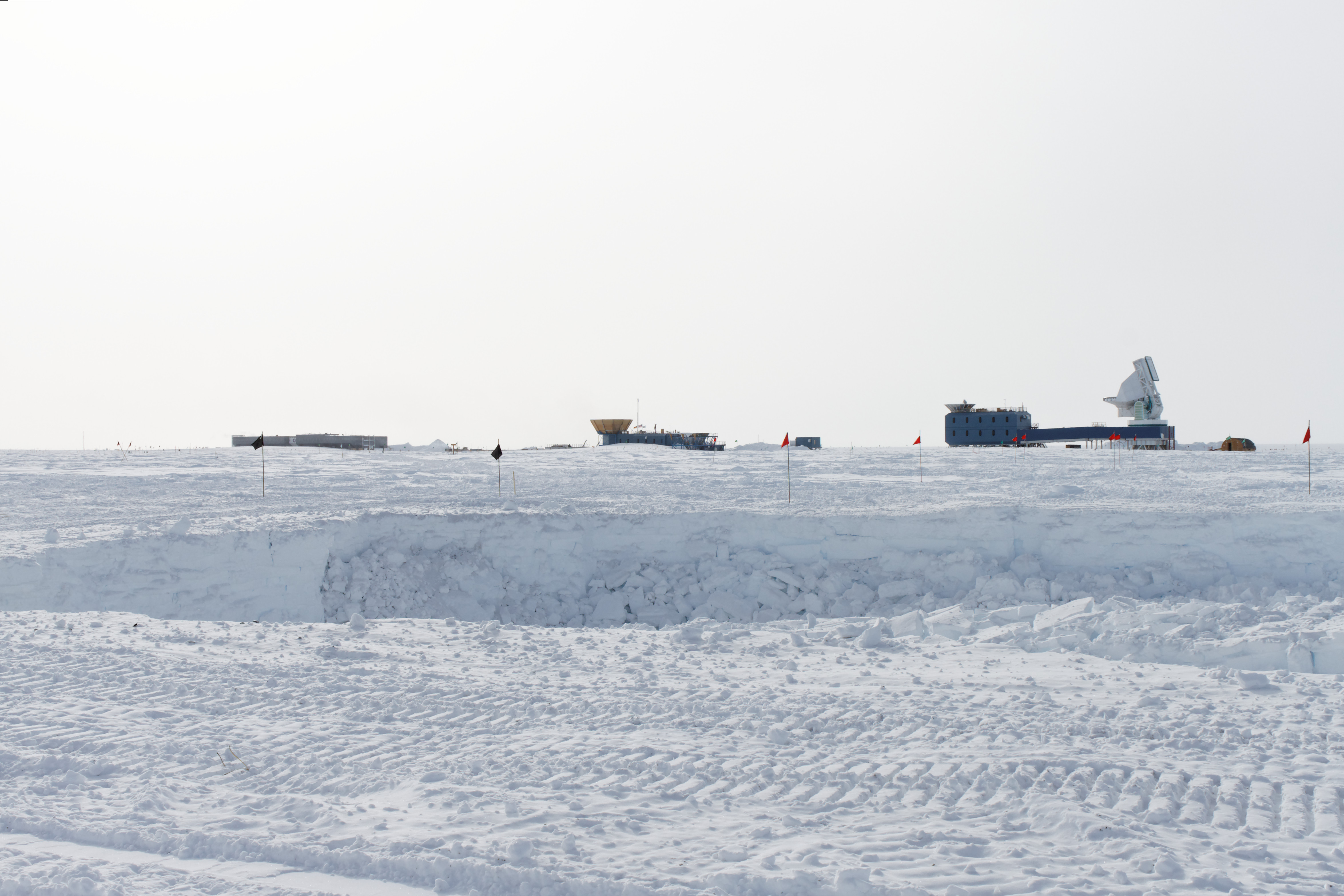
The crater from the first explosion, with the elevated station, MAPO and South Pole Telescope in the background
We started the morning by sorting the packaging from the first blast’s dynamite, digging through and recycling cardboard and greasy looking nitroglycerin-soaked brown paper. A heavy equipment operator brought out a horizontal silo on a sled, a red Wisconsin-Dairy emblazoned piece of farm equipment, 180-degree water sloshing inside of it and shooting out the feed nozzle, instantly transforming into smoky steam streamers.
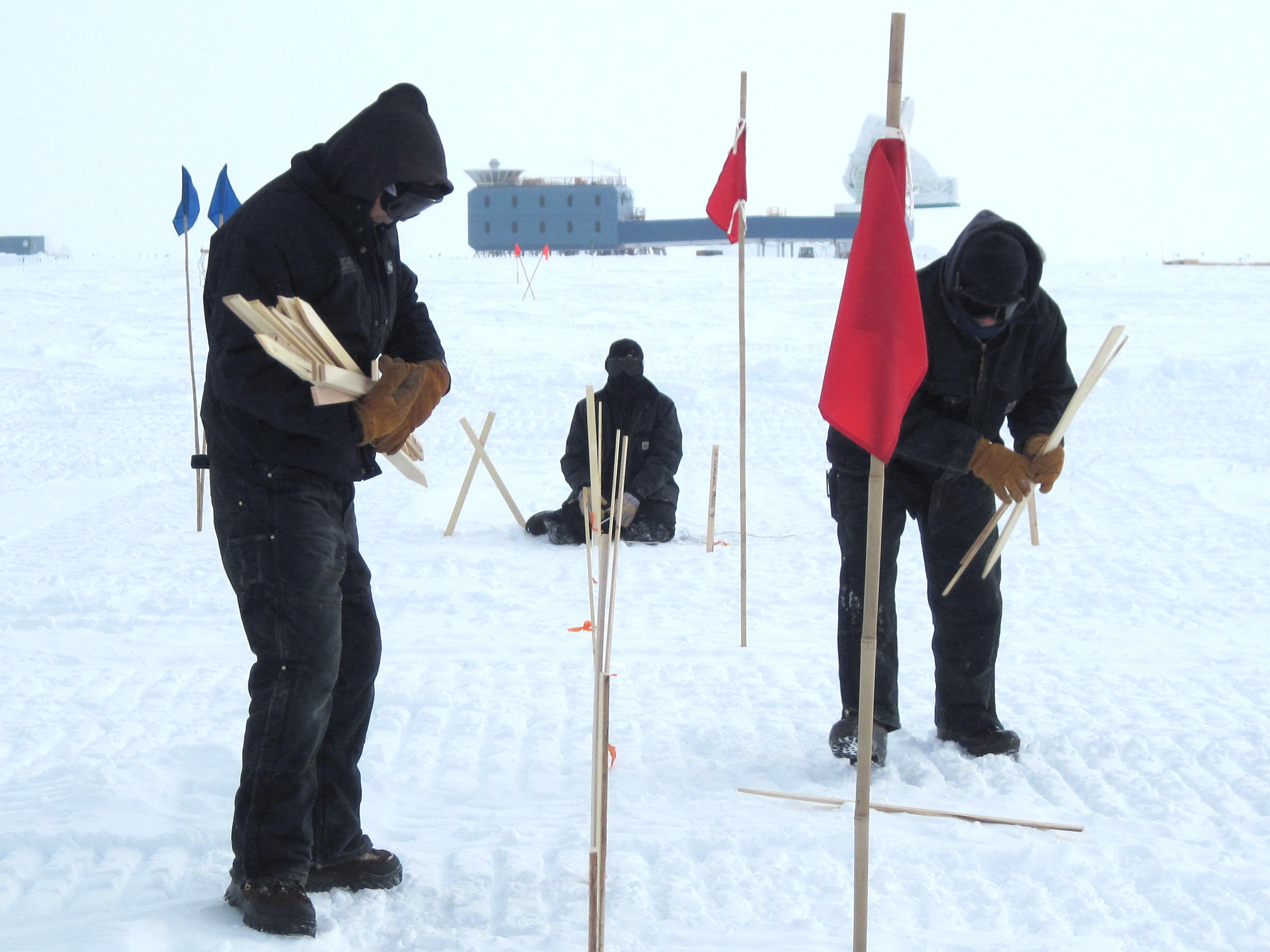
Based on the GPR readings (ground-penetrating radar), the blasters placed stakes along the outer edges of the buildings of the original South Pole Station from the 1950s, now buried under many years of snow drifts, maybe 20 feet below the surface. It was ghostly to walk on top of—knowing that under our feet were open rooms, food left on tables, fuel caches, trash, pee jars and girlie magazine centerfolds plastered on every surface.
Laying stakes
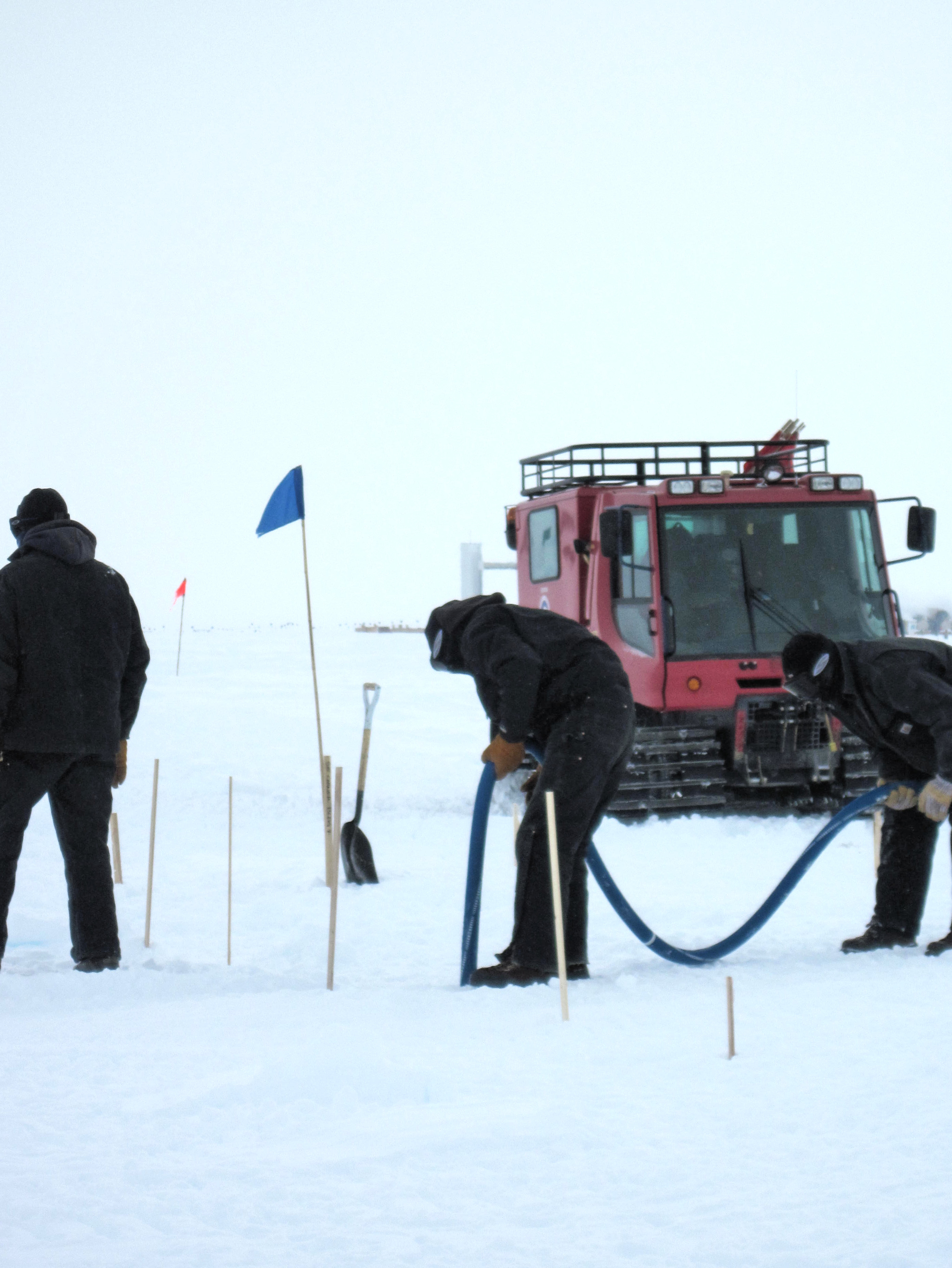
To drill the holes, the blasters would place the flat nozzle of the hose on the surface of the ice and turn the valve at the base of the silo, gravity pushing the water through the hose until a burst of steam came from the far end, the water cutting the ice like a hot knife through butter. The blasters fought with the long hose, full and heavy, until it was positioned to slide straight down aside the buried buildings. When they hit the 25-foot mark (or in some cases, a hollow thud on the roof of a building when the GPR readings had been off—these holes had to be re-drilled) they would turn around and hoist the hose out, three or four of them putting the weight of it on one shoulder and tug-of-warring the hose out of the hole, throwing their whole bodies into the effort. When I helped with this part of the process, my puffy leather work gloves were so icy from water and steam that I couldn’t bend them into any other shape than that of gripping the hose.
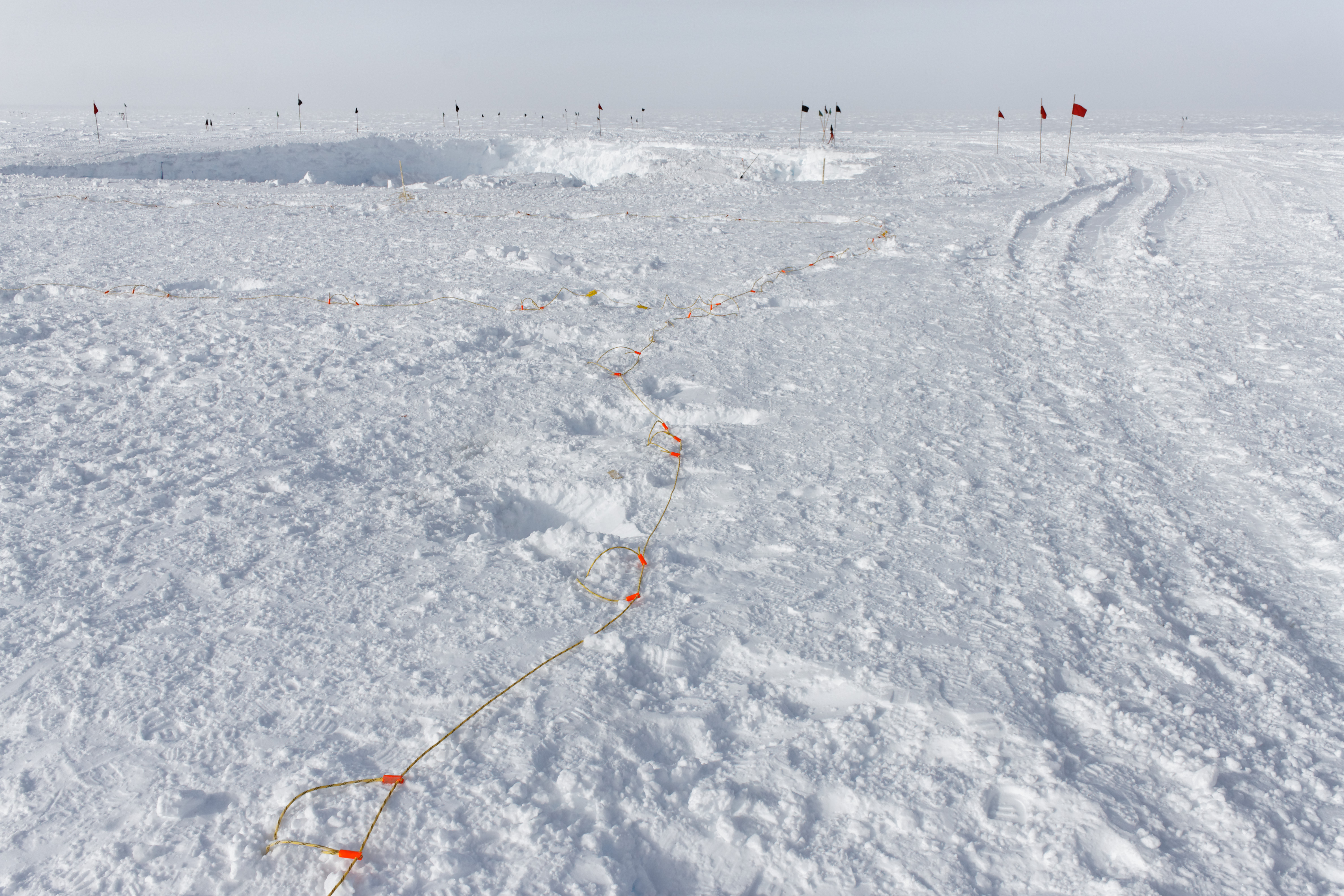
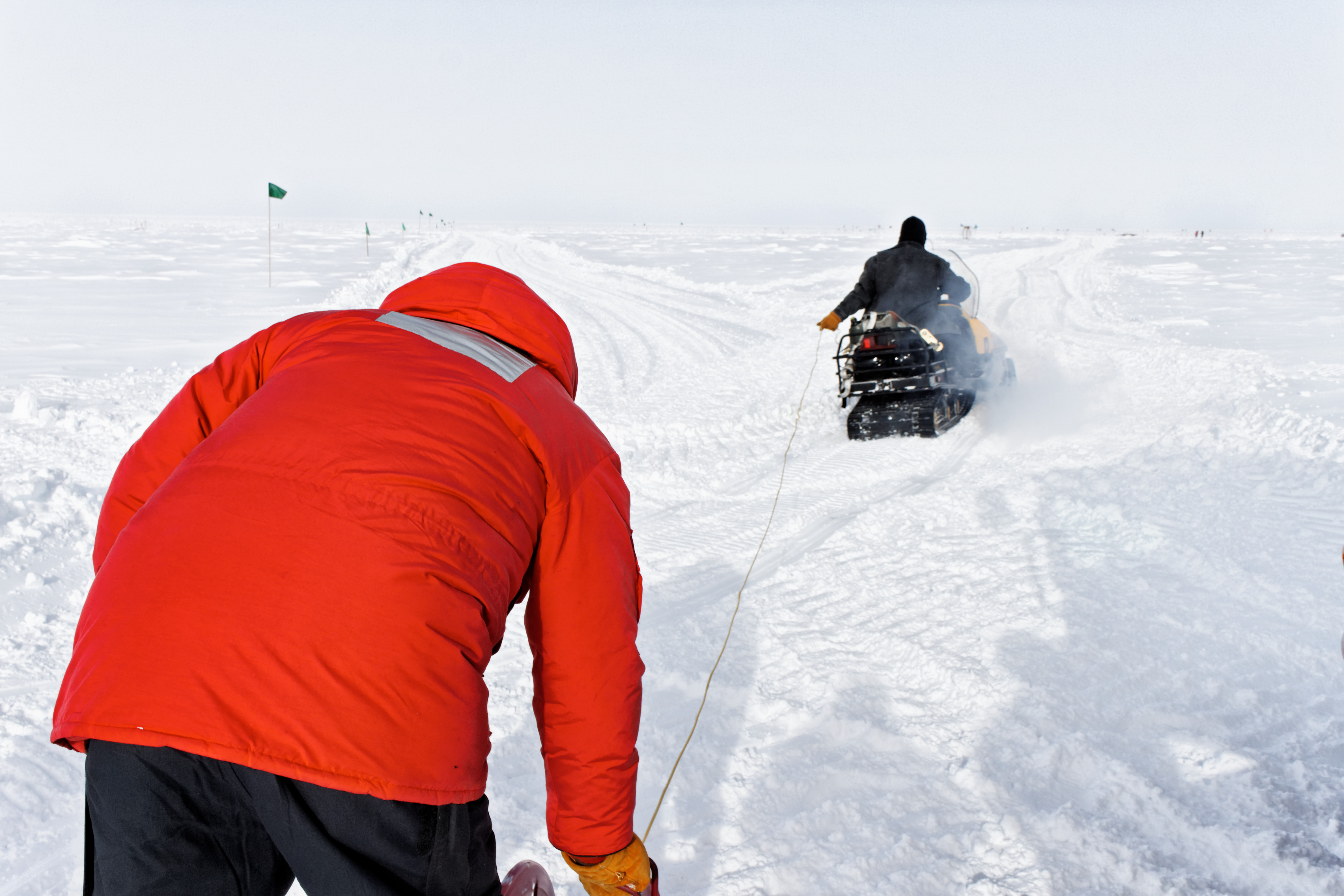
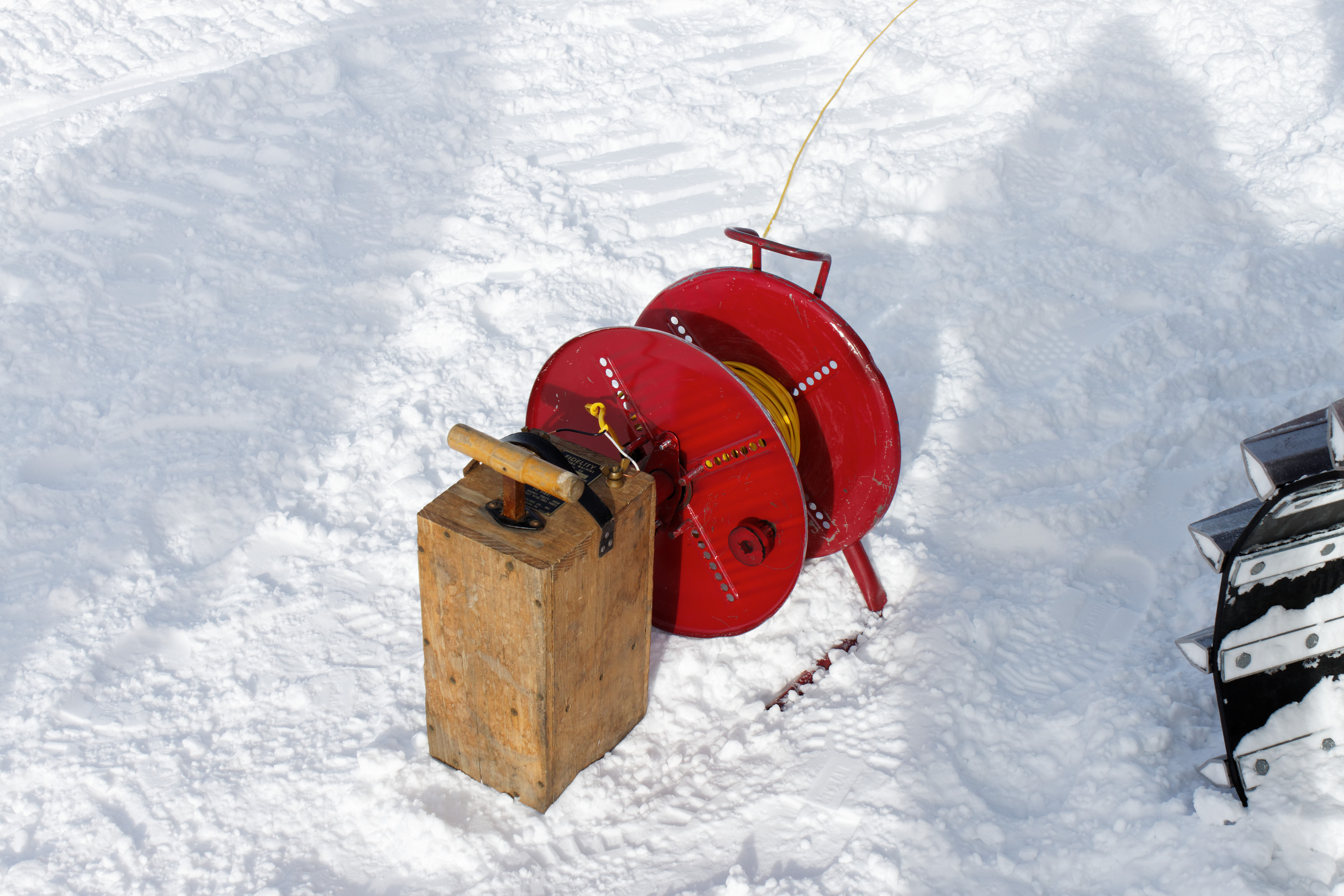
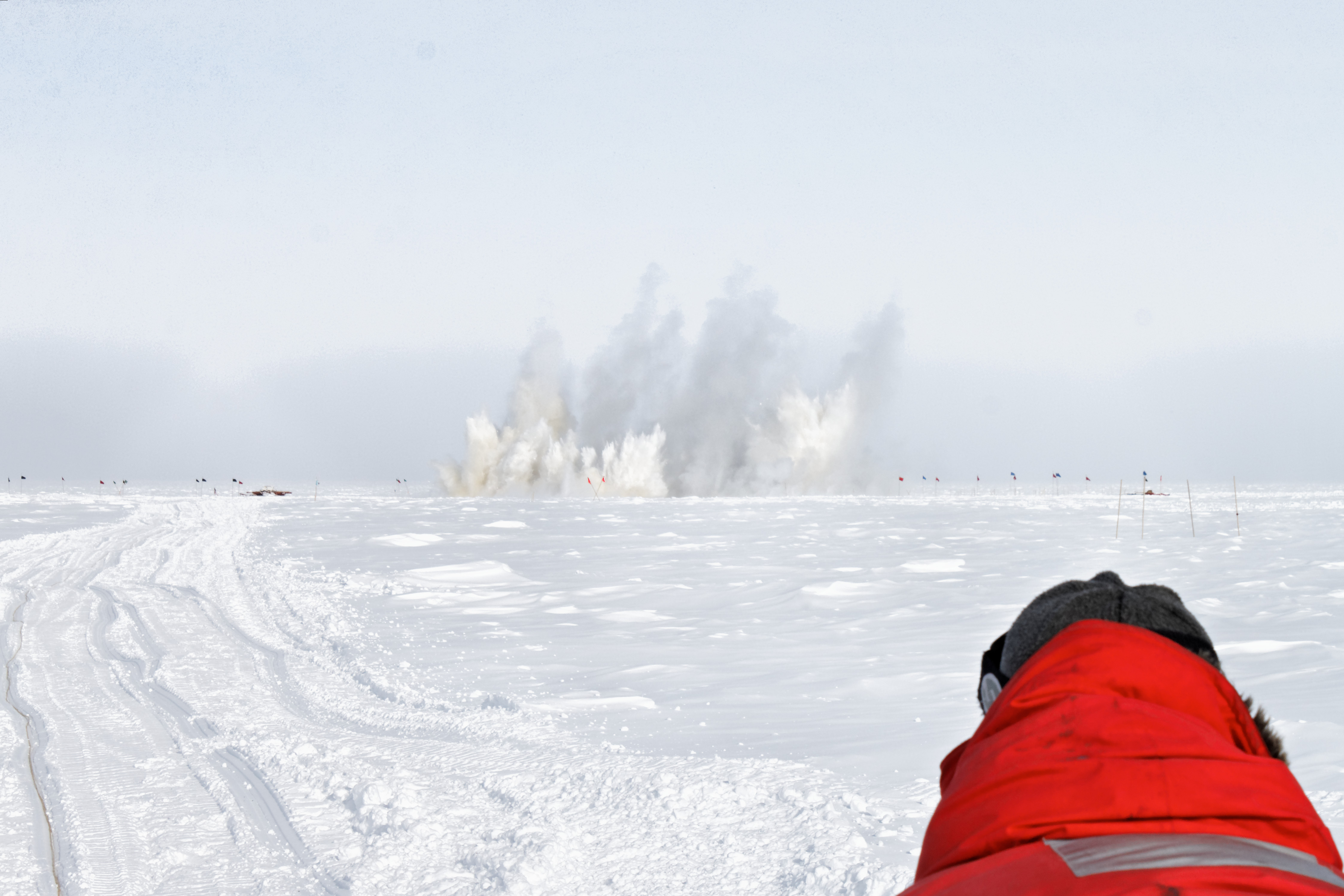
A few days later, those of us who had helped drill and/or lay the dynamite (mostly G.A.s and a few station management personnel) went out to the site to view the blast. The lead blaster had instructed us to always keep an eye on him; while we of course wanted to watch the explosion, we had to be ready to jump behind a Pisten Bully in case something went wrong. Jason, one of the G.A.s who had worked many days with the blasters got to push the plunger, blowing up all the thousands of pounds of dynamite and the contents of the structures below.
Strings of dynamite below the surfaceRunning the connection wires
Explosion and Jason
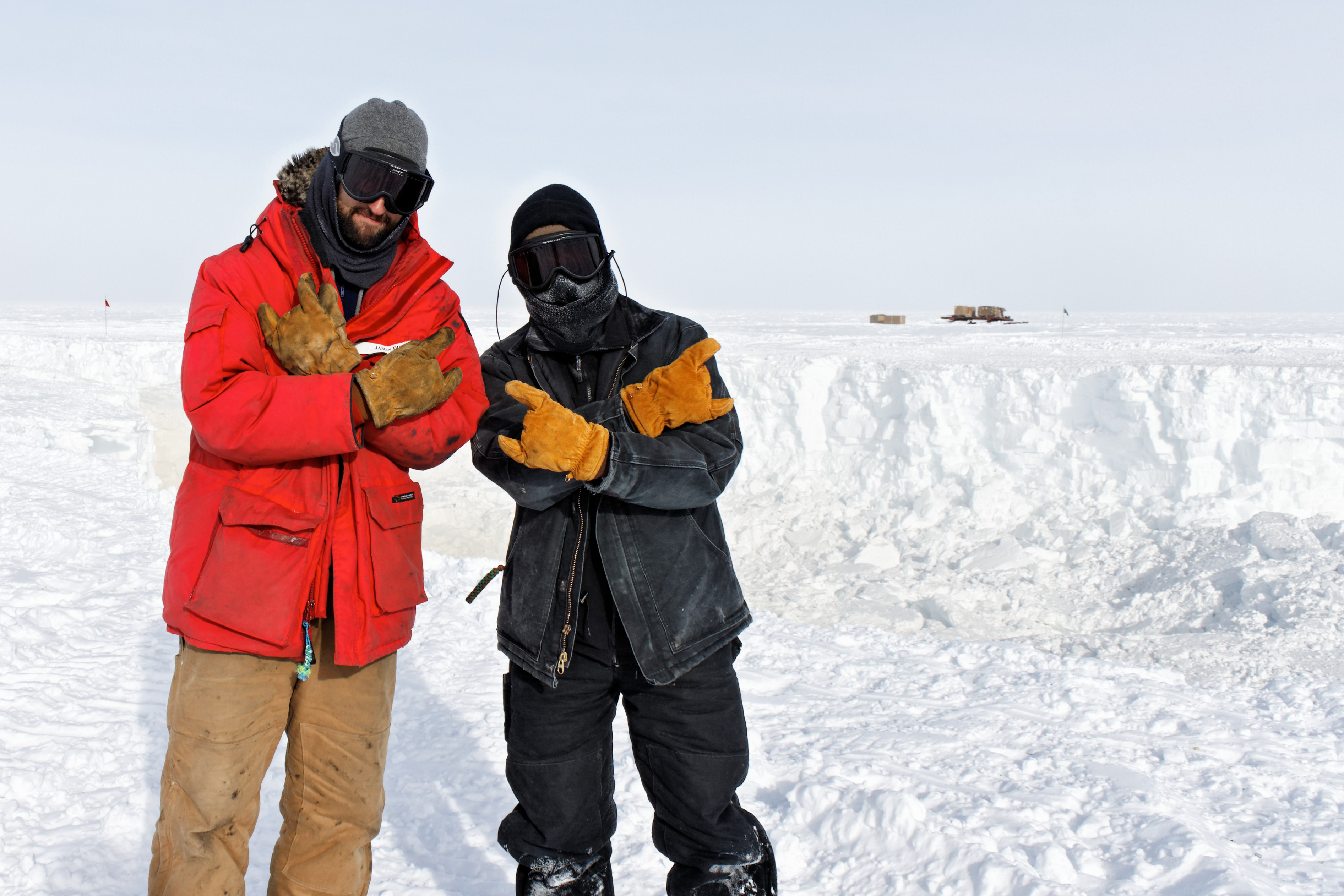
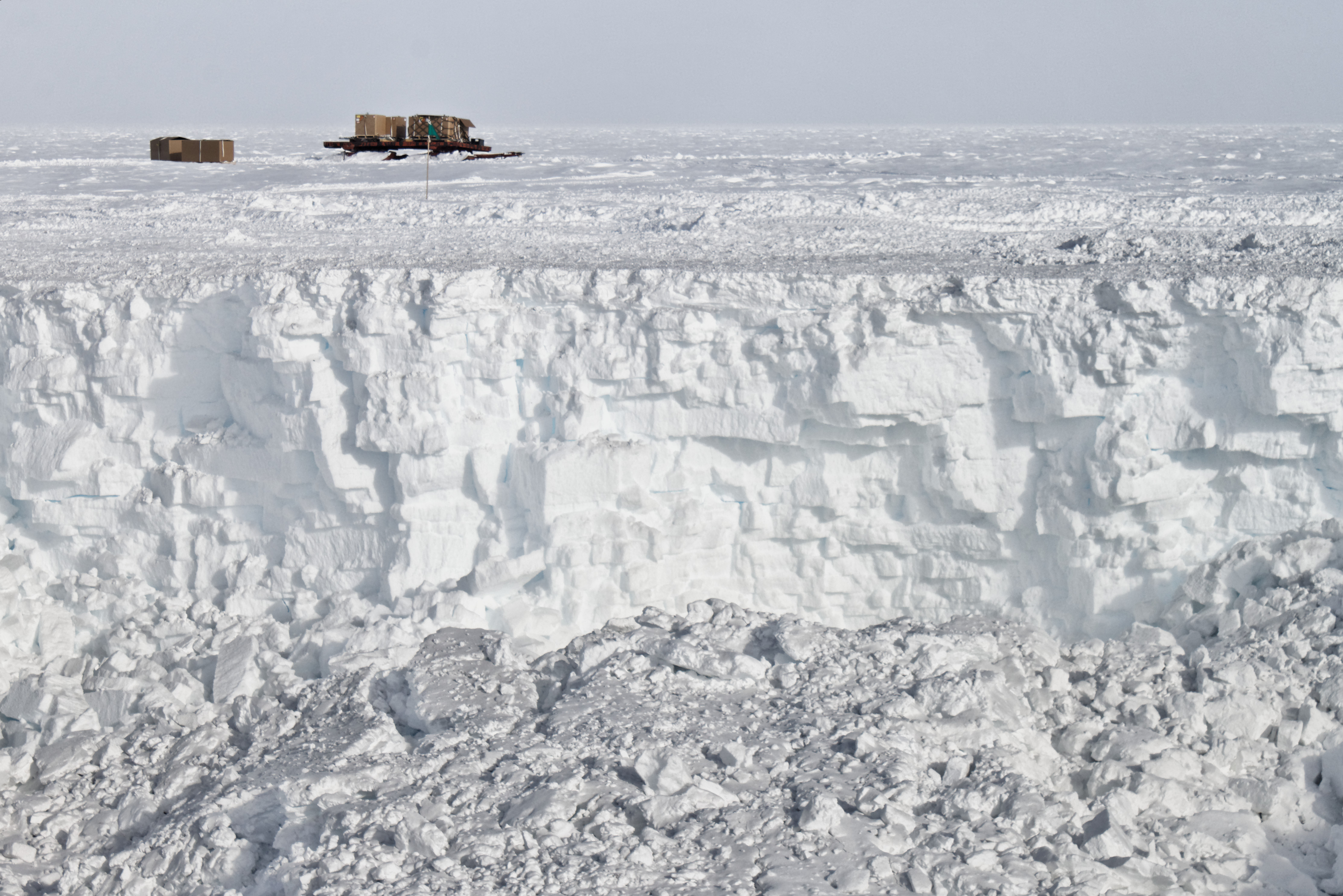
After the blasters did a preliminary check to make sure the dynamite had all exploded, we all drove out to the blast site, the sulfurous yellow smoke still hanging low in the imploded crater. The brick-like layers of drift snow, one for every winter, were like tree trunk rings, and we all had to be careful of crevices and cracks near the edge, indicating a shelf that might slide into the hole.
Jason and EdLayers
Pisten Bullys and CraterMe
Last year at the beginning of the summer the original Old Pole Station (1957-1975) was still buried under the snow whole, and the Dome (1975-2003, decommissioned in 2008), the second station, stood on the ice waiting to be deconstructed. This year, they’re now both gone—the elevated station the last man standing.
Lying in bed in the Jamesway with the lights off and the window covered; the air is so dry that slight movements cause static electric shocks so intense you can see, hear and feel them, like tiny blue fireworks. If I touch the plug of the Christmas lights with my foot or the blanket and cause a shock, it causes them to flicker on momentarily.
Working in the VMF, a trackloader will groan to a start, leaving behind oily black icicle stalagmites.
At night, you can hear the wind whip the canvas walls of our Jamesway tent, the plywood structures inside shifting, clapping. Both sides of the pillow are cold sides. During the storm (the biggest since 1990), we came back to our room after dawdling due to the weather one night to discover half an inch of snow on the bed that had come in through the gaps between the canvas. We worked for half an hour plugging up the holes with towels and issue socks, each bit of insulation causing a gap somewhere else.
When dull white clouds cover the sun, it flattens out the shadows making it nearly impossible to see the texture of the ground directly in front of you. This makes it difficult to walk, and coming to or from station we stumble and trip like a bunch of drunks.
The terrain is constantly evolving. The heavy equipment operators work day and night shifts to clear snow away from the buildings, and later to the “end of the world,” downwind from the station, Summer Camp and storage berms so it won’t blow back. Mountains of snow will appear and disappear, grow and shrink, making it difficult to know exactly where I was before I got to know the area well.
You can hear tractors roaring all night long, grumbling up and beeping back down the hills, moving snow. When a plane lands late, you can hear it as though it is landing right in Summer Camp. You can also hear everyone else in the Jamesway; coughs, sneezes, low battery radio beeps, alarm clocks, or when someone is putting their pants on.
When “freshies” come in, fruit, vegetables, and real eggs, Comms will make an all-station announcement asking for help. People line up from the bottom of the Destination Zulu stairs, up two flights to the galley on the second floor. Passing boxes up the steps, oohing and squealing at the contents. “Mango!” “Pineapple!” “PLUMS!”
So, six weeks before we leave the ice, you may wonder exactly what I do to earn my living around here.
Everything we do at the South Pole exists solely for the purpose of supporting science endeavors. The scientists and all of their support staff need to be able to travel to the continent, eat, sleep, and research in the station and the surrounding couple of miles. Most of the science projects and subsequent departments need vehicles at some point; track loaders, snowmobiles, plow-accessorized tractors, Pisten Bullys and LMCs, Ditch Witches for trench digging, cranes, cherry-picker lifts and various other vehicles for special projects and transportation. This is where the Heavy Shop comes in. Most of these machines don’t like the regular 50 below temperatures and tend to break down often and especially need care at the beginning of the summer season after taking an 8-month nap at temperatures of 100 below.
Much of what the Heavy Shop did at the very beginning of the season was bringing up equipment for the summer. We spent a lot of time digging out herds of snowmobiles almost completely buried in winter drifts and towing them back to the shop for warmups and maintenance; towing out huge portable heaters to the heavy equipment and, after digging that out, placing the foot-wide flexible hoses of the heaters on the vehicles’ motors and covering them with old quilts and leaving them running for hours and hours just to warm them up enough for a drive back to the shop; heating up and starting shuttle vans and then pulling them off the blocks they spent the winter on so that they wouldn’t become completely buried with engines full of ice.
Vehicles buried at the beginning of the summer season with the station in the background (photo from VMF common drive)
(Photo from VMF common drive)
Heating the CAT 307B (Photo from VMF common drive)
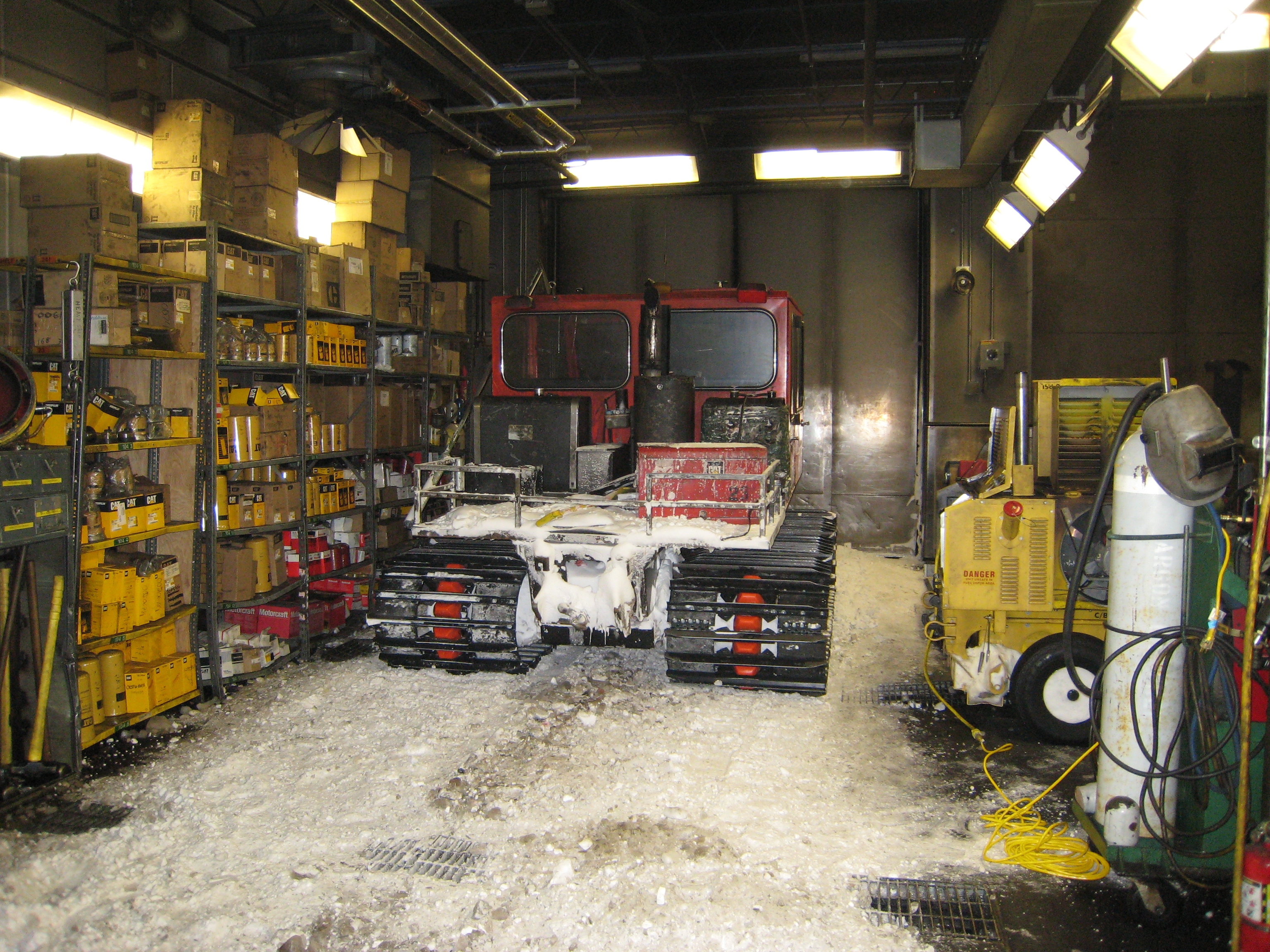
Now, every vehicle that comes into the shop is, understandably, completely covered with snow throughout the body of the engine, packed into the grooves of the track, iced onto the roof and sometimes even the sides. When it comes into the shop it melts everywhere, mixing with glycol, engine oil, and sometimes hydraulic fluid. Because of the rules of the Antarctic Treaty (and general common sense) this can’t just be shoveled back out onto the clean snow.
A snowy LMC in the shop (photo from VMF common drive)
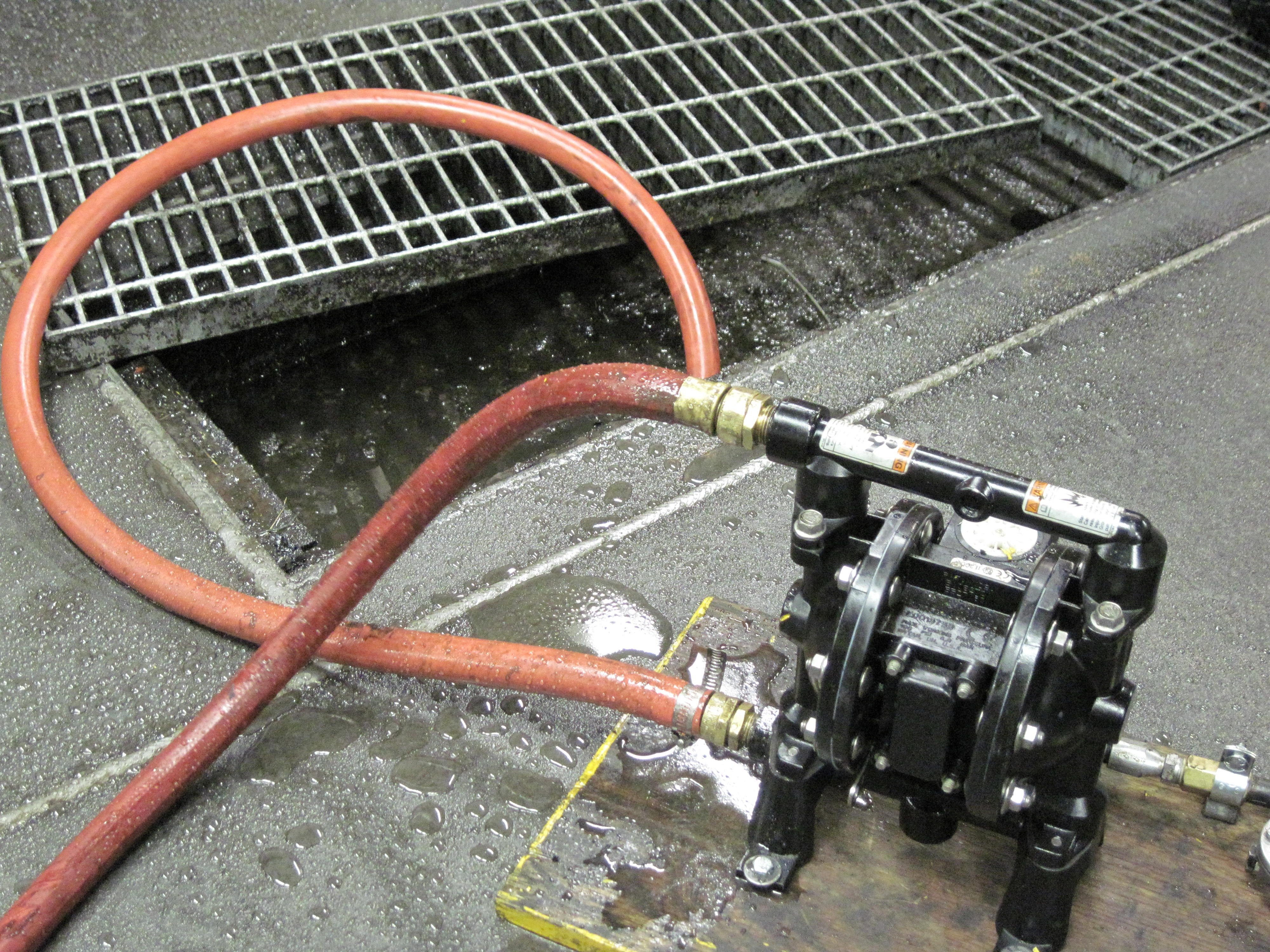
I get to remove waste ice from the shop in a variety of ways, and I spend probably two to six hours a day doing this. I can place a heating fan on the frozen grates and, when they melt to water, use a pneumatic pump to suck it out of the floor into the oil/water separator.
I can also use an air hammer, sharpened iron bar, or pickaxe (sometimes all three) to break the grate contents into smaller bits and take them out with a bucket if it’s really watery, a shovel, or by hand—pocked, sharp, oily slippery ice. If the melted water misses one of the ten or so grated reservoirs in the floor, and freezes solid to the floor, then I use the pickaxe or pointy iron bar to chop that up into small bits and sweep-shovel it off the floor. With the latter two crud-removal systems the ice has to be put into a 55-gallon drum and melted with a hot electric band. Then I get to use that same pneumatic pump to suck that waste water into the oil/water separator.
Crud, barrels and pump (on a block so it won't freeze from the cold floor)
This pump (which I’ve given many nicknames that I keep to myself) tends to freeze up anytime the water running through it is too cold or slushy, when the mechanics open the bay doors to bring in a vehicle, letting 50 below air pour in (this happens all the time—it’s a shop), when it sucks up a blob of crud that blocks the suction, or when you look at it the wrong way.
Clogged
Most of the rags we have are recycled torn up clothing and sheets, and once, when I put a frilly, lacy rag on the pump to keep it reasonably dry, it stopped working for almost a week out of spite; no amount of taking it apart to look for blockages, bleeding the hoses, soaking the hoses in hot water, cajoling it, or priming it with oily water could make it work again until I removed the frilly rag.
Once the water has gone through the separator, I use an electric pump to transfer it to different 55-gallon drums. Once I have two or three of these full–at the beginning of the season it was about 5 per week, but now that the temperature is up to -10 and everything is really melty, the shop is like a swamp and I do up to 4 per day–I grab it, all 440 or so pounds of it with a dolly, throw my whole weight on it, and take it for a walk. The wastewater input is through a subterranean (sub-ice-ean?) hallway that remains at 50 or 60 below no matter how warm it gets outside. I drag the now-wheeled barrel through the shop and VMF office, past the plumbers and electricians’ shop, across the Logistics Arch which houses much of the station’s frozen food storage, and over to the power plant arch. The pipe is in the naturally refrigerated hallway, but the switch to turn off the pump inside of the wastewater input pipe, which helps to prevent me from getting covered in raw sewage, is inside of the power plant bathroom, the only unisex toilet for five floors and as many departments. This is incredibly irritating because I have to wait until whoever is depositing their own sewage while reading hunting and fishing magazines is finished before I can begin my job. Once the internal pump is turned off, I remove the cap of the pipe and connect yet another pump (pump count for this task: 4) before sucking the separated waste water into the pipe to be treated.
Other things I do at work include receiving, inventorying and putting away anything we ever purchase including hoses, pumps, turbochargers, tools, o-rings, bellypans, windshields, welding materials, batteries and many more exciting objects, and anything the entire Ops department purchases (read: half the station), like amplifiers, DVDs, and sousaphones. I sweep and put things away, push water into my favorite grates and suck it out again, change the empty barrels for full barrels of ethylene glycol, arctic low-pour hydraulic fluid and engine oil, and dolly out full barrels of waste liquids and used oil and fuel filters.
Using the hoist to swap empty barrels for full ones. This was a few weeks into the job, and those Carhartts were shiny new when I received them in CHC.
I take out and sort shop trash, which is much more complicated than it sounds—everything here is recycled if possible, and the waste system is quite extensive. I’ve also gotten to do some more mechanic-y things like fixing the pump when it clogs, repairing leaky couplings on the fresh oil and glycol pumps, helping change the oil on Elephant Man, the beast of a vehicle that drags the mobile firefighting sled, and learning how to change broken fittings on hydraulic hoses. I have learned how to operate and start snowmobiles, Pisten Bullys and LMCs, and, unofficially, some of the heavier equipment like track loaders. I also get to shovel quite a bit, sometimes even for different departments which is actually pretty fun.
Shoveling out a fuel hose that was buried in snow up to my waist
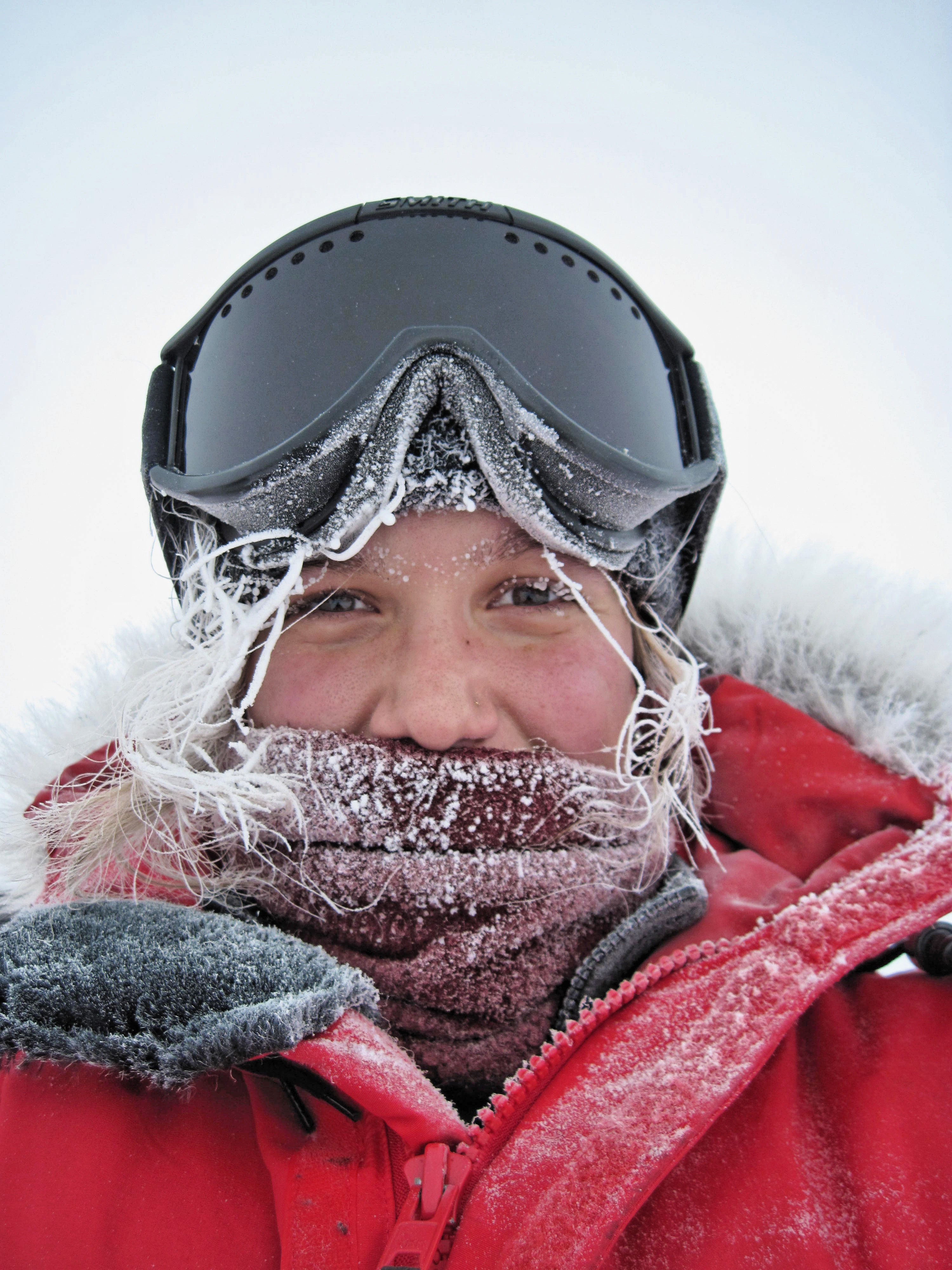
Frozen eyelashes and hair while shoveling for Fuels
Despite the greasy nature of the job, I actually enjoy it. The tasks are pretty simple, just physically tiring, but it feels good to get exercise at work every day and it’s satisfying to see a task get done, even though it will get undone by the next morning. I feel really lucky to work in the VMF—the crew there is so funny and relaxed, while somehow simultaneously being some of the hardest workers on the entire station and being really responsive to the needs of the crew. My supervisors just laughed and offered advice when I overflowed the waste water barrel all over the entire shop (a HUGE mess), and later the water/oil separator (a slightly less huge mess), or when I dropped the cap to the waste input pipe through the grated floor outside the power plant, never to be seen again. I honestly think that the heavy shop is the best department at the whole South Pole, but I might be a little biased.
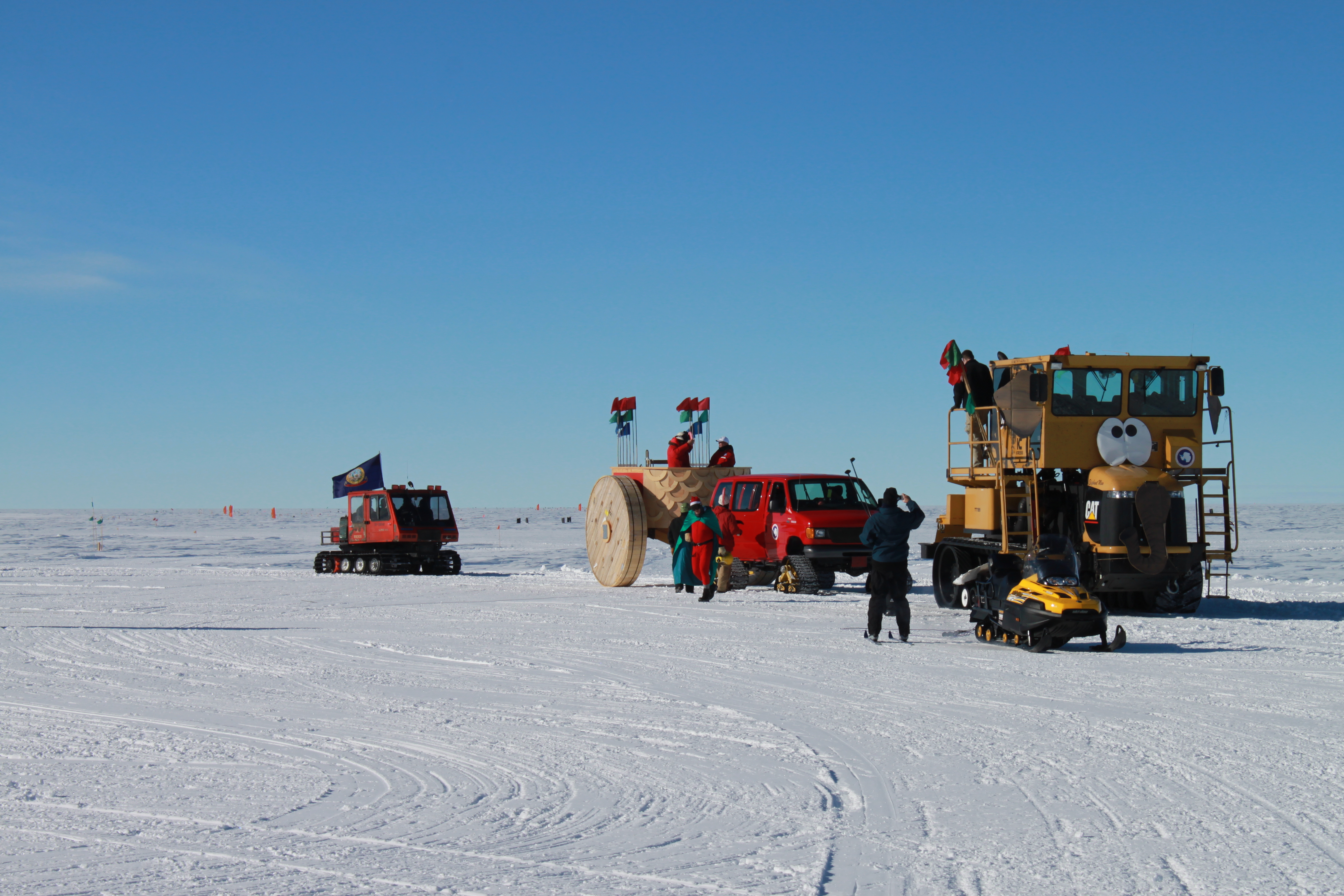
Daniel and I ran our first race ever, a Christmas morning 2.1 mile course at 10,000 foot physiological altitude, with a -25 windchill and soft ice underfoot. Participants in jogging clothes and costumes ran, jogged, walked, skied, drove snowmobiles, Pisten Bullys and tractors decked out like parade floats.
Click to enlarge photos.
Participants getting ready to race around the world
Pre-race
My goals in the race were to jog the whole time—optimistically jog, I told people who asked if I planned to run the race—which I did, except for to snap a few pictures, and to clock in under half an hour. I had spoken to a real skier/runner who said he hoped to be able to average 12 minute miles due to the terrain and altitude, so I thought 15 minute miles was okay for a novice runner.
Elissa and Fire Captain Don
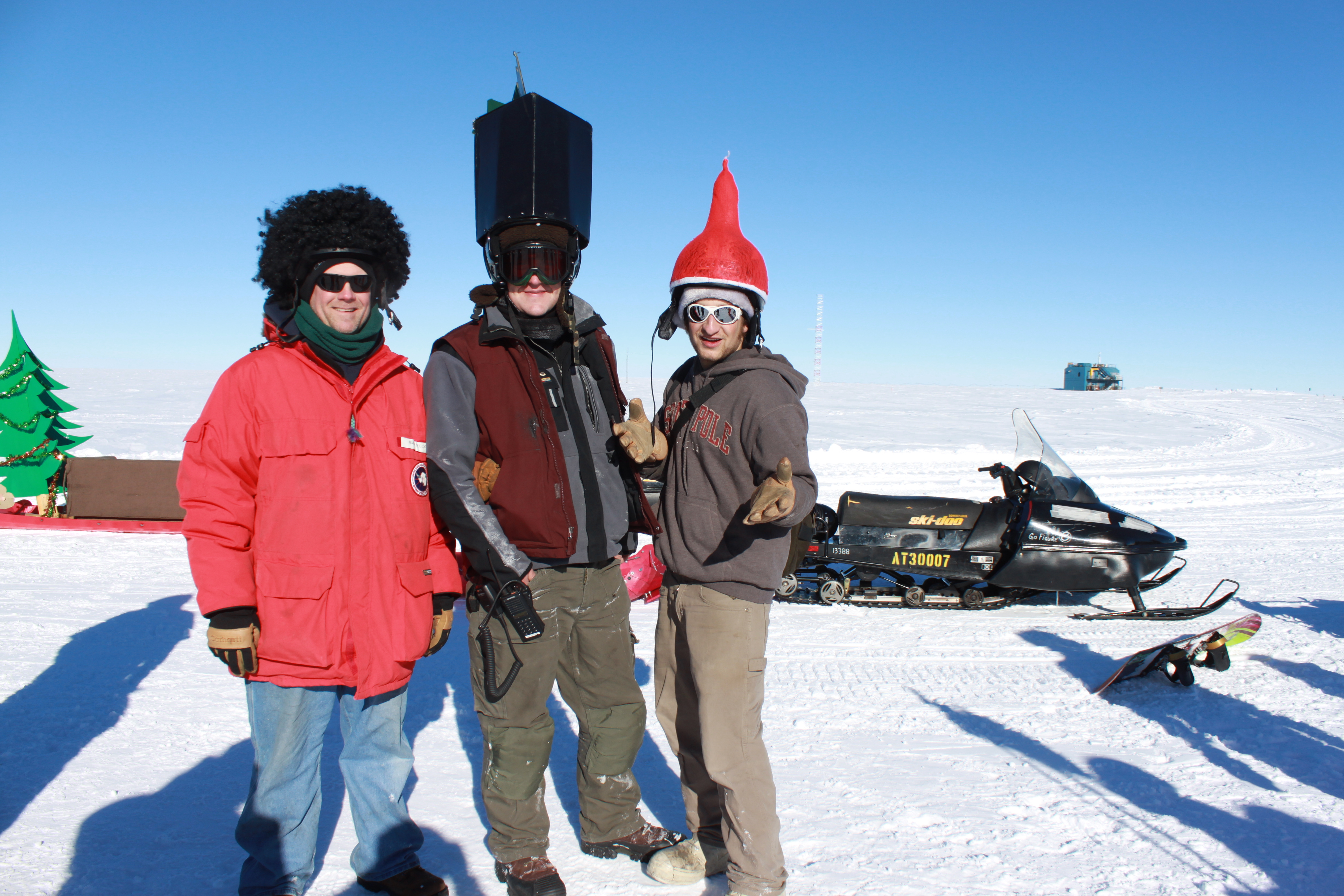
Ralph, Eric and Max don't let safety get in the way of fashion--check out those snowmobile helmets
The male winner ran the race in 13:32 minutes, and the female winner ran it in 18:22 minutes. Daniel was close behind the female winner, beating the second place woman, and I ran it in a little over 28 minutes. The male and female winners of the race get to fly to McMurdo in a few weeks and run their sea-level marathon. I have heard that the South Pole contestants do quite well and often win this race due to the drop in altitude.
Daniel crosses the finish line at 18 or so minutes–we didn’t get an official time, unfortunately
Kiell crossing the finish line
After the race we had brunch, eggs to order, potatoes, fresh fruit and cheese, pastries, scotch eggs, bacon, sausage, toast, coffee. We returned to Summer Camp to shower and start getting ready for evening festivities and dinner. People get pretty dressed up for holidays—Thanksgiving was like this, too—some people went all the way in suits and ties, dresses heels, and makeup. It’s fun to see everyone dolled up like that since most of the time we’re quite dirty due to showering restrictions, and lots of people tend to wear their issue clothes, like the Carhartt overalls, even when their workday is over.
I put Charlie Brown Christmas on, with my laptop on the sink in the bathroom while my friend Rachel showered and got ready to serve wine at the second of three dinner seatings. When it was time, we started with appetizers and eggnog in the hallway outside the galley, musicians singing Christmas carols while we noshed. Dinner was delicious, beef wellington, lobster tail, basil mashed potatoes, green beans with hazelnut shallot butter, challah, red wine and cherry pie with fresh whipped cream and orange chocolate for dessert.
After dinner we played four games of paper telephone (I don’t really recommend laughing so hard on a full stomach), followed by dancing until 1 in the morning in the galley before going back outside to the midnight sun and walking home to our little jamesway room to go to bed.





























 brown paper blue ink